. 2012 Dec 1;303(11):L991-1000.
doi: 10.1152/ajplung.00192.2012. Epub 2012 Sep 28.

Antioxidant mimetics modulate oxidative stress and cellular signaling in airway epithelial cells infected with respiratory syncytial virus

Affiliations

Antioxidant mimetics modulate oxidative stress and cellular signaling in airway epithelial cells infected with respiratory syncytial virus

Yashoda M Hosakote et al. Am J Physiol Lung Cell Mol Physiol. .

Abstract

Respiratory syncytial virus (RSV) is one of the most common causes of bronchiolitis and pneumonia among infants and young children worldwide. In previous investigations, we have shown that RSV infection induces rapid generation of reactive oxygen species (ROS), which modulate viral-induced cellular signaling, and downregulation of antioxidant enzyme (AOE) expression, resulting in oxidative stress in vitro and in vivo, which plays a pathogenetic role in RSV-induced lung disease. In this study, we determined whether pharmacological intervention with synthetic catalytic scavengers could reduce RSV-induced proinflammatory gene expression and oxidative cell damage in an in vitro model of infection. Treatment of airway epithelial cells (AECs) with the salen-manganese complexes EUK-8 or EUK-189, which possess superoxide dismutase, catalase, and glutathione peroxidase activity, strongly reduced RSV-induced ROS formation by increasing cellular AOE enzymatic activity and levels of the lipid peroxidation products F(2)-8-isoprostane and malondialdehyde, which are markers of oxidative stress. Treatment of AECs with AOE mimetics also significantly inhibited RSV-induced cytokine and chemokine secretion and activation of the transcription factors nuclear factor-κB and interferon regulatory factor-3, which orchestrate proinflammatory gene expression. Both EUKs were able to reduce viral replication, when used at high doses. These results suggest that increasing antioxidant cellular capacities can significantly impact RSV-associated oxidative cell damage and cellular signaling and could represent a novel therapeutic approach in modulating virus-induced lung disease.


Figures
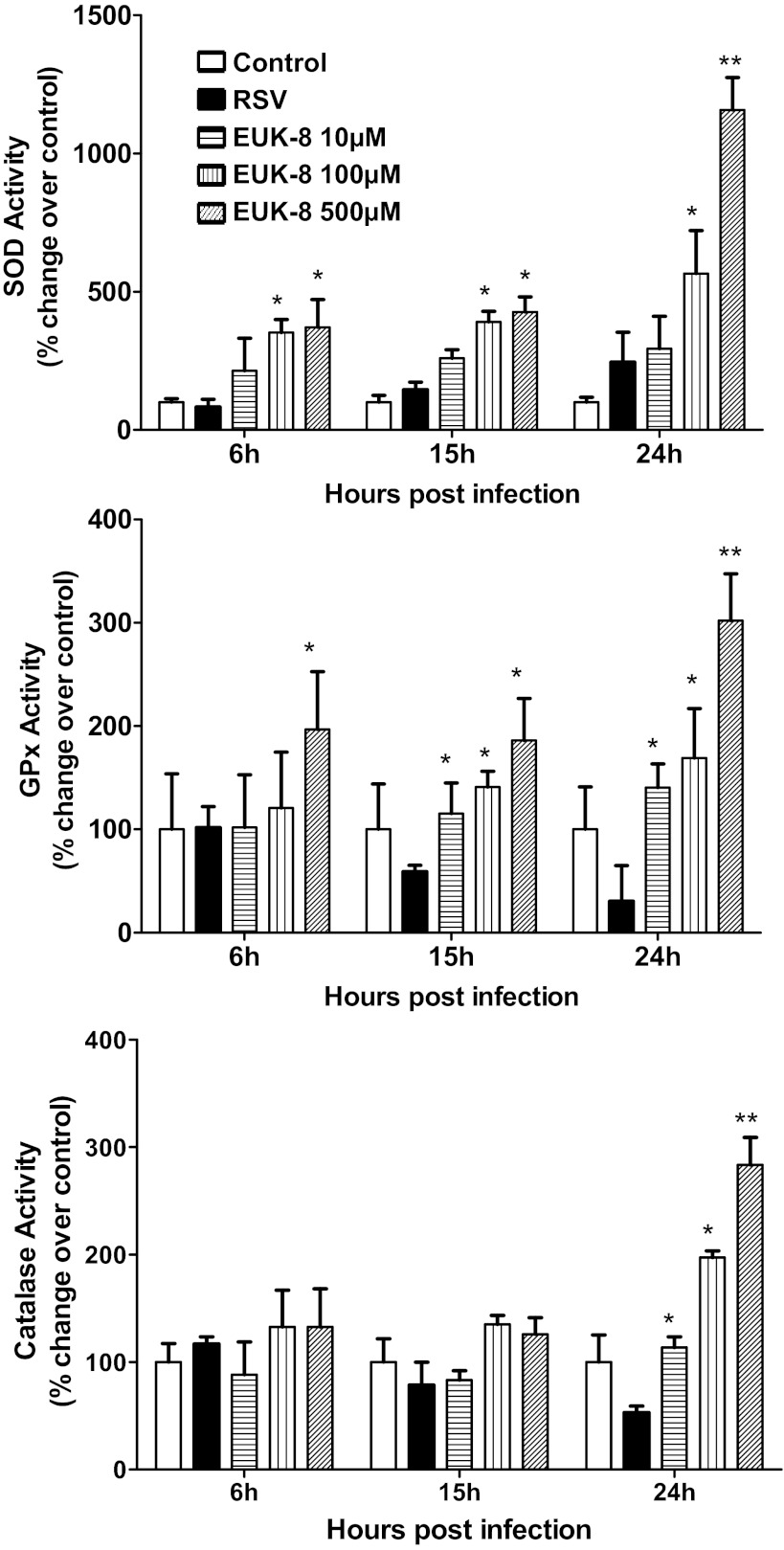
Fig. 1.
Fig. 1.
Effect of EUK treatment on total superoxide dismutase (SOD), catalase, and glutathione peroxidase (GPx) activity in respiratory syncytial virus (RSV)-infected cells. Total lysates were prepared from uninfected and RSV-infected treated or untreated with different doses of EUK-8 at 6, 15, and 24 h postinfection to measure total SOD, catalase, and GPx enzyme activities. Data are expressed as %change over control. Results are representative of two independent experiments. *P < 0.05 and **P < 0.01 compared with RSV-infected cells.
Fig. 2.
Fig. 2.
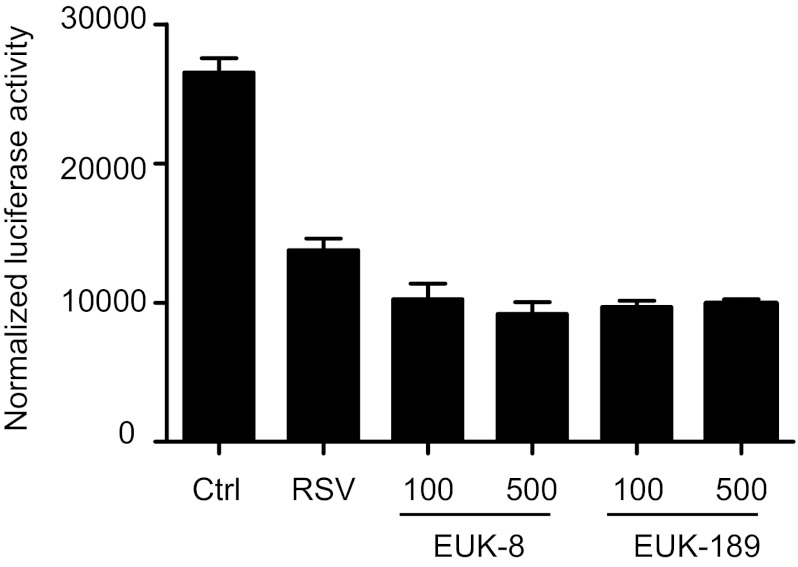
Effect of EUK treatment on NF-E2-related factor 2-dependent gene transcription. A549 cells were transiently transfected with an airway epithelial cell-luciferase reporter plasmid and β-galactosidase control plasmid. The next day, cells were infected with RSV in the presence or absence of either EUK-8 or -189, at 100 or 500 μM concentration, and harvested at 24 h postinfection to measure luciferase activity. Uninfected plates served as controls. For each plate, luciferase was normalized to the β-galactosidase activity. Data are expressed as means ± SE of normalized luciferase activity. Data are representative of two independent experiments performed in triplicates.
Fig. 3.
Fig. 3.
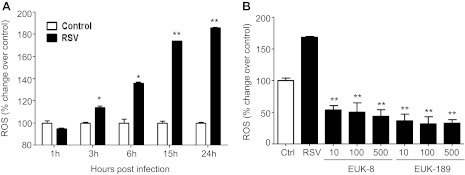
Effect of EUK treatment on RSV-induced reactive oxygen species (ROS) formation and cellular oxidative stress. A: A549 cells were infected with RSV and, at various time points after infection, cells were loaded with 2′,7′-dichlorodihydro-fluorescein diacetate (DCF-DA), and fluorescence was measured in control and infected cells. *P < 0.05 and **P < 0.01 compared with control cells. B: A549 cells were treated with different μM concentrations of EUK-8 and EUK-189, infected with RSV for 24 h, and harvested to measure DCF-DA fluorescence. Ctrl, control, uninfected cells. Mean fluorescence intensity is reported as % increase over control. Results are representative of two independent experiments. *P < 0.05 and **P < 0.01 compared with untreated RSV-infected cells.
Fig. 4.
Fig. 4.
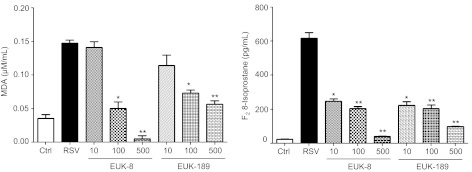
Effect of EUK treatment on RSV-induced lipid peroxidation. A549 cells were treated with different μM concentrations of EUK-8 and EUK-189 and infected with RSV. Cell supernatants were harvested at 24 h postinfection to measure F2-isoprostanes and malondialdehyde (MDA). Results are expressed as means ± SE. Results are representative of two independent experiments run in triplicate. *P < 0.05 and **P < 0.01 compared with untreated RSV-infected cells.
Fig. 5.
Fig. 5.
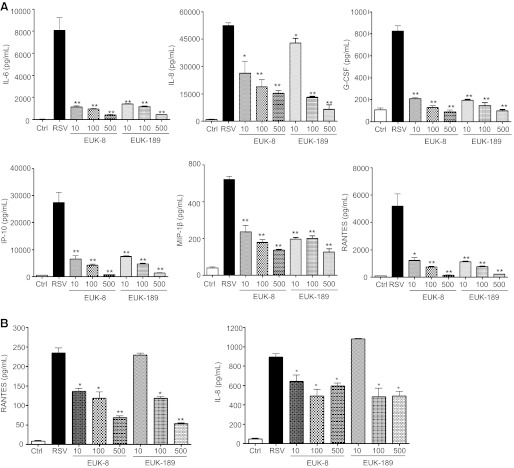
Effect of EUK treatment on RSV-induced cytokine and chemokine production. A549 cells (A) or small alveolar epithelial (SAE) cells (B) were infected with RSV in the absence or presence of different μM concentrations of EUK-8 and EUK-189. Cell supernatants from uninfected and RSV-infected, treated or untreated, were assayed at 24 h postinfection for cytokine and chemokine secretion by Bio-Plex. IL, interleukin; G-CSF, granulocyte colony-stimulating factor; IP-10, interferon-induced protein-10; MIP-1β, macrophage inflammatory protein-1β; RANTES, regulated on activation normal T cell expressed and secreted. Results are expressed as means ± SE. Results are representative of two independent experiments run in triplicate. *P < 0.05 and **P < 0.01 compared with untreated RSV-infected cells.
Fig. 6.
Fig. 6.
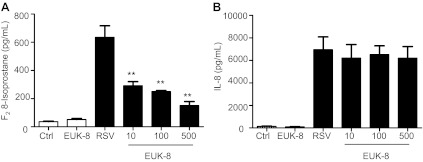
Effect of EUK postinfection treatment on RSV-induced lipid peroxidation and IL-8 secretion. A549 cells were treated with different μM concentrations of EUK-8 at 3 h postinfection and harvested at 24 h postinfection to measure 8-isoprostane (A) and IL-8 (B). Results are expressed as means ± SE. Results are representative of two independent experiments run in triplicate. **P < 0.01 compared with untreated RSV-infected cells.
Fig. 7.
Fig. 7.
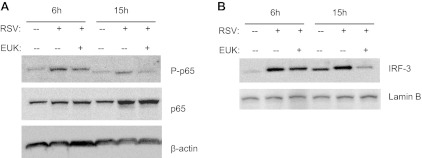
Effect of EUK treatment on RSV-induced interferon regulatory factor (IRF)-3 and p65 activation. Total cell lysates (A) or nuclear extracts (B) were prepared from A549 cells, control and infected with RSV for 6 and 15 h, in the absence or presence of 100 μM EUK-8 and assayed for p65 phosphorylation and IRF-3 nuclear levels, respectively, by Western blot. Membranes were stripped and reprobed for either β-actin or lamin b as a control for equal loading of the samples. Blot is representative of two independent experiments with similar results.
Fig. 8.
Fig. 8.
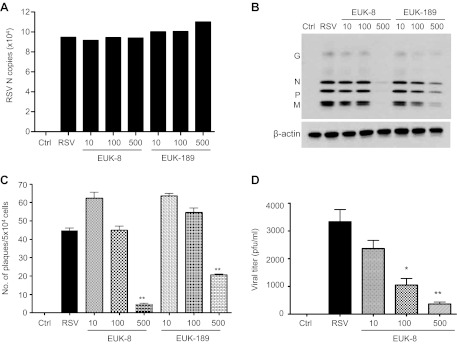
Effect of EUK treatment on viral replication. A549 cells were treated with different μM concentrations of EUK-8 and EUK-189, followed by infection with RSV. Cells were harvested at 24 h postinfection to prepare either total RNA to measure RSV N gene copies by real-time PCR (A) or total cell lysates to detect RSV proteins by Western blot. Membrane was stripped and reprobed with β-actin as a control for equal loading of the samples (B). Figures are representative of two independent experiments with similar results. A549 cells were treated with different μM concentrations of EUK-8 and EUK-189 followed by infection with RSV at a multiplicity of infection of 0.01. Viral replication was determined 24 h postinfection by either direct immunostaining (C) or by titration of viral infectious particles released in the cell supernatants by plaque assay (D). Data are representative of two independent experiments with similar results. *P < 0.05 and **P < 0.01 compared with untreated RSV-infected cells.
Fig. 9.
Fig. 9.
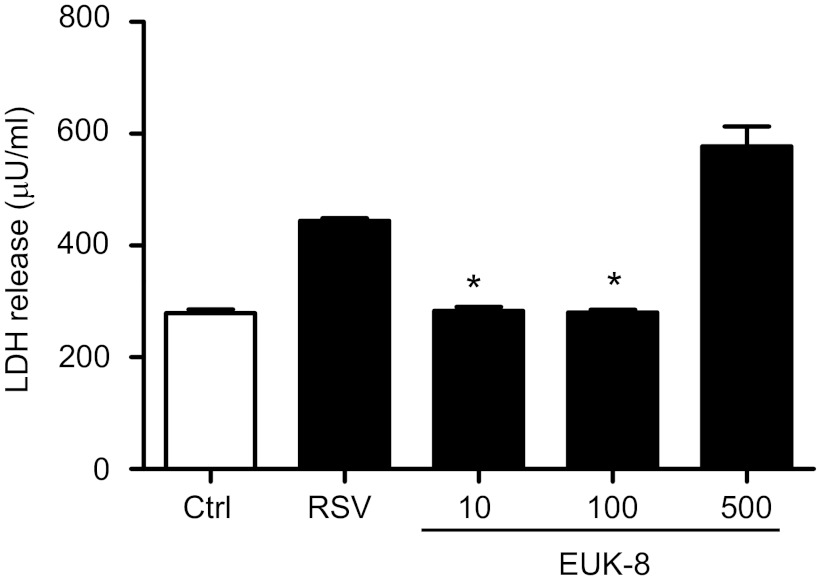
Effect of EUK treatment on RSV-induced lactate dehydrogenase (LDH) release. A549 cells were infected with RSV in the absence or presence of different μM concentrations of EUK-8. Cell supernatants from uninfected and RSV infected, treated or untreated, were assayed at 24 h postinfection for LDH activity. Results are expressed as means ± SE. Results are representative of two independent experiments run in triplicate. *P < 0.05 compared with untreated, RSV-infected cells.

References

    1. Allen RG, Tresini M. Oxidative stress and gene regulation. Free Rad Biol Med 28: 463–499, 2000 - PubMed
    1. Bao X, Liu T, Spetch L, Kolli D, Garofalo RP, Casola A. Airway epithelial cell response to human metapneumovirus infection. Virology 368: 91–101, 2007 - PMC - PubMed
    1. Batinic-Haberle I, Reboucas JS, Spasojevic I. Superoxide dismutase mimics: chemistry, pharmacology, and therapeutic potential. Antioxid Redox Signal 13: 877–918, 2010 - PMC - PubMed
    1. Bitko V, Velazquez A, Yank L, Yang YC, Barik S. Transcriptional induction of multiple cytokines by human respiratory syncytial virus requires activation of NF-kB and is inhibited by sodium salicylate and aspirin. Virology 232: 369–378, 1997 - PubMed
    1. Brasier AR, Spratt H, Wu Z, Boldogh I, Zhang Y, Garofal RP, Casola A, Pashmi J, Haag A, Luxon B, Kurosky A. Nuclear heat shock response and novel nuclear domain 10 reogranization in respiratory syncytial virus-infected A549 cells identified by high resolution 2D gel electrophoresis. J Virol 78: 11461–11476, 2004 - PMC - PubMed

Publication types

MeSH terms

Substances