


Determinants of recovery from severe posterior reversible encephalopathy syndrome
- PMID: 23024751
- PMCID: PMC3443081
- DOI: 10.1371/journal.pone.0044534
Determinants of recovery from severe posterior reversible encephalopathy syndrome
Erratum in
- PLoS One. 2013;8(11). doi:10.1371/annotation/2d87c752-042a-4c61-9254-9a3c73620bcd
Abstract
Objective: Few outcome data are available about posterior reversible encephalopathy syndrome (PRES). We studied 90-day functional outcomes and their determinants in patients with severe PRES.
Design: 70 patients with severe PRES admitted to 24 ICUs in 2001-2010 were included in a retrospective cohort study. The main outcome measure was a Glasgow Outcome Scale (GOS) of 5 (good recovery) on day 90.
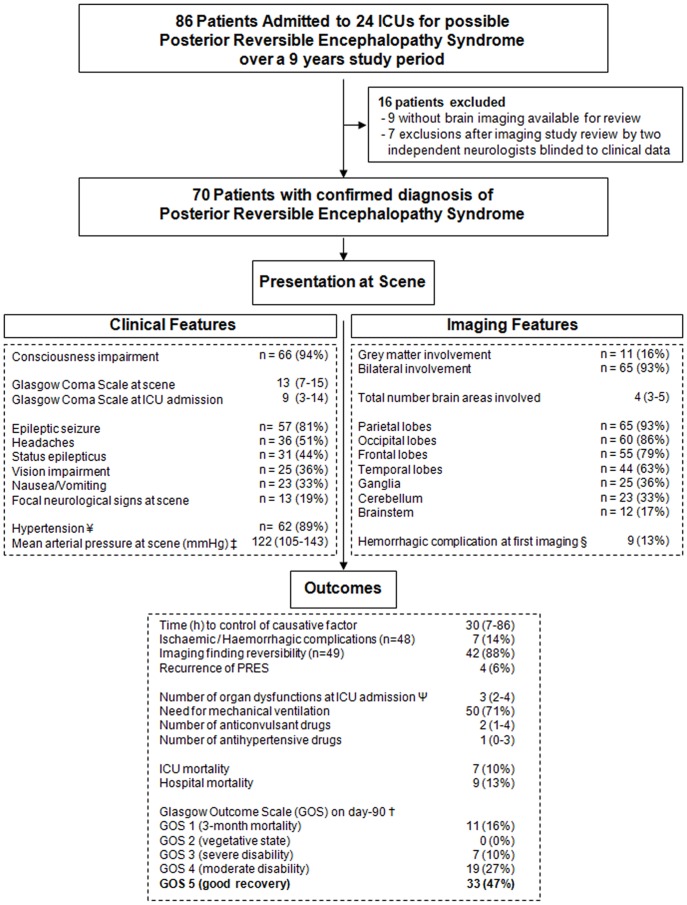
Main results: Consciousness impairment was the most common clinical sign, occurring in 66 (94%) patients. Clinical seizures occurred in 57 (81%) patients. Median mean arterial pressure was 122 (105-143) mmHg on scene. Cerebral imaging abnormalities were bilateral (93%) and predominated in the parietal (93%) and occipital (86%) white matter. Median number of brain areas involved was 4 (3-5). Imaging abnormalities resolved in 43 (88%) patients. Ischaemic and/or haemorrhagic complications occurred in 7 (14%) patients. The most common causes were drug toxicity (44%) and hypertensive encephalopathy (41%). On day 90, 11 (16%) patients had died, 26 (37%) had marked functional impairments (GOS, 2 to 4), and 33 (56%) had a good recovery (GOS, 5). Factors independently associated with GOS<5 were highest glycaemia on day 1 (OR, 1.22; 95%CI, 1.02-1.45, p = 0.03) and time to causative-factor control (OR, 3.3; 95%CI, 1.04-10.46, p = 0.04), whereas GOS = 5 was associated with toxaemia of pregnancy (preeclampsia/eclampsia) (OR, 0.06; 95%CI, 0.01-0.38, p = 0.003).
Conclusions: By day 90 after admission for severe PRES, 44% of survivors had severe functional impairments. Highest glycaemia on day 1 and time to causative-factor control were strong early predictors of outcomes, suggesting areas for improvement.
Conflict of interest statement
Figures
References
-
- Hinchey J, Chaves C, Appignani B, Breen J, Pao L, et al. (1996) A reversible posterior leukoencephalopathy syndrome. N Engl J Med 334: 494–500. - PubMed
-
- Schwartz RB, Jones KM, Kalina P, Bajakian RL, Mantello MT, et al. (1992) Hypertensive encephalopathy: findings on CT, MR imaging, and SPECT imaging in 14 cases. AJR Am J Roentgenol 159: 379–383. - PubMed
-
- Schwartz RB, Bravo SM, Klufas RA, Hsu L, Barnes PD, et al. (1995) Cyclosporine neurotoxicity and its relationship to hypertensive encephalopathy: CT and MR findings in 16 cases. AJR Am J Roentgenol 165: 627–631. - PubMed
Publication types
MeSH terms
LinkOut - more resources
Full Text Sources
Medical
