


Stereospecific cross-coupling of secondary organotrifluoroborates: potassium 1-(benzyloxy)alkyltrifluoroborates
- PMID: 23025482
- PMCID: PMC3481220
- DOI: 10.1021/ja307861n
Stereospecific cross-coupling of secondary organotrifluoroborates: potassium 1-(benzyloxy)alkyltrifluoroborates
Abstract
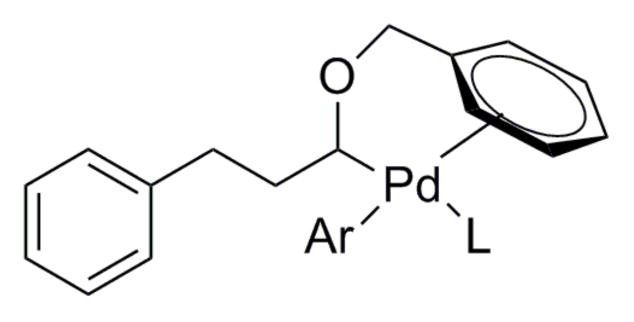
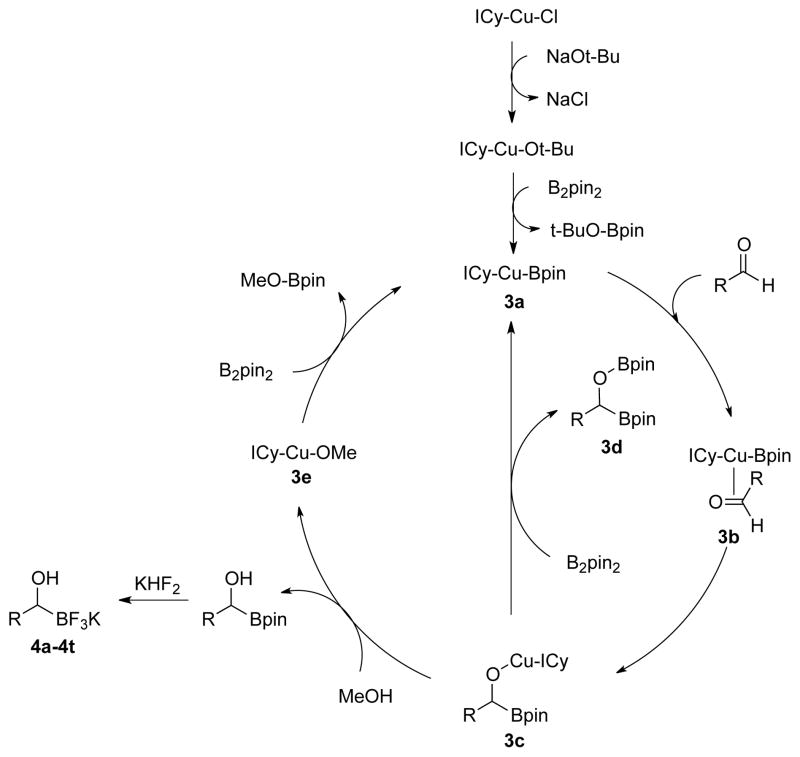
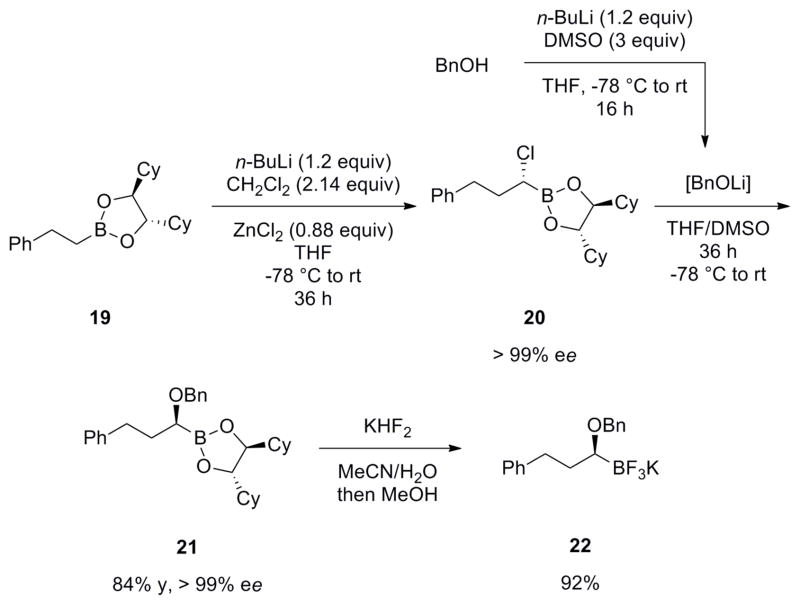
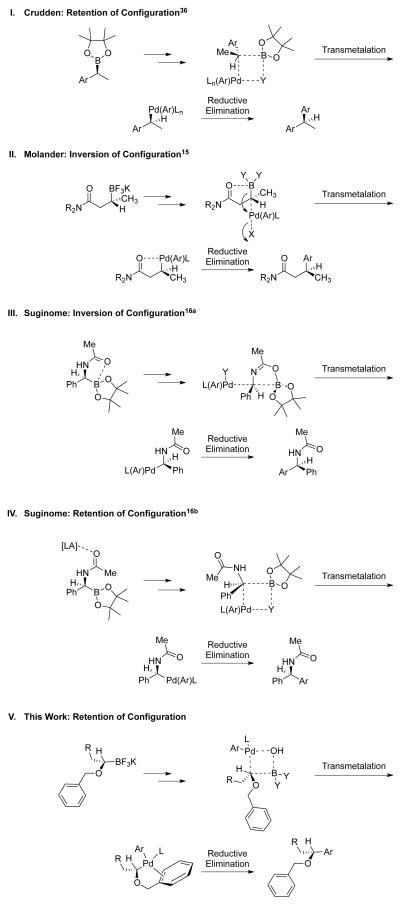
Potassium 1-(alkoxy/acyloxy)alkyltrifluoroborates have been synthesized through a copper-catalyzed diboration of aldehydes and subsequent conversion of the resulting potassium 1-(hydroxy)alkyltrifluoroborates. The palladium-catalyzed Suzuki-Miyaura reaction employing the potassium 1-(benzyloxy)alkyltrifluoroborates with aryl and heteroaryl chlorides provides access to protected secondary alcohols in high yields. The β-hydride elimination pathway is avoided through use of the benzyl protecting group, which is proposed to stabilize the diorganopalladium intermediate by coordination of the arene to the metal center. This cross-coupling is stereospecific with complete retention of stereochemistry.
Conflict of interest statement
The authors declare no competing financial interest.
Figures




References
-
-
Carey FA, Sundberg RJ. Advanced Organic Chemistry: Part B: Reaction and Synthesis. 5. Springer; New York: 2007. For a review on the enantioselective alkylation of carbonyls, see: Ramon DJ, Yus M. Alkylation of Carbonyl and Imino Groups. In: Science of Synthesis, Stereoselective Synthesis. De Vries JG, Molander GA, Evans PA, editors. Vol. 2. Georg Thieme Verlag; Stuttgart, Germany: 2011. pp. 349–400.For a review on the enantioselective arylation of carbonyls, see: Kauffman MC, Walsh PJ. Arylation and Alkenylation of Carbonyl and Imino Groups. In: Science of Synthesis, Stereoselective Synthesis. De Vries JG, Molander GA, Evans PA, editors. Vol. 2. Georg Thieme Verlag; Stuttgart, Germany: 2011. pp. 449–496.(d) For reviews on the enantioselective addition of diorganozinc compounds to aldehydes, see: Soai K, Niwa S. Chem Rev. 1992;92:833.Pu L, Yu HB. Chem Rev. 2001;101:757.
-
-
- Hartwig J. Organotransition Metal Chemistry: From Bonding to Catalysis. University Science Books; Sausalito: 2010.
-
-
(a) For a review on the enantioselective hydrogenation of prochiral ketones, see: Arai N, Ohmura T. Reduction of Carbonyl Groups: Hydrogenation. In: De Vries JG, Molander GA, Evans PA, editors. Science of Synthesis, Stereoselective Synthesis. Vol. 2. Georg Thieme Verlag; Stuttgart, Germany: 2011. pp. 59–132.Gladiali S, Alberico E. Chem Soc Rev. 2006;35:226.(b) For a review on the enantioselective reduction of prochiral ketones, see: Zaidlewicz M, Pakulski MM. Reduction of Carbonyl Groups: Transfer Hydrogenation, Hydrosilylation, Catalytic Hydroboration, and Reduction with Borohydrides, Aluminum Hydrides, or Boranes. In: De Vries JG, Molander GA, Evans PA, editors. Science of Synthesis, Stereoselective Synthesis. Vol. 2. Georg Thieme Verlag; Stuttgart, Germany: 2011. pp. 59–132.Corey EJ, Helal CJ. Angew Chem Int Ed. 1998;37:1986.Cho BT. Chem Soc Rev. 2009;38:443.De Wilderman S, Sereinig N. Enzymatic Reduction of Carbonyl Groups. In: Science of Synthesis, Stereoselective Synthesis. De Vries JG, Molander GA, Evans PA, editors. Vol. 2. Georg Thieme Verlag; Stuttgart, Germany: 2011. pp. 59–132.For a review on the enzymatic reduction of ketones, see: Moore JC, Pollard DJ, Kosjek B, Devine PN. Acc Chem Res. 2007;40:1412.Kroutil W, Mang H, Edegger K, Faber K. Curr Opin Chem Biol. 2004;8:120.
-
-
- Binder CM, Singaram B. Org Prep Proced Int. 2011;43:139.
-
- Rudolph J, Schmidt F, Bolm C. Adv Synth Catal. 2004;346:867.
Publication types
MeSH terms
Substances
Grants and funding
LinkOut - more resources
Full Text Sources
Other Literature Sources
Medical
