Prevalence and persistence of psychiatric disorders in youth after detention: a prospective longitudinal study
- PMID: 23026953
- PMCID: PMC3737771
- DOI: 10.1001/archgenpsychiatry.2011.2062
Prevalence and persistence of psychiatric disorders in youth after detention: a prospective longitudinal study
Abstract
Context: Psychiatric disorders are prevalent among incarcerated juveniles. Most juveniles eventually return to their communities, where they become the responsibility of the community mental health system. However, no large-scale study has examined psychiatric disorders after youth leave detention.
Objective: To examine changes in the prevalence and persistence of psychiatric disorders during the 5 years after detention, focusing on sex and racial/ethnic differences.
Design: Prospective longitudinal study with up to 5 interviews (1829 youth: 1172 males and 657 females). To ensure representation of key demographic subgroups, the randomly selected sample was stratified by sex, race/ethnicity (African American, non-Hispanic white, and Hispanic), age, and legal status (juvenile or adult court).
Setting: The Northwestern Juvenile Project, sampling youth from the Cook County Juvenile Temporary Detention Center, Chicago, Illinois.
Participants: Detained youth, aged 10 to 18 years at baseline interview.
Main outcome measures: At baseline, the Diagnostic Interview Schedule for Children Version 2.3. At follow-up interviews, the Diagnostic Interview Schedule for Children Version IV (Child and Young Adult versions) and the Diagnostic Interview Schedule Version IV (substance use disorders and antisocial personality disorder).
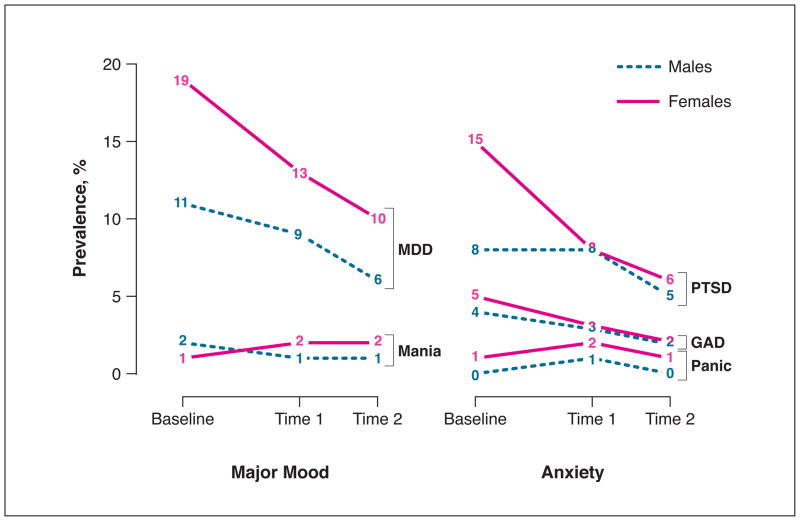
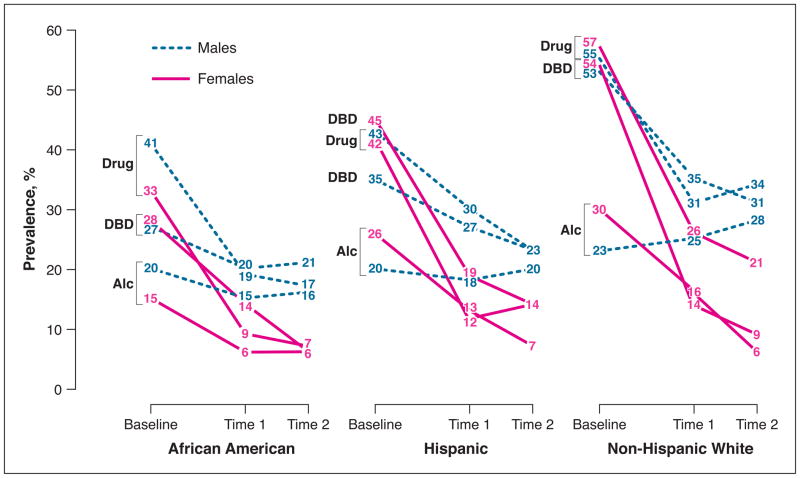
Results: Five years after baseline, more than 45% of males and nearly 30% of females had 1 or more psychiatric disorders with associated impairment. More than 50% of males and more than 40% of females had 1 or more psychiatric disorders without impairment. Substance use disorders were the most common; males, however, had higher rates over time (5 years after baseline, adjusted odds ratio [AOR], 2.61; 95% CI, 1.96-3.47). Non-Hispanic whites and Hispanics also had higher rates of substance use disorders vs African Americans (AOR, 1.96; 95% CI, 1.54-2.49 and AOR, 1.59; 95% CI, 1.24-2.03). Females had higher rates of major depression over time (AOR, 1.59; 95% CI, 1.22-2.08).
Conclusions: Although prevalence rates of most psychiatric disorders declined as youth aged, a substantial proportion of delinquent youth continue to have disorders. There are notable sex and racial/ethnic differences in the prevalence and persistence of psychiatric disorders in this population.
Figures
References
-
- Davis DL, Bean GJ, Schumacher JE, Stringer TL. Prevalence of emotional disorders in a juvenile justice institutional population. American Journal of Forensic Psychology. 1991;9(1):5–17.
-
- Forehand R, Wierson M, Frame C, Kempton T, Armistead L. Juvenile delinquency entry and persistence: do attention problems contribute to conduct problems? Journal of Behavior Therapy and Experimental Psychiatry. 1991;22(4):261–264. - PubMed
-
- Eppright TD, Kashani JH, Robison BD, Reid JC. Comorbidity of conduct disorder and personality disorders in an incarcerated juvenile population. American Journal of Psychiatry. 1993;150(8):1233–1236. - PubMed
-
- Rohde P, Mace DE, Seeley JR. The association of psychiatric disorders with suicide attempts in a juvenile delinquent sample. Criminal Behavior and Mental Health. 1997;7:187–200.
-
- Steiner H, Garcia IG, Mathews Z. Posttraumatic stress disorder in incarcerated juvenile delinquents. Journal of the American Academy of Child and Adolescent Psychiatry. 1997;36(3):357–365. - PubMed
Publication types
MeSH terms
Grants and funding
LinkOut - more resources
Full Text Sources
Medical