


Towards medication-enhancement of cognitive interventions in schizophrenia
- PMID: 23027413
- PMCID: PMC3629915
- DOI: 10.1007/978-3-642-25758-2_4
Towards medication-enhancement of cognitive interventions in schizophrenia
Abstract
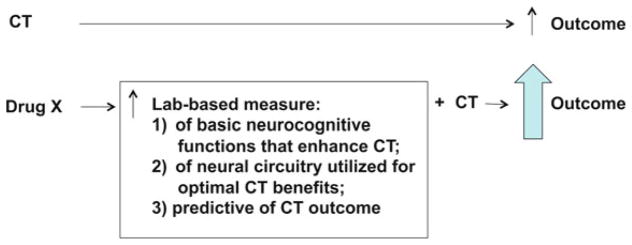
Current antipsychotic medications do little to improve real-life function in most schizophrenia patients. A dispassionate view of the dispersed and variable neuropathology of schizophrenia strongly suggests that it is not currently, and may never be, correctable with drugs. In contrast, several forms of cognitive therapy have been demonstrated to have modest but lasting positive effects on cognition, symptoms, and functional outcomes in schizophrenia patients. To date, attempts to improve clinical outcomes in schizophrenia by adding pro-cognitive drugs to antipsychotic regimens have had limited success, but we propose that a more promising strategy would be to pair drugs that enhance specific neurocognitive functions with cognitive therapies that challenge and reinforce those functions. By using medications that engage spared neural resources in the service of cognitive interventions, it might be possible to significantly enhance the efficacy of cognitive therapies. We review and suggest several laboratory measures that might detect potential pro-neurocognitive effects of drugs in individual patients, using a "test dose" design, aided by specific biomarkers predicting an individual's drug sensitivity. Lastly, we argue that drug classes viewed as "counter-intuitive" based on existing models for the pathophysiology of schizophrenia-including pro-catecholaminergic and NMDA-antagonistic drugs-might be important candidate "pro-cognitive therapy" drugs.
Figures
References
-
- Abi-Dargham A, Gil R, Krystal J, Baldwin RM, Seibyl JP, Bowers M, van Dyck CH, Charney DS, Innis RB, Laruelle M. Increased striatal dopamine transmission in schizophrenia: confirmation in a second cohort. Am J Psychiatry. 1998;155:761–767. - PubMed
-
- Akil M, Pierri JN, Whitehead RE, Edger CL, Mohila C, Sampson AR, Lewis DA. Lamina-specific alterations in the dopamine innervation of the prefrontal cortex in schizophrenic subjects. Am J Psychiatry. 1999;156:1580–1589. - PubMed
-
- Aparacio-Legarza MI, Cutts AJ, Davis B, Reynolds GP. Deficits in [3H]D-aspartate binding to glutamate uptake sites in striatal and accumbens tissue in patients with schizophrenia. Neurosci Lett. 1997;232:13–16. - PubMed
-
- Barch DM. Pharmacological strategies for enhancing cognition in schizophrenia. In: Swerdlow N, editor. Behavioral neurobiology of schizophrenia and its treatment. Current topics in behavioral neuroscience. Vol. 4. Springer; Heidelberg: 2010. pp. 43–96. - PubMed
-
- Barch DM, Carter CS. Amphetamine improves cognitive function in medicated individuals with schizophrenia and in healthy volunteers. Schizophr Res. 2005;77:43–58. - PubMed
Publication types
MeSH terms
Substances
Grants and funding
LinkOut - more resources
Full Text Sources
Medical
