Review
. 2013 Mar;35(3):253-60.
doi: 10.1002/bies.201200101. Epub 2012 Oct 2.

The roots of cancer: stem cells and the basis for tumor heterogeneity

Affiliations
Review

The roots of cancer: stem cells and the basis for tumor heterogeneity

Maho Shibata et al. Bioessays. 2013 Mar.

Abstract

Recent studies of prostate cancer and other tumor types have revealed significant support, as well as unexpected complexities, for the application of concepts from normal stem cell biology to cancer. In particular, the cell of origin and cancer stem cell models have been proposed to explain the heterogeneity of tumors during the initiation, propagation, and evolution of cancer. Thus, a basis of intertumor heterogeneity has emerged from studies investigating whether stem cells and/or non-stem cells can serve as cells of origin for cancer and give rise to tumor subtypes that vary in disease outcome. Furthermore, analyses of putative cancer stem cells have revealed the genetically diverse nature of cancers and expanded our understanding of intratumor heterogeneity and clonal evolution. Overall, the principles that have emerged from these stem cell studies highlight the challenges to be surmounted to develop effective treatment strategies for cancer.


Figures

Figure 1
Figure 1
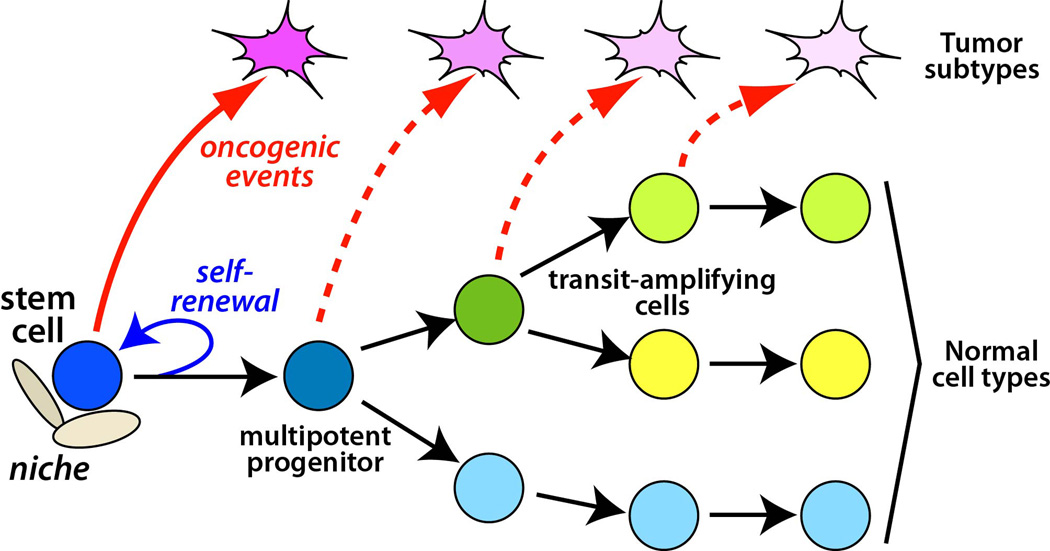
Cell of origin and relationship to tumor subtypes. The lineage hierarchy of a normal tissue is schematically depicted with a stem cell at the top of the hierarchy giving rise to a multipotent progenitor, downstream transit-amplifying cells, and differentiated cell types. The stem cell is capable of self-renewal, and its properties are regulated by a neighboring niche. Oncogenic transformation of different cell types of origin such as a stem cell (red arrow) or downstream progenitors (dashed arrows) can give rise to distinct tumor subtypes.
Figure 2
Figure 2
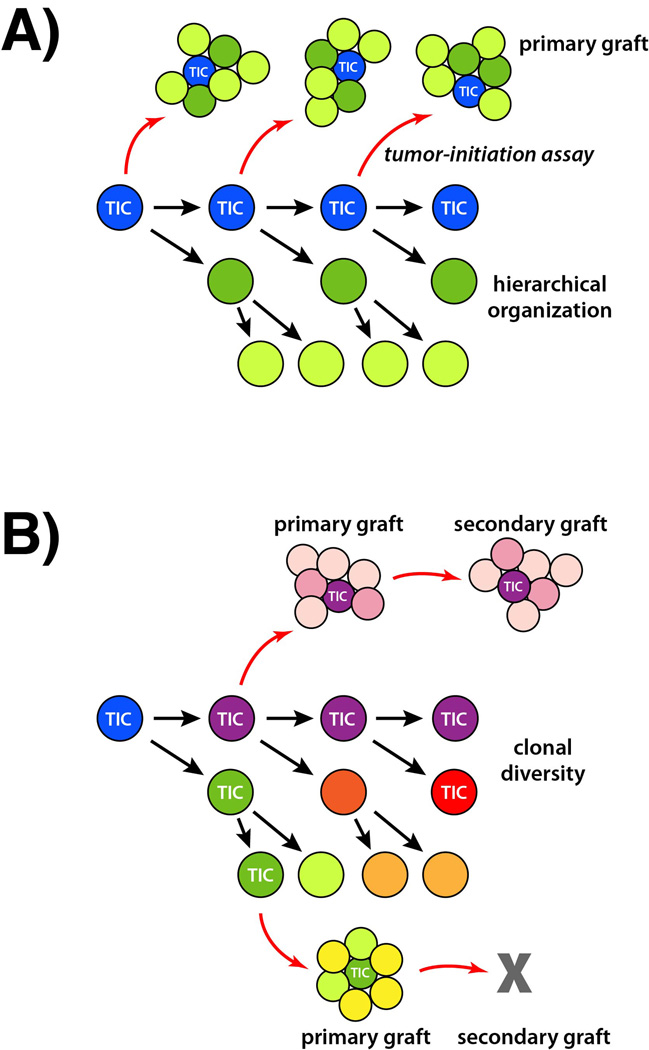
The cancer stem cell model and clonal evolution. A: The traditional cancer stem cell model postulates that a tumor-initiating cell (TIC) gives rise to distinct tumor cell types through a lineage hierarchy. Within the tumor, only the TIC and not its progeny can generate successful tumor grafts in a tumor-initiating assay (red arrows). The resulting grafts recapitulate the hierarchical organization and phenotype of the parental tumor. B: In a clonal evolution model, a tumor may contain multiple distinct tumor-initiating cells that in turn generate clonal diversity and resulting intratumor heterogeneity. These different tumor-initiating cells may differ in their tumor-propagating capabilities in serial grafting assays.

References

    1. Visvader JE. Cells of origin in cancer. Nature. 2011;469:314–322. - PubMed
    1. Liu C, Sage JC, Miller MR, Verhaak RG, Hippenmeyer S, et al. Mosaic analysis with double markers reveals tumor cell of origin in glioma. Cell. 2011;146:209–221. - PMC - PubMed
    1. Alcantara Llaguno S, Chen J, Kwon CH, Jackson EL, Li Y, et al. Malignant astrocytomas originate from neural stem/progenitor cells in a somatic tumor suppressor mouse model. Cancer Cell. 2009;15:45–56. - PMC - PubMed
    1. Wang Y, Yang J, Zheng H, Tomasek GJ, Zhang P, et al. Expression of mutant p53 proteins implicates a lineage relationship between neural stem cells and malignant astrocytic glioma in a murine model. Cancer Cell. 2009;15:514–526. - PMC - PubMed
    1. Zhu Y, Guignard F, Zhao D, Liu L, Burns DK, et al. Early inactivation of p53 tumor suppressor gene cooperating with NF1 loss induces malignant astrocytoma. Cancer Cell. 2005;8:119–130. - PMC - PubMed

Publication types