. 2012 Dec;160(4):1881-95.
doi: 10.1104/pp.112.202747. Epub 2012 Oct 1.

UDP-glycosyltransferases from the UGT73C subfamily in Barbarea vulgaris catalyze sapogenin 3-O-glucosylation in saponin-mediated insect resistance

Affiliations

UDP-glycosyltransferases from the UGT73C subfamily in Barbarea vulgaris catalyze sapogenin 3-O-glucosylation in saponin-mediated insect resistance

Jörg M Augustin et al. Plant Physiol. 2012 Dec.

Abstract

Triterpenoid saponins are bioactive metabolites that have evolved recurrently in plants, presumably for defense. Their biosynthesis is poorly understood, as is the relationship between bioactivity and structure. Barbarea vulgaris is the only crucifer known to produce saponins. Hederagenin and oleanolic acid cellobioside make some B. vulgaris plants resistant to important insect pests, while other, susceptible plants produce different saponins. Resistance could be caused by glucosylation of the sapogenins. We identified four family 1 glycosyltransferases (UGTs) that catalyze 3-O-glucosylation of the sapogenins oleanolic acid and hederagenin. Among these, UGT73C10 and UGT73C11 show highest activity, substrate specificity and regiospecificity, and are under positive selection, while UGT73C12 and UGT73C13 show lower substrate specificity and regiospecificity and are under purifying selection. The expression of UGT73C10 and UGT73C11 in different B. vulgaris organs correlates with saponin abundance. Monoglucosylated hederagenin and oleanolic acid were produced in vitro and tested for effects on P. nemorum. 3-O-β-d-Glc hederagenin strongly deterred feeding, while 3-O-β-d-Glc oleanolic acid only had a minor effect, showing that hydroxylation of C23 is important for resistance to this herbivore. The closest homolog in Arabidopsis thaliana, UGT73C5, only showed weak activity toward sapogenins. This indicates that UGT73C10 and UGT73C11 have neofunctionalized to specifically glucosylate sapogenins at the C3 position and demonstrates that C3 monoglucosylation activates resistance. As the UGTs from both the resistant and susceptible types of B. vulgaris glucosylate sapogenins and are not located in the known quantitative trait loci for resistance, the difference between the susceptible and resistant plant types is determined at an earlier stage in saponin biosynthesis.


Figures

Figure 1.
Figure 1.
Chemical structures of the four known G-type B. vulgaris saponins that correlate with resistance to P. nemorum and other herbivores. The cellobioside and sapogenin parts of the saponin are underlined, and relevant carbon positions are numbered.
Figure 2.
Figure 2.
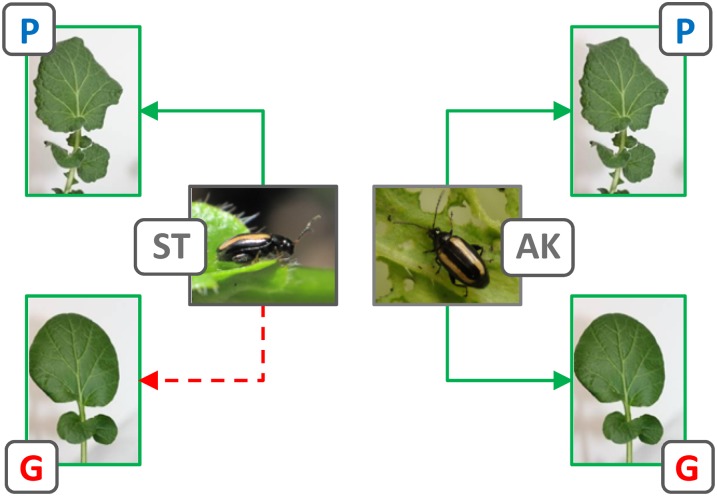
Feeding behavior of adult P. nemorum that are either susceptible (ST) or resistant (AK) toward the saponin-based defense of G-type B. vulgaris; the P-type produces different saponins and is not resistant against P. nemorum. Potential feeding is shown by green arrows, and termination of feeding briefly after initiation is indicated by a red dashed arrow. Larvae of the ST line die if fed on G-type plants.
Figure 3.
Figure 3.
Maximum likelihood phylogeny of UGT73Cs described in this study and from online databases. Species are indicated as prefixes to the UGT name: Bv, B. vulgaris; At, A. thaliana; Al, A. lyrata; Br, B. rapa. UGT73C9, UGT73C10, and UGT73C12, shown in blue, are from P-type B. vulgaris, while UGT73C11 and UGT73C13, shown in red, are from the G-type. AtUGT73B5 is included as an outgroup. Bootstrap values (100 iterations) are shown next to the corresponding nodes.
Figure 4.
Figure 4.
Activity of the heterologously expressed B. vulgaris UGT73Cs toward sapogenins. Enzyme assays contained 750 ng of recombinant UGT in 50 µL and 50 µm oleanolic acid (oa), hederagenin (he), or betulinic acid (be) as acceptor substrates and 1 mm UDP-Glc as donor substrate. The assays were incubated for 60 min at 30°C and analyzed by TLC. Compounds were visualized by spraying with 10% sulfuric acid in methanol and subsequent heating. The (inverted) image was taken at long-wave UV (366 nm) excitation. Migration of authentic oleanolic acid, hederagenin, 3-O-β-Glc oleanolic acid (oa-Glc), and 3-O-β-Glc hederagenin (he-Glc) is shown in the reference lane (Ref.). Positions of aglycones (aglc), monoglucosides (m-Glc), and diglucosides (di-Glc) are indicated on the left side.
Figure 5.
Figure 5.
Substrate specificity of UGT73C10 and UGT73C12. TLC analyses of activity assays with recombinant UGT73C10 or UGT73C12 using 14C-labeled UDP-Glc as donor substrate are shown. Substrates tested were oleanolic acid (oa), hederagenin* (he), β-amyrin (βa), betulinic acid (be), kaempferol (ka), quercetin (qu), and TCP, applied at either 100 or 10 µm concentration. *The hederagenin batch contained a low amount of oleanolic acid.
Figure 6.
Figure 6.
Comparison of relative saponin abundance and expression of the UGTs in different B. vulgaris organs. A, Relative saponin abundance in leaf, petiole, and root extracts of three G-type plants (G1–G3), based on the mean peak areas ± sd of the extracted ion chromatograms from liquid chromatography-mass spectrometry of the four insect resistance-correlated G-type saponins: hederagenin cellobioside (he-cell), oleanolic acid cellobioside (oa-cell), gypsogenin cellobioside (gy-cell), and 4-epi-hederagenin cellobioside (4e-cell). Overlaid base peak chromatograms of all liquid chromatography-mass spectrometry runs are provided in Supplemental Figure S12. B, Expression of UGT73C11 in the three G-type plants (G1–G3) and combined expression of UGT73C9 and UGT73C10 in three P-type plants (P1–P3), determined with primer set 1 relative to actin (ACT2). Values are means ± sd of technical duplicates. C, Corresponding expression analysis of UGT73C13 in G1 to G3 and UGT73C12 in P1 to P3, determined with primer set 2.
Figure 7.
Figure 7.
Consumption of radish leaf discs painted with different amounts of 3-O-β-Glc hederagenin (A) and 3-O-β-Glc oleanolic acid (B) by susceptible ST and resistant AK lines of P. nemorum. Consumption is shown as mean total area consumed from two leaf discs (total area, 92 mm2) that were presented to one beetle (±1.96 se corresponding to a confidence interval of 95%). Assays with 3.75 nmol of 3-O-β-Glc oleanolic acid were omitted due to the low efficacy at higher doses.

References

    1. Agerbirk N, Olsen CE, Bibby BM, Frandsen HO, Brown LD, Nielsen JK, Renwick JAA. (2003a) A saponin correlated with variable resistance of Barbarea vulgaris to the diamondback moth Plutella xylostella. J Chem Ecol 29: 1417–1433 - PubMed
    1. Agerbirk N, Ørgaard M, Nielsen JK. (2003b) Glucosinolates, P. nemorum resistance, and leaf pubescence as taxonomic characters in the genus Barbarea (Brassicaceae). Phytochemistry 63: 69–80 - PubMed
    1. Aharoni A, Gaidukov L, Khersonsky O, McQ Gould S, Roodveldt C, Tawfik DS. (2005) The ‘evolvability’ of promiscuous protein functions. Nat Genet. 371: 73–76 - PubMed
    1. Augustin JM, Kuzina V, Andersen SB, Bak S. (2011) Molecular activities, biosynthesis and evolution of triterpenoid saponins. Phytochemistry 72: 435–457 - PubMed
    1. Badenes-Perez FR, Shelton AM, Nault BA. (2005) Using yellow rocket as a trap crop for diamondback moth (Lepidoptera: Plutellidae). J Econ Entomol 98: 884–890 - PubMed

Publication types

MeSH terms