


The impact of stressor patterns on clinical features in patients with tako-tsubo cardiomyopathy: experiences of two tertiary cardiovascular centers
- PMID: 23027688
- PMCID: PMC6652420
- DOI: 10.1002/clc.22053
The impact of stressor patterns on clinical features in patients with tako-tsubo cardiomyopathy: experiences of two tertiary cardiovascular centers
Abstract
Background: Tako-tsubo cardiomyopathy (TTC) is typically triggered by an acute emotional or physical stress event. The aim of this study was to investigate the impact of stressor patterns on clinical features, laboratory parameters, and electrocardiographic and echocardiographic findings in patients with TTC.
Hypothesis: Clinical features are different according to stressor patterns.
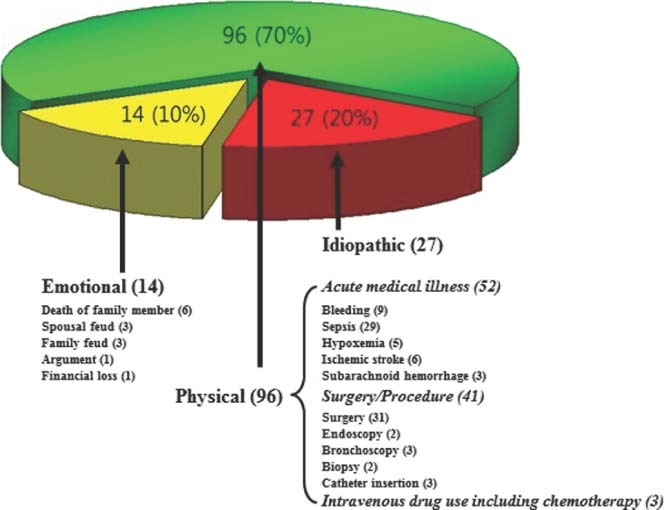
Methods: Of 137 patients enrolled from the TTC registry database, 14 patients had emotional triggers (E group), 96 had physical triggers (P group), and 27 had no triggers (N group).
Results: Most clinical presentations and in-hospital courses were similar among the groups. However, the E group had a higher prevalence of chest pain (P = 0.006) and palpitation (P = 0.006), whereas the P group had a higher prevalence of cardiogenic shock (P = 0.040), than other groups. The P group had a significantly higher heart rate (P = 0.001); higher high-sensitivity C-reactive protein (P = 0.006), creatine kinase MB fraction (P = 0.045), and N terminal-probrain natriuretic peptide (P = 0.036) levels; higher left ventricular end-diastolic pressure (P = 0.019) and left ventricular end-systolic diameter (P = 0.002); but lower left ventricular ejection fraction (P = 0.018). The E group had lesser prevalence of apical ballooning pattern (P = 0.038) than other groups. The P group required more frequent use of inotropics (P = 0.041) and diuretics (P = 0.047) and had significantly longer intensive care unit (P = 0.014) and in-hospital stays (P = 0.001).
Conclusions: The clinical features of TTC are different according to preceding stressor patterns. The TTC group with preceding physical stressors was less likely to have preserved cardiovascular reserve and more likely to require hemodynamic support than other groups. The overall prognosis of TTC is excellent, regardless of triggering stressors.
© 2012 Wiley Periodicals, Inc.
Figures
References
-
- Kurisu S, Sato H, Kawagoe T, et al. Tako‐tsubo‐like left ventricular dysfunction with ST‐segment elevation: a novel cardiac syndrome mimicking acute myocardial infarction. Am Heart J. 2002;143:448–455. - PubMed
-
- Gianni M, Dentali F, Grandi AM, et al. Apical ballooning syndrome or takotsubo cardiomyopathy: a systematic review. Eur Heart J. 2006;27:1523–1529. - PubMed
-
- Pilgrim TM, Wyss TR. Takotsubo cardiomyopathy or transient left ventricular apical ballooning syndrome: a systematic review. Int J Cardiol. 2008;124:283–292. - PubMed
-
- Prasad A, Lerman A, Rihal CS. Apical ballooning syndrome (Tako‐Tsubo or stress cardiomyopathy): a mimic of acute myocardial infarction. Am Heart J. 2008;155:408–417. - PubMed
-
- Lee YP, Poh KK, Lee CH, et al. Diverse clinical spectrum of stress‐induced cardiomyopathy. Int J Cardiol. 2009;133:272–275. - PubMed
Publication types
MeSH terms
Substances
LinkOut - more resources
Full Text Sources
Medical
Research Materials
Miscellaneous
