. 2012 Oct 16;109(42):16870-5.
doi: 10.1073/pnas.1207300109. Epub 2012 Oct 1.

Chlamydia trachomatis protein GrgA activates transcription by contacting the nonconserved region of σ66

Affiliations

Chlamydia trachomatis protein GrgA activates transcription by contacting the nonconserved region of σ66

Xiaofeng Bao et al. Proc Natl Acad Sci U S A. .

Abstract

The bacterial RNA polymerase holoenzyme consists of a catalytic core enzyme in complex with a σ factor that is required for promoter-specific transcription initiation. Primary, or housekeeping, σ factors are responsible for most of the gene expression that occurs during the exponential phase of growth. Primary σ factors share four regions of conserved sequence, regions 1-4, which have been further subdivided. Many primary σ factors also contain a nonconserved region (NCR) located between subregions 1.2 and 2.1, which can vary widely in length. Interactions between the NCR of the primary σ factor of Escherichia coli, σ(70), and the β' subunit of the E. coli core enzyme have been shown to influence gene expression, suggesting that the NCR of primary σ factors represents a potential target for transcription regulation. Here, we report the identification and characterization of a previously undocumented Chlamydia trachomatis transcription factor, designated GrgA (general regulator of genes A). We demonstrate in vitro that GrgA is a DNA-binding protein that can stimulate transcription from a range of σ(66)-dependent promoters. We further show that GrgA activates transcription by contacting the NCR of the primary σ factor of C. trachomatis, σ(66). Our findings suggest GrgA serves as an important regulator of σ(66)-dependent transcription in C. trachomatis. Furthermore, because GrgA is present only in chlamydiae, our findings highlight how nonconserved regions of the bacterial RNA polymerase can be targets of regulatory factors that are unique to particular organisms.


Conflict of interest statement

The authors declare no conflict of interest.

Figures
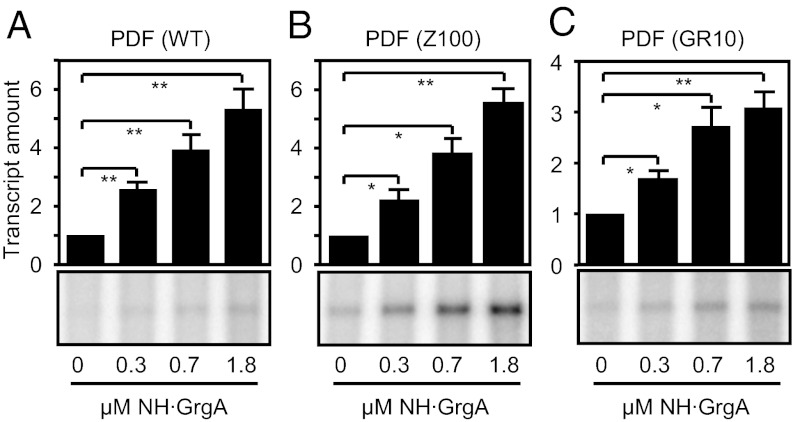
Fig. 1.
Fig. 1.
GrgA stimulates transcription of the defA promoter in vitro. Shown are in vitro transcription assays performed using cRNAP, a DNA template carrying the indicated defA promoter variant, and the indicated concentration of NH⋅GrgA. The Z100 promoter derivative (used in B) carries a base pair substitution in the promoter –35 element, whereas the GR10 derivative (used in C) carries a substitution in DNA upstream of the –35 element (14). Graphs show the averages and SDs for three independent measurements. We note that C-terminally His-tagged GrgA also demonstrated a dose-dependent stimulatory effect on defA promoter activity (Fig. S2). Single and double asterisks denote that the difference between control and GrgA-containing reactions were statistically significant (P < 0.05 and P < 0.01, respectively).
Fig. 2.
Fig. 2.
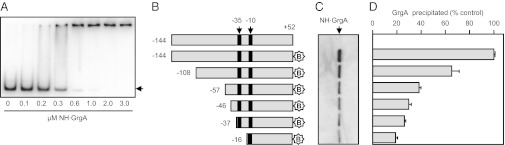
GrgA binds DNA. (A) EMSA assays performed in the absence of poly(dI-dC) using a DNA fragment carrying sequences extending from position –144 to +52 of the defA promoter. (B) Schematic of the DNA fragments used to precipitate NH·GrgA (star indicates the presence of a 3′ biotin moiety). (C) Western blot analysis of the amount of NH·GrgA precipitated by the corresponding DNA fragments in B. (D) Graph shows the amount of GrgA precipitated as a percentage of that precipitated by the biotinylated –144 to +52 fragment. Plotted are the averages and SDs for three independent measurements.
Fig. 3.
Fig. 3.
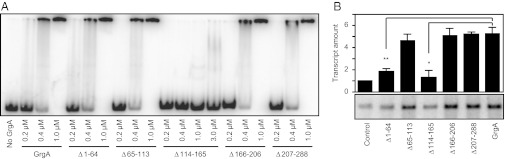
DNA binding by GrgA is essential but not sufficient for full transcription activation. (A) EMSA assays performed using a radiolabeled DNA fragment carrying sequences extending from position –144 to +52 of the defA promoter in the presence of the indicated concentrations of wild-type GrgA or the indicated GrgA mutant. (B) In vitro transcription assays performed in the presence or absence of 1.8 μM wild-type GrgA or the indicated GrgA mutant. Assays were performed using cRNAP and a DNA template carrying the Z100 defA promoter variant. Graph shows the averages and SDs for three independent measurements.
Fig. 4.
Fig. 4.
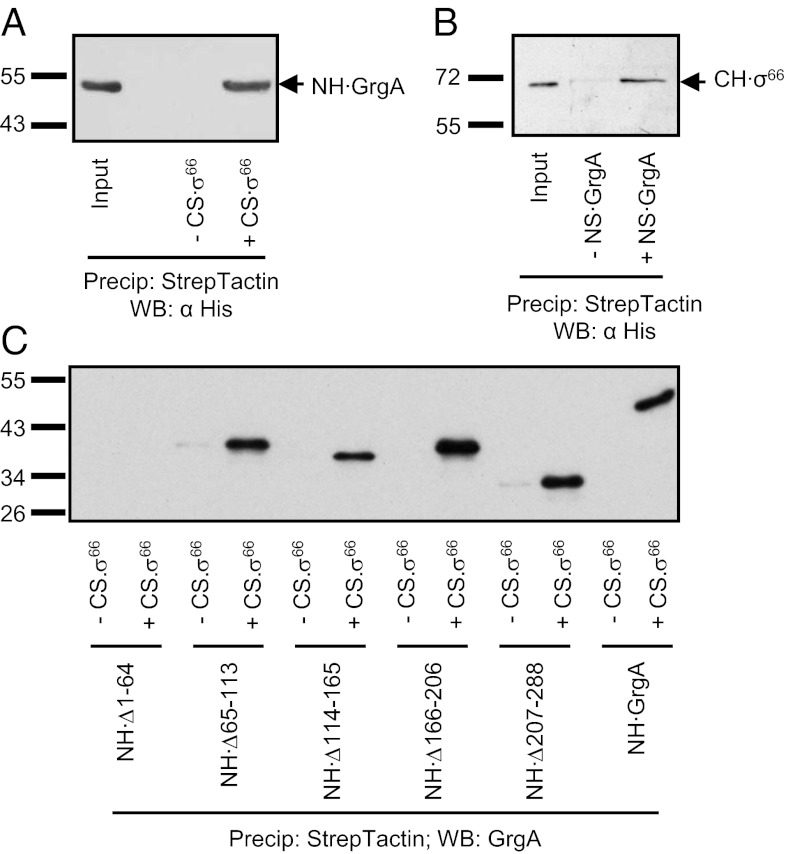
GrgA binds σ66. (A) Precipitation of NH·GrgA by Strep-Tactin–immobilized CS·σ66. Shown is a Western blot detecting His-tagged GrgA. (B) Precipitation of CH·σ66 by NS·GrgA. Shown is a Western blot detecting σ66. (C) Precipitation of wild-type GrgA or the indicated mutant GrgA derivatives by Strep-Tactin–immobilized CS·σ66. Shown is a Western blot detecting GrgA variants. Anti-GrgA instead of anti-His was used for detection because the anti-His recognized GrgA variants with greatly varying efficiency, as demonstrated in Fig. S8.
Fig. 5.
Fig. 5.
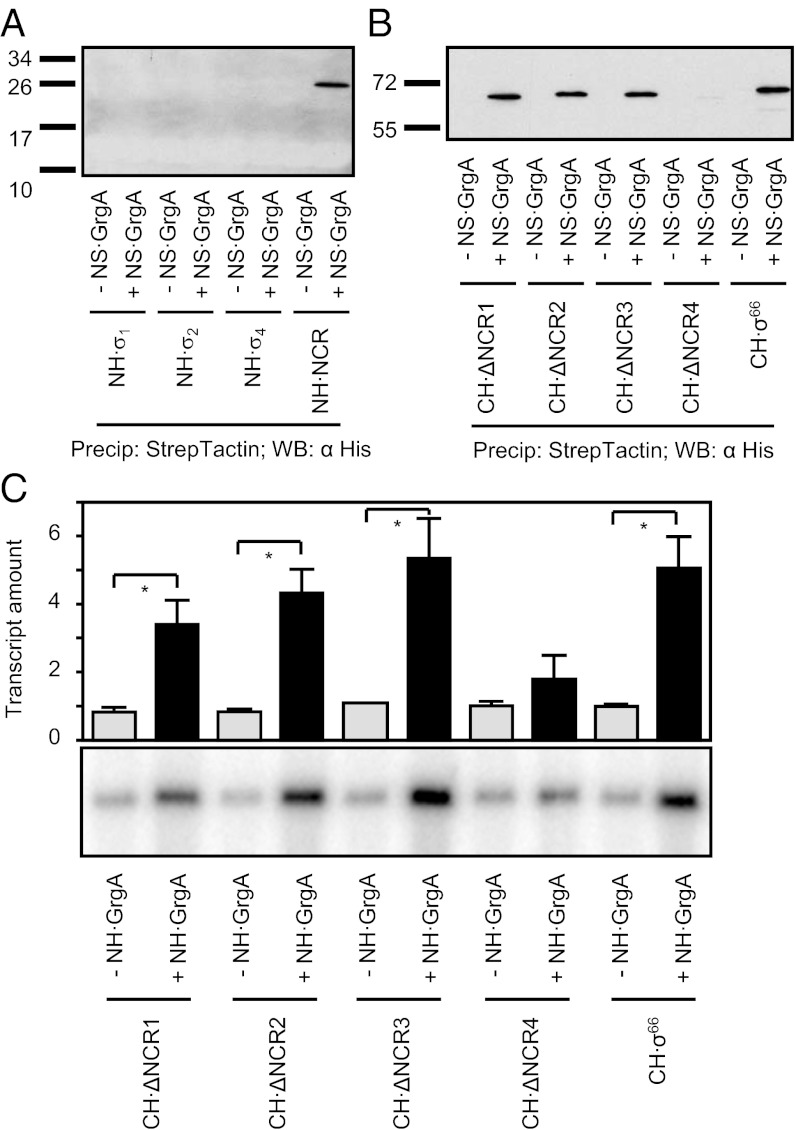
Interaction between GrgA and the nonconserved region of σ66 is required for efficient transcription activation. (A) Precipitation of His-tagged fragments of σ66 by Strep-Tactin–immobilized GrgA (NS·GrgA). Shown is a Western blot detecting the His-tagged σ66 fragments recovered after precipitation. (B) Precipitation of His-tagged derivatives of σ66 by Strep-Tactin–immobilized GrgA (NS·GrgA). Shown is a Western blot detecting the His-tagged σ66 derivatives recovered after precipitation. ΔNCR1 lacks residues 132–183; ΔNCR2 lacks residues 184–223; ΔNCR3, lacks residues 224–268; and ΔNCR4 lacks residues 270–316 (Fig. S6). (C) In vitro transcription assays performed in the presence or absence of 1.8 μM wild-type GrgA using a hybrid holoenzyme consisting of E. coli core and the indicated σ66 derivative. The DNA template used for these assays was the Z100 defA promoter variant. Graph shows the averages and SDs for three independent measurements.
Fig. 6.
Fig. 6.
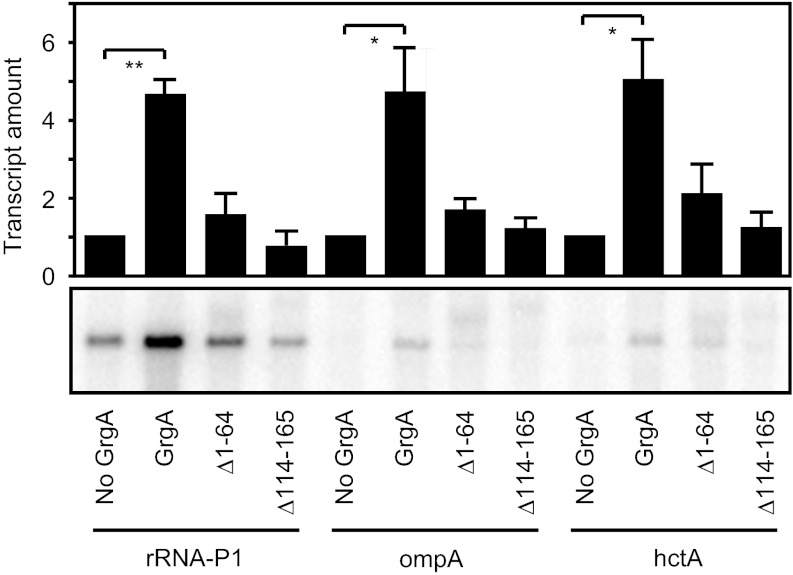
GrgA is a general activator of σ66-dependent transcription in vitro. In vitro transcription assays performed in the presence or absence of 1.8 μM wild-type GrgA or the indicated GrgA mutant. Assays were done using cRNAP and a DNA template carrying the indicated promoter. Graph shows the averages and SDs for three independent measurements.

References

    1. Stephens RS, Myers G, Eppinger M, Bavoil PM. Divergence without difference: Phylogenetics and taxonomy of Chlamydia resolved. FEMS Immunol Med Microbiol. 2009;55:115–119. - PubMed
    1. Schachter J. Infection and disease epidemiology. In: Stephens RS, editor. Chlamydia Intracellular Biology, Pathogenesis. Washington, DC: ASM Press; 1999. pp. 139–169.
    1. Hybiske K, Stephens RS. Mechanisms of Chlamydia trachomatis entry into nonphagocytic cells. Infect Immun. 2007;75:3925–3934. - PMC - PubMed
    1. Hybiske K, Stephens RS. Mechanisms of host cell exit by the intracellular bacterium Chlamydia. Proc Natl Acad Sci USA. 2007;104:11430–11435. - PMC - PubMed
    1. Todd WJ, Caldwell HD. The interaction of Chlamydia trachomatis with host cells: Ultrastructural studies of the mechanism of release of a biovar II strain from HeLa 229 cells. J Infect Dis. 1985;151:1037–1044. - PubMed

Publication types

MeSH terms

LinkOut - more resources