. 2012 Oct 23;109(43):17382-7.
doi: 10.1073/pnas.1211446109. Epub 2012 Oct 1.

Efficient TALEN-mediated gene knockout in livestock

Affiliations

Efficient TALEN-mediated gene knockout in livestock

Daniel F Carlson et al. Proc Natl Acad Sci U S A. .

Abstract

Transcription activator-like effector nucleases (TALENs) are programmable nucleases that join FokI endonuclease with the modular DNA-binding domain of TALEs. Although zinc-finger nucleases enable a variety of genome modifications, their application to genetic engineering of livestock has been slowed by technical limitations of embryo-injection, culture of primary cells, and difficulty in producing reliable reagents with a limited budget. In contrast, we found that TALENs could easily be manufactured and that over half (23/36, 64%) demonstrate high activity in primary cells. Cytoplasmic injections of TALEN mRNAs into livestock zygotes were capable of inducing gene KO in up to 75% of embryos analyzed, a portion of which harbored biallelic modification. We also developed a simple transposon coselection strategy for TALEN-mediated gene modification in primary fibroblasts that enabled both enrichment for modified cells and efficient isolation of modified colonies. Coselection after treatment with a single TALEN-pair enabled isolation of colonies with mono- and biallelic modification in up to 54% and 17% of colonies, respectively. Coselection after treatment with two TALEN-pairs directed against the same chromosome enabled the isolation of colonies harboring large chromosomal deletions and inversions (10% and 4% of colonies, respectively). TALEN-modified Ossabaw swine fetal fibroblasts were effective nuclear donors for cloning, resulting in the creation of miniature swine containing mono- and biallelic mutations of the LDL receptor gene as models of familial hypercholesterolemia. TALENs thus appear to represent a highly facile platform for the modification of livestock genomes for both biomedical and agricultural applications.


Conflict of interest statement

Conflict of interest statement: S.C.F. is an executive and shareholder in Recombinetics, Inc., a company focused on the commercialization of transcription activator-like effector nucleases for livestock biomedical and agricultural applications. D.F.C. is an employee and shareholder of Recombinetics, Inc.

Figures
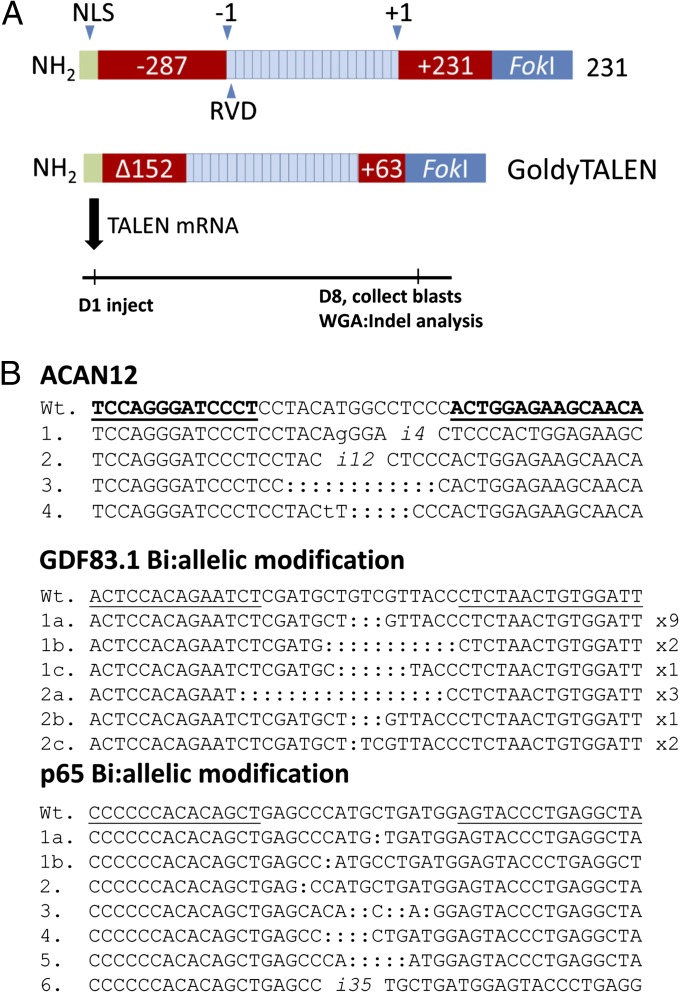
Fig. 1.
Fig. 1.
TALEN activity in bovine embryos. (A) TALENs for embryo injection generated in either the +231 or GT scaffold. Each scaffold shares a common SV40 nuclear localization signal (NLS) and C-terminal fusion of the FokI homodimer domain. Numbering is relative to the DNA-binding domain; the amino acid before the first repeat variable di-residue repeat (RVD) is labeled “−1” and the amino acid following the last RVD repeat is labeled “+1.” Bovine or swine, in vitro-produced zygotes were injected with TALEN mRNA on day 1 (D1) and cultured in vitro to blastocyst formation. Individual blastocysts (blasts) were collected on day 8, subjected to WGA, and analyzed for indels. (B) TALEN-mediated indels in bovine (ACAN12 and GDF83.1 injected) and porcine (p65-11.1 injected) embryos. Wild-type sequence is shown above with TALEN binding sites underlined. Both deletion and insertion (denoted with an “i” and number of base pairs) events were identified. Mismatch bases are indicated by lowercase text. Only biallelic modifications are shown for GDF83.1 and p65-11.1 embryos. Embryos with a homozygous indel (same indel on each allele) are shown on a single line. Indel alleles of compound biallelic embryos (two or more unique indel alleles) are displayed on multiple lines (e.g., 1a, 1b). Some blastocysts were partially mosaic. Sequence analysis of embryos 1 and 2 injected with bovine GDF83.1 TALENs revealed three unique indel alleles each; the number of reads for each allele is noted to the right of the sequence. In addition to indel alleles, 3 and 1 wild-type sequence reads were observed for GDF83.1 embryos 1 and 2, respectively.
Fig. 2.
Fig. 2.
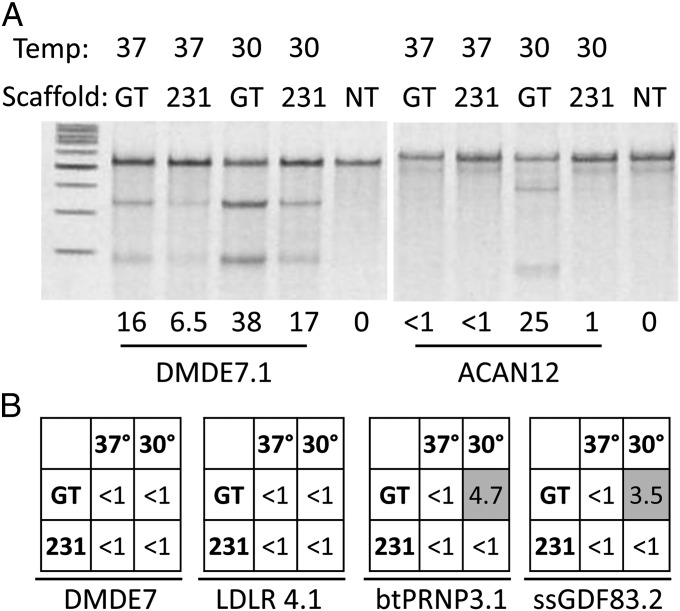
Comparison of TALEN scaffolds for gene-editing in livestock fibroblasts. (A) The Surveyor assay was conducted on transfected fibroblasts transfected with either DMDE7.1 or ACAN12 TALEN-pairs. Scaffold and temperature treatment is indicated above the gel and percent NHEJ is indicated below. NT, not treated. (B) Activity of four additional TALEN-pairs, identified at the bottom of each matrix, with either the +231 or GT scaffold (left column in each matrix) at either 30 or 37 °C.
Fig. 3.
Fig. 3.
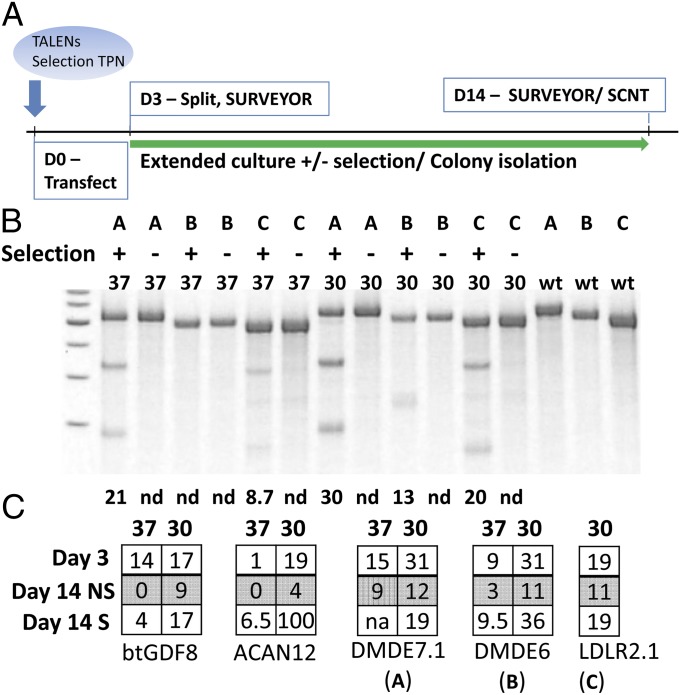
Transposon coselection for indel enrichment. (A) The experimental timeline. Day zero (D0), cells were transfected with a mixture of plasmids, including an expression cassette for each TALEN, a transposon encoding a selection marker, and transposase expression cassette. Transfected cells were cultured for 3 d at either 30 or 37 °C before splitting, collection of a sample for Surveyor assay, and replating for extended culture with and without selection for transposon integration. Cells cultured for 14+ d were collected for Surveyor assay. (B) Fibroblasts were transfected using Mirus LT1 reagent and Surveyor assay was performed on day 14 populations. Temperature treatment, selection and TALEN identification (identified by single letters (A, B, and C) as indicated in C are shown above the gel. (C) Fibroblasts were transfected by nucleofection and the percent NHEJ was measured at day 3, and in day 14 nonselected (NS) and selected (S) populations. Temperature treatment is indicated above each matrix. ND, not detected; WT, wild-type amplicon, Surveyor-treated.
Fig. 4.
Fig. 4.
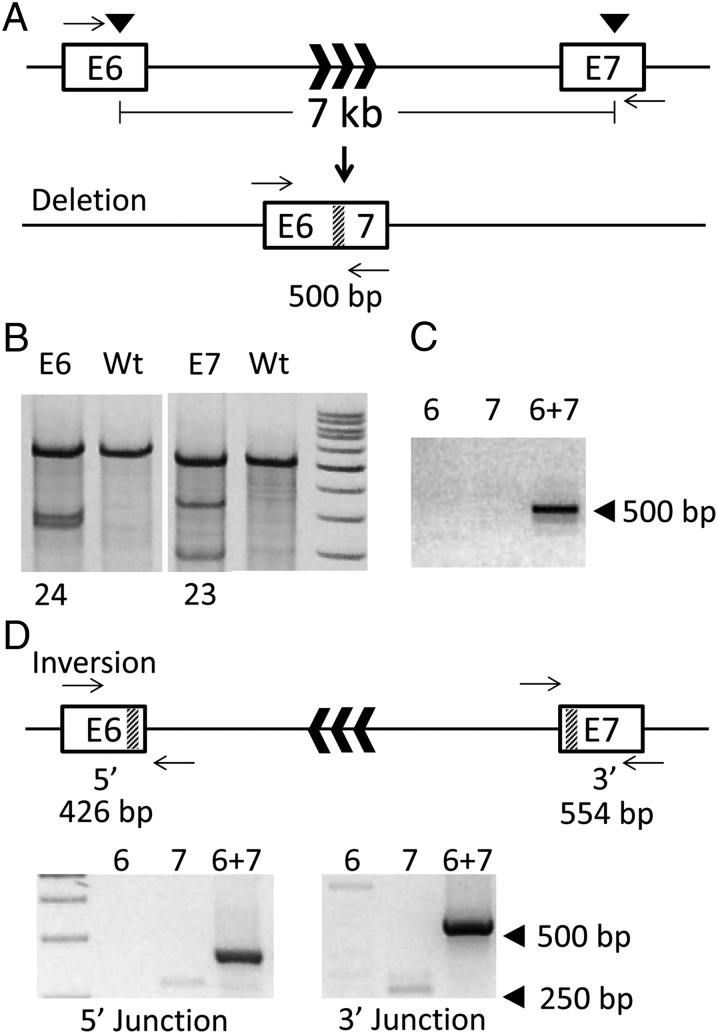
TALEN-induced deletions and inversions. (A) DMD locus. Transcriptional orientation is denoted by black chevrons in intron-6. (B) Surveyor assay of cells transfected simultaneously with TALENs targeted to exon 6 and 7 reveal NHEJ indels at both sites. (C) PCR with primers (black arrows) flanking the presumptive deletion yield a ∼500-bp product when both exon-6 and exon-7 TALENs were introduced simultaneously, but not when transfected singly. (D) The predicted outcome of an inversion event of the sequence between the TALEN target sites. Primers flanking the presumptive flanking sites at the 5′- and 3′-ends of the inversion locus are shown (black arrows) along with predicted product size. PCR products were observed at both 5′- and 3′-junctions only when both exon-6 and exon-7 TALENs were introduced simultaneously.
Fig. 5.
Fig. 5.
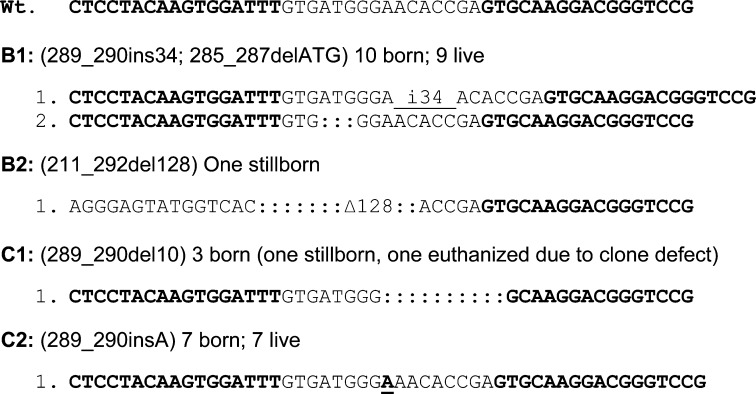
Genotypes of LDLR-knockout Ossabaw swine. The genotypes of 22 cloned piglets were evaluated by cloning and sequencing of amplicons spanning the LDLR2.1 target site. Four distinct genotypes were identified and labeled B1 and B2 for pigs derived from the B pool and C1 and C2 for pigs derived from the C pool. The wild-type sequence is shown above and the TALEN recognition sites are indicated in bold. Inserted bases are indicated by underlined text or denoted with an “i” and number of base pairs.

References

    1. Aigner B, et al. Transgenic pigs as models for translational biomedical research. J Mol Med (Berl) 2010;88:653–664. - PubMed
    1. Rogers CS, et al. Disruption of the CFTR gene produces a model of cystic fibrosis in newborn pigs. Science. 2008;321:1837–1841. - PMC - PubMed
    1. Abuin A, Bradley A. Recycling selectable markers in mouse embryonic stem cells. Mol Cell Biol. 1996;16:1851–1856. - PMC - PubMed
    1. Kim YG, Cha J, Chandrasegaran S. Hybrid restriction enzymes: Zinc finger fusions to Fok I cleavage domain. Proc Natl Acad Sci USA. 1996;93:1156–1160. - PMC - PubMed
    1. Porteus MH, Carroll D. Gene targeting using zinc finger nucleases. Nat Biotechnol. 2005;23:967–973. - PubMed

Publication types