The genetics of Alzheimer disease
- PMID: 23028126
- PMCID: PMC3475404
- DOI: 10.1101/cshperspect.a006296
The genetics of Alzheimer disease
Abstract
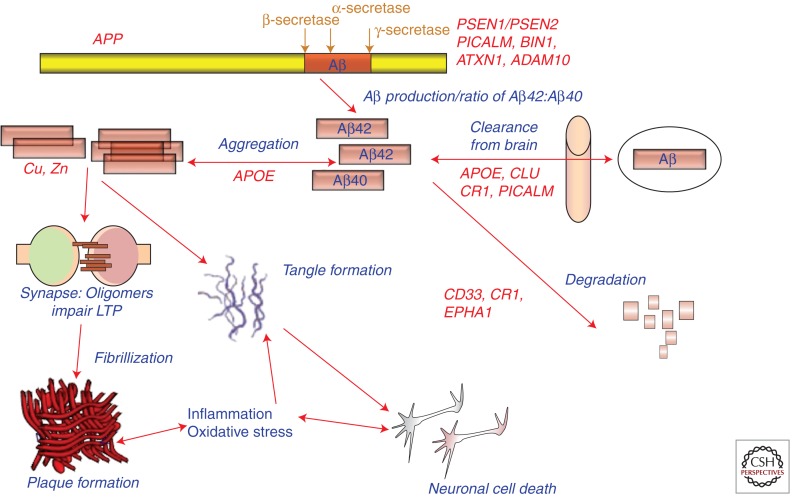
Family history is the second strongest risk factor for Alzheimer disease (AD) following advanced age. Twin and family studies indicate that genetic factors are estimated to play a role in at least 80% of AD cases. The inheritance of AD exhibits a dichotomous pattern. On one hand, rare mutations in APP, PSEN1, and PSEN2 virtually guarantee early-onset (<60 years) familial AD, which represents ∼5% of AD. On the other hand, common gene polymorphisms, such as the ε4 and ε2 variants of the APOE gene, can influence susceptibility for ∼50% of the common late-onset AD. These four genes account for 30%-50% of the inheritability of AD. Genome-wide association studies have recently led to the identification of 11 additional AD candidate genes. This paper reviews the past, present, and future attempts to elucidate the complex and heterogeneous genetic underpinnings of AD.
Figures
References
-
- Bertram L, Tanzi RE 2008. Thirty years of Alzheimer’s disease genetics: Systematic meta-analyses herald a new era. Nat Rev Neurosci 9: 768–778 - PubMed
-
- Bertram L, McQueen MB, Mullin K, Blacker D, Tanzi RE 2007. Systematic meta-analyses of Alzheimer disease genetic association studies: The AlzGene database. Nat Genet 39: 17–23 - PubMed
Publication types
MeSH terms
Substances
LinkOut - more resources
Full Text Sources
Other Literature Sources
Medical
Miscellaneous