The effect of adding ready-to-use supplementary food to a general food distribution on child nutritional status and morbidity: a cluster-randomized controlled trial
- PMID: 23028263
- PMCID: PMC3445445
- DOI: 10.1371/journal.pmed.1001313
The effect of adding ready-to-use supplementary food to a general food distribution on child nutritional status and morbidity: a cluster-randomized controlled trial
Abstract
Background: Recently, operational organizations active in child nutrition in developing countries have suggested that blanket feeding strategies be adopted to enable the prevention of child wasting. A new range of nutritional supplements is now available, with claims that they can prevent wasting in populations at risk of periodic food shortages. Evidence is lacking as to the effectiveness of such preventive interventions. This study examined the effect of a ready-to-use supplementary food (RUSF) on the prevention of wasting in 6- to 36-mo-old children within the framework of a general food distribution program.
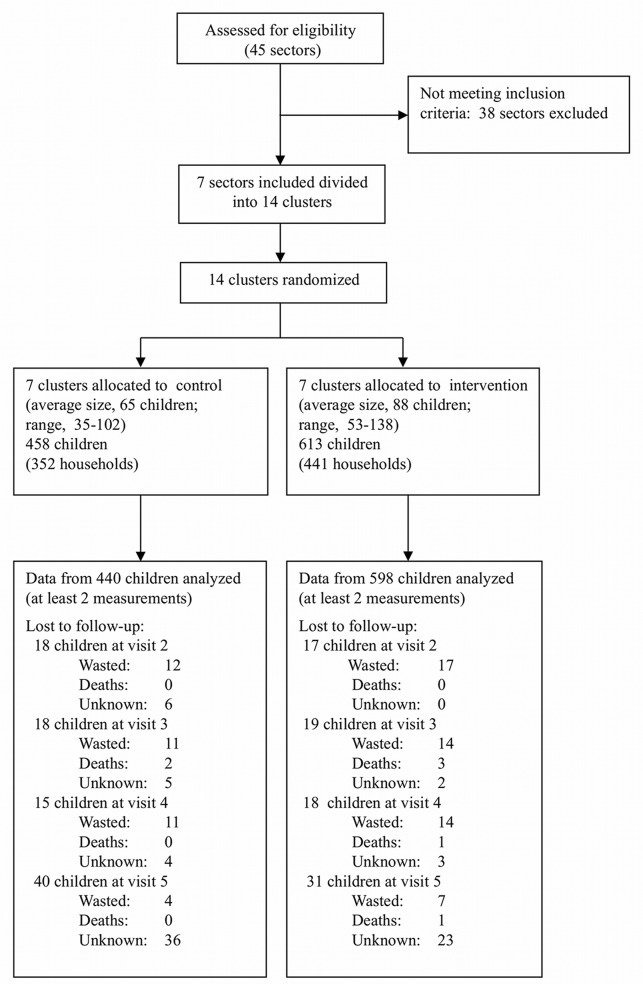
Methods and findings: We conducted a two-arm cluster-randomized controlled pragmatic intervention study in a sample of 1,038 children aged 6 to 36 mo in the city of Abeche, Chad. Both arms were included in a general food distribution program providing staple foods. The intervention group was given a daily 46 g of RUSF for 4 mo. Anthropometric measurements and morbidity were recorded monthly. Adding RUSF to a package of monthly household food rations for households containing a child assigned to the intervention group did not result in a reduction in cumulative incidence of wasting (incidence risk ratio: 0.86; 95% CI: 0.67, 1.11; p = 0.25). However, the intervention group had a modestly higher gain in height-for-age (+0.03 Z-score/mo; 95% CI: 0.01, 0.04; p<0.001). In addition, children in the intervention group had a significantly higher hemoglobin concentration at the end of the study than children in the control group (+3.8 g/l; 95% CI: 0.6, 7.0; p = 0.02), thereby reducing the odds of anemia (odds ratio: 0.52; 95% CI: 0.34, 0.82; p = 0.004). Adding RUSF also resulted in a significantly lower risk of self-reported diarrhea (-29.3%; 95% CI: 20.5, 37.2; p<0.001) and fever episodes (-22.5%; 95% CI: 14.0, 30.2; p<0.001). Limitations of this study include that the projected sample size was not fully attained and that significantly fewer children from the control group were present at follow-up sessions.
Conclusions: Providing RUSF as part of a general food distribution resulted in improvements in hemoglobin status and small improvements in linear growth, accompanied by an apparent reduction in morbidity.
Trial registration: ClinicalTrials.gov NCT01154595 Please see later in the article for the Editors' Summary.
Conflict of interest statement
The authors have declared that no competing interests exist.
Comment in
-
Lipid-based nutrient supplements: how can they combat child malnutrition?PLoS Med. 2012;9(9):e1001314. doi: 10.1371/journal.pmed.1001314. Epub 2012 Sep 18. PLoS Med. 2012. PMID: 23028264 Free PMC article.
References
-
- Black RE, Allen LH, Bhutta ZA, Caulfield LE, de Onis M, et al. (2008) Maternal and child undernutrition 1—maternal and child undernutrition: global and regional exposures and health consequences. Lancet 371: 243–260. - PubMed
-
- Ciliberto MA, Sandige H, Ndekha MJ, Ashorn P, Briend A, et al. (2005) Comparison of home-based therapy with ready-to-use therapeutic food with standard therapy in the treatment of malnourished Malawian children: a controlled, clinical effectiveness trial. Am J Clin Nutr 81: 864–870. - PubMed
Publication types
MeSH terms
Associated data
LinkOut - more resources
Full Text Sources
Medical