. 2012 Sep;8(9):e1002924.
doi: 10.1371/journal.ppat.1002924. Epub 2012 Sep 27.

A novel rhabdovirus associated with acute hemorrhagic fever in central Africa

Affiliations

A novel rhabdovirus associated with acute hemorrhagic fever in central Africa

Gilda Grard et al. PLoS Pathog. 2012 Sep.

Erratum in

  • Correction: A Novel Rhabdovirus Associated with Acute Hemorrhagic Fever in Central Africa.
    Grard G, Fair JN, Lee D, Slikas E, Steffen I, Muyembe JJ, Sittler T, Veeraraghavan N, Ruby JG, Wang C, Makuwa M, Mulembakani P, Tesh RB, Mazet J, Rimoin AW, Taylor T, Schneider BS, Simmons G, Delwart E, Wolfe ND, Chiu CY, Leroy EM. Grard G, et al. PLoS Pathog. 2016 Mar 18;12(3):e1005503. doi: 10.1371/journal.ppat.1005503. eCollection 2016 Mar. PLoS Pathog. 2016. PMID: 26991269 Free PMC article. No abstract available.
  • Correction: Correction: A Novel Rhabdovirus Associated with Acute Hemorrhagic Fever in Central Africa.
    Grard G, Fair JN, Lee D, Slikas E, Steffen I, Muyembe JJ, Sittler T, Veeraraghavan N, Ruby JG, Wang C, Makuwa M, Mulembakani P, Tesh RB, Mazet J, Rimoin AW, Taylor T, Schneider BS, Simmons G, Delwart E, Wolfe ND, Chiu CY, Leroy EM. Grard G, et al. PLoS Pathog. 2017 Sep 7;13(9):e1006583. doi: 10.1371/journal.ppat.1006583. eCollection 2017 Sep. PLoS Pathog. 2017. PMID: 28880960 Free PMC article.

Abstract

Deep sequencing was used to discover a novel rhabdovirus (Bas-Congo virus, or BASV) associated with a 2009 outbreak of 3 human cases of acute hemorrhagic fever in Mangala village, Democratic Republic of Congo (DRC), Africa. The cases, presenting over a 3-week period, were characterized by abrupt disease onset, high fever, mucosal hemorrhage, and, in two patients, death within 3 days. BASV was detected in an acute serum sample from the lone survivor at a concentration of 1.09 × 10(6) RNA copies/mL, and 98.2% of the genome was subsequently de novo assembled from ≈ 140 million sequence reads. Phylogenetic analysis revealed that BASV is highly divergent and shares less than 34% amino acid identity with any other rhabdovirus. High convalescent neutralizing antibody titers of >1:1000 were detected in the survivor and an asymptomatic nurse directly caring for him, both of whom were health care workers, suggesting the potential for human-to-human transmission of BASV. The natural animal reservoir host or arthropod vector and precise mode of transmission for the virus remain unclear. BASV is an emerging human pathogen associated with acute hemorrhagic fever in Africa.


Conflict of interest statement

The authors have filed a patent application related to BASV. This does not alter the authors' adherence to all PLOS Pathogens policies on sharing data and materials.

Figures

Figure 1
Figure 1. Map of Africa showing countries that are affected by viral hemorrhagic fever (VHF) outbreaks.
Ebola VHF is pictured in orange, Marburg VHF in green, Crimean-Congo HF in violet, Lujo VHF in pink, and Lassa VHF in blue. Yellow fever and dengue VHF, which exhibit a wide geographic distribution throughout Sub-Saharan Africa, are not shown. Mangala village, located in the Bas-Congo province in DRC, is represented by a red star.
Figure 2
Figure 2. Deep sequencing and whole-genome de novo assembly of BASV.
After initial discovery of BASV from a single 454 pyrosequencing read, 98.2% of the BASV genome was assembled de novo from >140 million paired-end Illumina reads. The horizontal lines (red) depict regions of the genome successfully assembled at the end of each cycle. PCR and Sanger sequencing were performed to confirm the assembly and genomic organization of BASV (green lines).
Figure 3
Figure 3. Phylogenetic analysis of the L proteins of BASV and other viruses in the order Mononegavirales.
The host from which each virus was isolated is represented by a specific color. To generate the Mononegavirales (Rhabdoviridae, Filoviridae and Paramyxoviridae) phylogeny trees, all complete sequences of the large (L) protein, or RNA-dependent RNA polymerase (2000–2300 amino acids in length) were downloaded from GenBank. Abbreviations and accession numbers used for the phylogenetic analysis are provided in Methods.
Figure 4
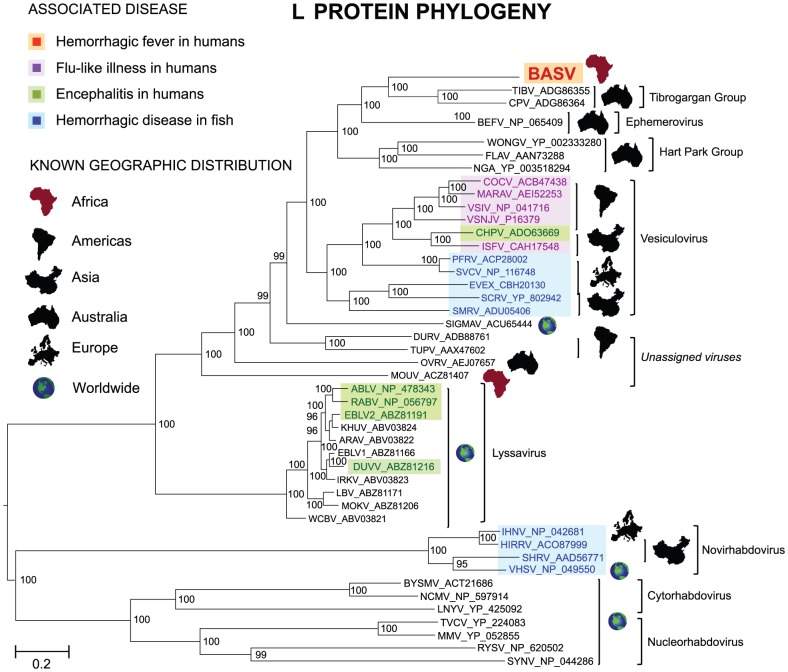
Figure 4. Phylogenetic analysis of the L proteins of BASV and other rhabdoviruses.
The geographic distribution for each virus or group of viruses is indicated with a specific icon, while diseases associated with infection by certain rhabdoviruses are indicated by specific colors. Abbreviations and accession numbers used for the phylogenetic analysis are provided in Methods.
Figure 5
Figure 5. Schematic representation of the genome organization of BASV and its protein similarity plot compared to representative rhabdoviruses.
The similarity plots are generated by aligning the concatenated rhabdovirus proteins and calculating scanning amino acid pairwise identities using a window size of 50 bp. The horizontal bar under each similarity plot shows the percent identity of the rhabdovirus protein relative to its corresponding protein in BASV. Genes coding for the 5 core rhabdovirus proteins are shown in green, while the accessory U1, U2, or U3 genes are shown in blue. Black bars correspond to accessory proteins which are not present in the genome. Note that BEFV contains 3 genes between G and L; only the alignment between the alpha-1 protein of BEFV and the U3 protein of BASV is shown (asterisk). The x-axis refers to the nucleotide position along the ∼12 kb genome of BASV.
Figure 6
Figure 6. Detection of antibodies to BASV by serum neutralization of VSVΔG-GFP pseudotypes.
Infectivities of VSVΔGFP pseudotypes bearing the glycoproteins of VSV or BASV, respectively, after incubation with 5-fold serial dilutions (1∶10, 1∶50, 1∶250, 1∶1,250, 1∶6,250, 1∶31,250) of sera from six individuals are depicted as percent of infectivity in the absence of serum. The six individuals tested include a patient with hemorrhagic fever (panel A, “Patient 3”), the nurse directly caring for him (panel F, “Contact 5”), and other health care workers in Mangala village (panels B–E). All data points represent the average of triplicate assays; error bars indicate standard deviations. Similar results were obtained in an independent experiment using murine leukemia virus (MLV)-based pseudotypes (data not shown).
Figure 7
Figure 7. BASV Screening in DRC, Africa.
(A) All 43 serum samples corresponding to unknown hemorrhagic fever cases or outbreaks in 2008–2010 from 9 provinces in DRC (pink) tested negative for BASV by PCR. (B) Sera from 50 donors in Kasai-Oriental province, DRC (Panel A, star) were tested for BASV-neutralizing antibodies. Sera at 1∶50 (dark blue) or 1∶500 dilution (light blue) were tested. Serum from the surviving Patient 3 was included as a positive control (grey shaded area). Data points represent an average of duplicate assays.
Figure 8
Figure 8. Proposed model for BASV transmission during the hemorrhagic fever outbreak in Mangala.
Patients presenting with symptoms of acute hemorrhagic fever are depicted in red. Dashed red lines represent potential routes of BASV transmission. Contacts 1 through 5 are health care workers at the local health center in Mangala village. Abbreviations: HCW, health care worker; y/o, year-old; Ab, antibody.

References

    1. Bray M (2005) Pathogenesis of viral hemorrhagic fever. Curr Opin Immunol 17: 399–403. - PubMed
    1. Carrion R Jr, Patterson JL (2011) Vaccines against viral hemorrhagic fevers: non-human primate models. Hum Vaccin 7: 667–673. - PubMed
    1. Geisbert TW, Jahrling PB (2004) Exotic emerging viral diseases: progress and challenges. Nat Med 10: S110–121. - PubMed
    1. Borio L, Inglesby T, Peters CJ, Schmaljohn AL, Hughes JM, et al. (2002) Hemorrhagic fever viruses as biological weapons: medical and public health management. JAMA 287: 2391–2405. - PubMed
    1. Fichet-Calvet E, Rogers DJ (2009) Risk maps of Lassa fever in West Africa. PLoS Negl Trop Dis 3: e388. - PMC - PubMed

Publication types

MeSH terms

Substances

Associated data