


Low bone strength is a manifestation of phenylketonuria in mice and is attenuated by a glycomacropeptide diet
- PMID: 23028819
- PMCID: PMC3445501
- DOI: 10.1371/journal.pone.0045165
Low bone strength is a manifestation of phenylketonuria in mice and is attenuated by a glycomacropeptide diet
Abstract
Purpose: Phenylketonuria (PKU), caused by phenylalanine (phe) hydroxylase loss of function mutations, requires a low-phe diet plus amino acid (AA) formula to prevent cognitive impairment. Glycomacropeptide (GMP), a low-phe whey protein, provides a palatable alternative to AA formula. Skeletal fragility is a poorly understood chronic complication of PKU. We sought to characterize the impact of the PKU genotype and dietary protein source on bone biomechanics.
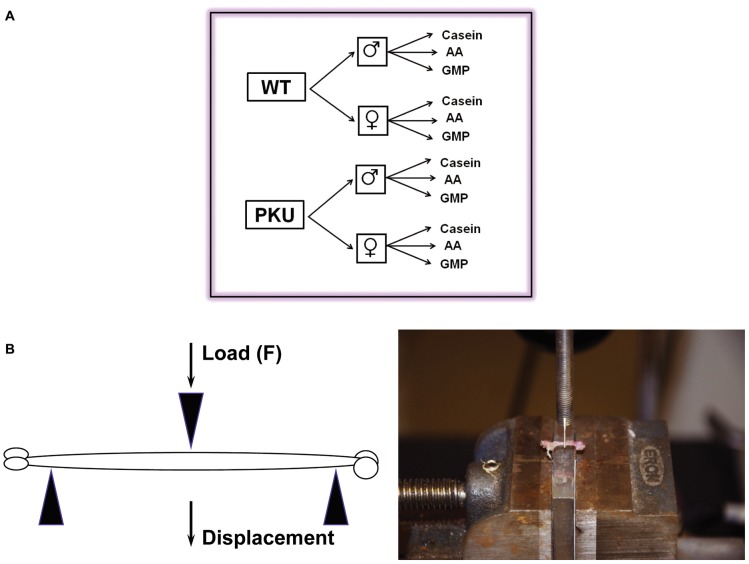
Procedures: Wild type (WT; Pah(+/+)) and PKU (Pah(enu2/enu2)) mice on a C57BL/6J background were fed high-phe casein, low-phe AA, and low-phe GMP diets between 3 to 23 weeks of age. Following euthanasia, femur biomechanics were assessed by 3-point bending and femoral diaphyseal structure was determined. Femoral ex vivo bone mineral density (BMD) was assessed by dual-energy x-ray absorptiometry. Whole bone parameters were used in principal component analysis. Data were analyzed by 3-way ANCOVA with genotype, sex, and diet as the main factors.
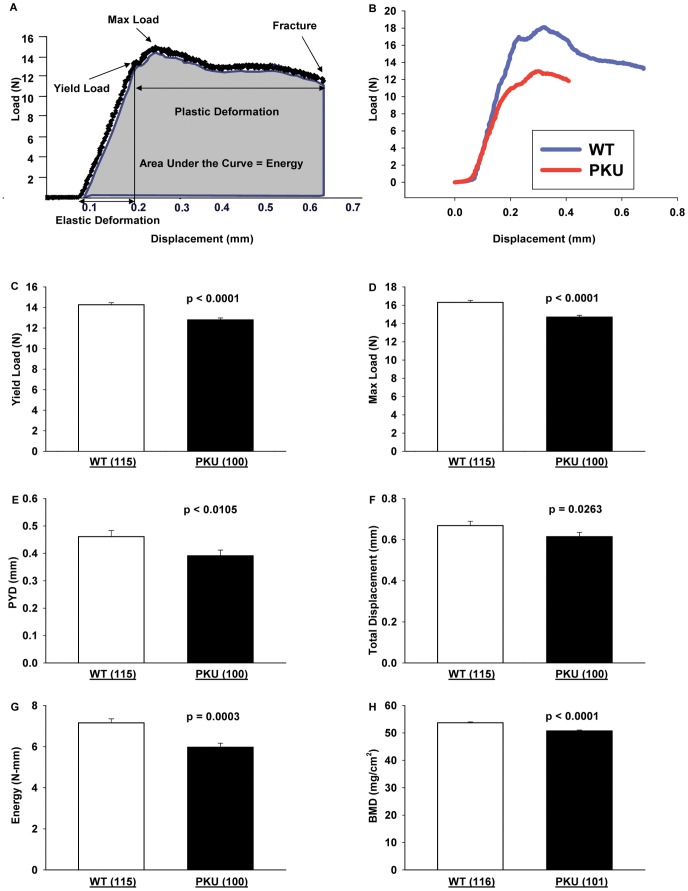
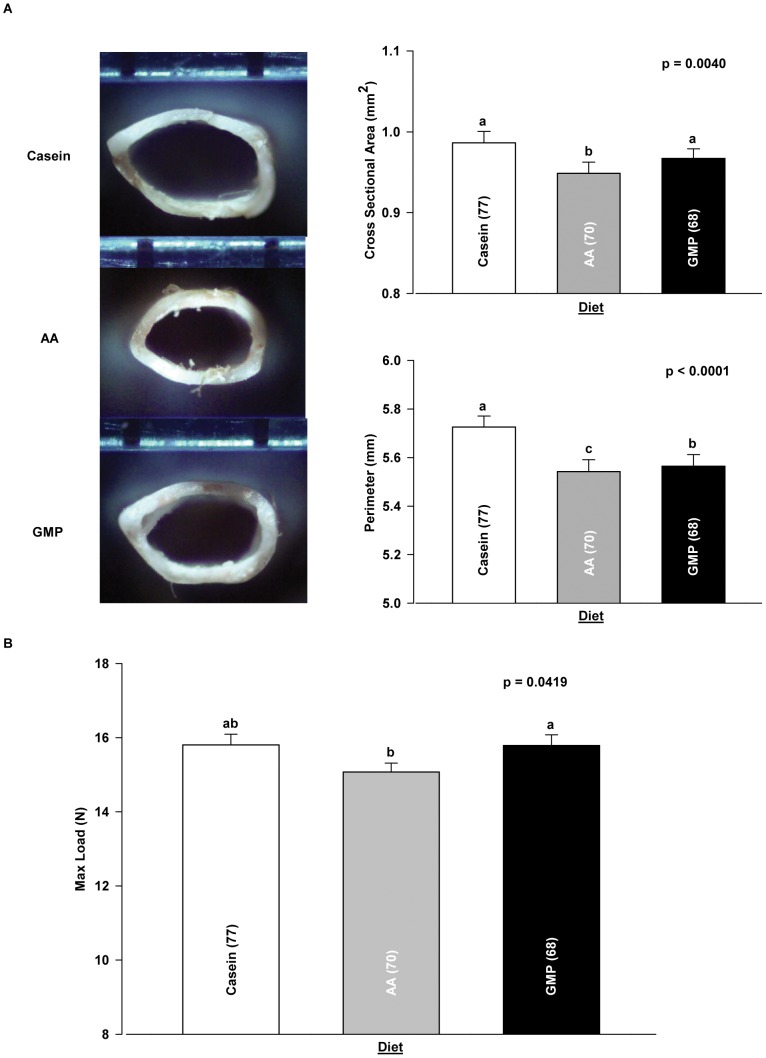
Findings: Regardless of diet and sex, PKU femora were more brittle, as manifested by lower post-yield displacement, weaker, as manifested by lower energy and yield and maximal loads, and showed reduced BMD compared with WT femora. Four principal components accounted for 87% of the variance and all differed significantly by genotype. Regardless of genotype and sex, the AA diet reduced femoral cross-sectional area and consequent maximal load compared with the GMP diet.
Conclusions: Skeletal fragility, as reflected in brittle and weak femora, is an inherent feature of PKU. This PKU bone phenotype is attenuated by a GMP diet compared with an AA diet.
Conflict of interest statement
Figures
References
-
- NIH (2000) Phenylketonuria (PKU): screening and management. NIH Consensus Statement 17: 1–33. - PubMed
-
- de Groot MJ, Hoeksma M, van Rijn M, Slart RH, van Spronsen FJ (2012) Relationships between lumbar bone mineral density and biochemical parameters in phenylketonuria patients. Mol Genet Metab 105: 566–570. - PubMed
-
- Perez-Duenas B, Cambra FJ, Vilaseca MA, Lambruschini N, Campistol J, et al. (2002) New approach to osteopenia in phenylketonuric patients. Acta Paediatr 91: 899–904. - PubMed
-
- Greeves LG, Carson DJ, Magee A, Patterson CC (1997) Fractures and phenylketonuria. Acta Paediatr 86: 242–244. - PubMed
Publication types
MeSH terms
Substances
Grants and funding
LinkOut - more resources
Full Text Sources
Other Literature Sources
Medical
Molecular Biology Databases
