


Combined effect of AMPK/PPAR agonists and exercise training in mdx mice functional performance
- PMID: 23029189
- PMCID: PMC3448675
- DOI: 10.1371/journal.pone.0045699
Combined effect of AMPK/PPAR agonists and exercise training in mdx mice functional performance
Abstract
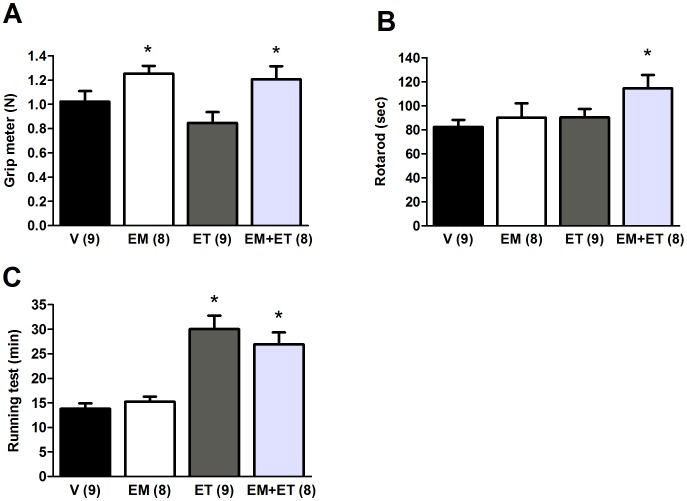
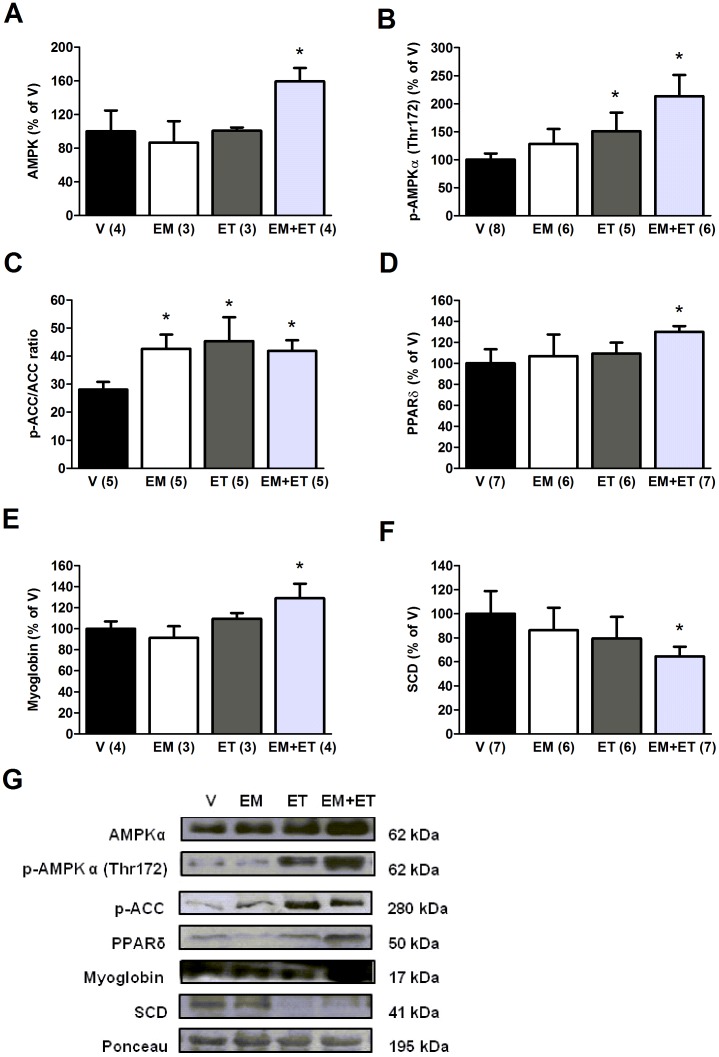
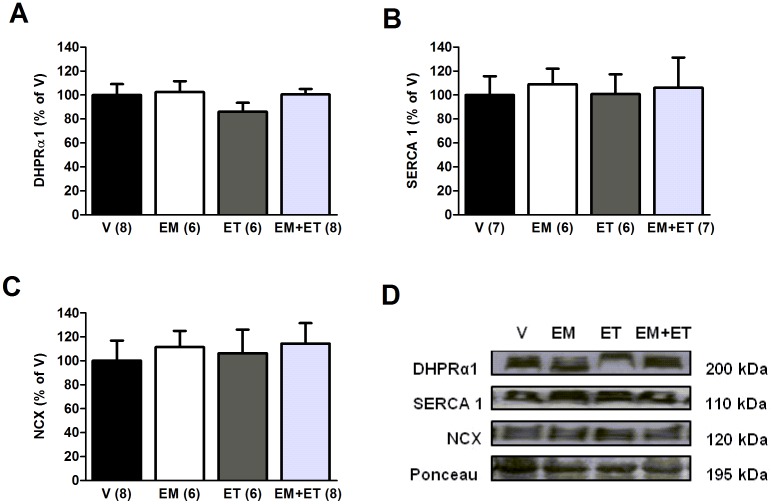
The present investigation was undertaken to test whether exercise training (ET) associated with AMPK/PPAR agonists (EM) would improve skeletal muscle function in mdx mice. These drugs have the potential to improve oxidative metabolism. This is of particular interest because oxidative muscle fibers are less affected in the course of the disease than glycolitic counterparts. Therefore, a cohort of 34 male congenic C57Bl/10J mdx mice included in this study was randomly assigned into four groups: vehicle solution (V), EM [AICAR (AMPK agonist, 50 mg/Kg-1.day-1, ip) and GW 1516 (PPARδ agonist, 2.5 mg/Kg-1.day-1, gavage)], ET (voluntary running on activity wheel) and EM+ET. Functional performance (grip meter and rotarod), aerobic capacity (running test), muscle histopathology, serum creatine kinase (CK), levels of ubiquitined proteins, oxidative metabolism protein expression (AMPK, PPAR, myoglobin and SCD) and intracellular calcium handling (DHPR, SERCA and NCX) protein expression were analyzed. Treatments started when the animals were two months old and were maintained for one month. A significant functional improvement (p<0.05) was observed in animals submitted to the combination of ET and EM. CK levels were decreased and the expression of proteins related to oxidative metabolism was increased in this group. There were no differences among the groups in the intracellular calcium handling protein expression. To our knowledge, this is the first study that tested the association of ET with EM in an experimental model of muscular dystrophy. Our results suggest that the association of ET and EM should be further tested as a potential therapeutic approach in muscular dystrophies.
Conflict of interest statement
Figures

References
-
- Worton RG, Thompson MW (1988) Genetics of Duchenne muscular dystrophy. Annu Rev Genet 22: 601–629. - PubMed
-
- Zatz M, Frota-Pessoa O, Levy JA, Peres CA (1976) Creatine-phosphokinase (CPK) activity in relatives of patients with x-linked muscular-dystrophies - A Brazilian study. Journal de Genétique Humaine 24: 153–168. - PubMed
-
- Zatz M, Rapaport D, Vainzof M, Rocha JML, Passos-Bueno MR, et al. (1991) Serum creatine-kinase (CK) and pyruvate-kinase (PK) activity as a function of clinical evolution in Duchenne (DMD) and Becker (BMD) muscular dystrophies. J Neurol Sci 102: 190–196. - PubMed
-
- Vainzof M, Ayub-Guerrieri D, Onofre PCG, Martins PCM, Lopes VF, et al. (2008) Animal models for genetic neuromuscular diseases. J Mol Neurosci 34: 241–248. - PubMed
Publication types
MeSH terms
Substances
LinkOut - more resources
Full Text Sources
Molecular Biology Databases
Research Materials
