Meta-Analysis
. 2012;7(9):e45867.
doi: 10.1371/journal.pone.0045867. Epub 2012 Sep 21.

Systematic review and meta-analysis of artemisinin based therapies for the treatment and prevention of schistosomiasis

Affiliations
Meta-Analysis

Systematic review and meta-analysis of artemisinin based therapies for the treatment and prevention of schistosomiasis

Luis Pérez del Villar et al. PLoS One. 2012.

Abstract

Background: Chemotherapy based on repeated doses of praziquantel is still the most effective control strategy against Schistosomiasis, however artemisinin derivatives emerged as a family of compounds with schistomicide activity. The aim of the present work is to compare the efficacy of artemisinin-based therapies in the treatment and prophylaxis of human schistosomiasis. The design of this work involved a quantitative systematic review and meta-analysis.

Methodology/principal findings: Retrieval of published studies was carried out through an electronic search of the PubMed (MEDLINE), EMBASE, Cochrane Library and CINAHL databases. This included reports comparing the therapeutic efficacy of artesunate alone, artesunate plus sulfadoxine-pyrimethamine and a combination of artemisinin derivatives plus praziquantel against praziquantel alone on different types of schistosomiasis. Moreover, studies on artesunate and artemether used as preventive drugs were also analyzed against placebo. The primary outcome measure for schistosomiasis treatment was "parasitological cure", whereas for the prophylaxis the outcome evaluated was "infection rate". Our results show that patients treated with artesunate alone have significantly lower cure rates than those treated with praziquantel (OR = 0.27 (95% C.I. 0.13-0.53; p<0.001)) and that the combined therapy of artesunate plus sulfadoxine-pyrimethamine is also significantly less effective than praziquantel treatment (OR = 0.14 (95% C.I. 0.02-0.92; p = 0.04)). However, the combination of an artemisinin derivatives plus praziquantel showed a higher cure rate than praziquantel monotherapy with OR = 2.07 (95% C.I. 1.27-3.36; p = 0.003). Finally, chemoprophylaxis with either artesunate (RR = 0.11 (95% C.I. 0.06-0.22; p<0.001)) or artemether (RR = 0.25 (95% C.I. 0.16-0.40; p<0.001)) was significantly better than a placebo in both cases.

Conclusions/significance: This meta-analysis confirms that artemisinin derivatives used in combination with praziquantel have the potential to increase the cure rates in schistosomiasis treatment, but not artesunate alone. It is also confirmed that repeated doses of artemisinin derivatives play a prophylactic role, significantly reducing the incidence of Schistosoma japonicum infections compared with placebo.


Conflict of interest statement

Competing Interests: The authors have declared that no competing interests exist.

Figures

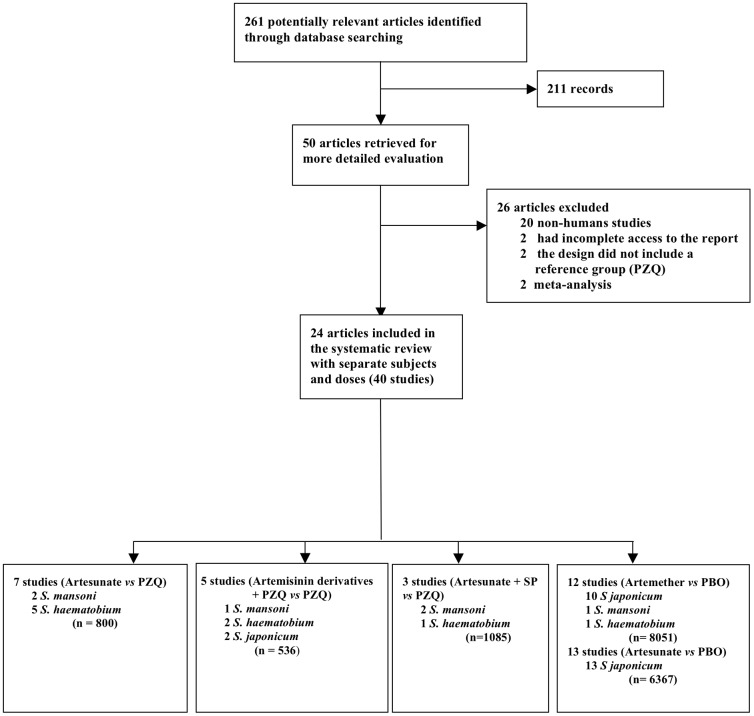
Figure 1
Figure 1. Flow diagram showing the selection process of studies included in the meta-analysis.
Figure 2
Figure 2. Forest plot of a random-effects subgroup meta-analysis comparing parasitological cure by artesunate as monotherapy vs. praziquantel.
Points represent odds ratios with their corresponding 95% C.I. Intermediate diamonds are combined odds ratios for each subgroup and the diamond at the bottom is the overall combined odds ratio. The vertical line emphasizes an odds ratio = 1 (no difference) and the dashed vertical line shows the value of the overall combined odds ratio. The original reports are labeled with author name, year and location (for details see table 1).
Figure 3
Figure 3. Forest plot of fixed-effect subgroup meta-analysis comparing parasitological cure after treatment with an artemisinin derivative plus praziquantel vs. praziquantel.
Points represent odds ratios with their corresponding 95% C.I. Intermediate diamonds are combined odds ratios for each subgroup and the diamond at the bottom is the overall combined odds ratio. The vertical line emphasizes an odds ratio = 1 (no difference) and the dashed vertical line shows the value of the overall combined odds ratio. The original reports are labeled with author name, year and location (for details see table 2).
Figure 4
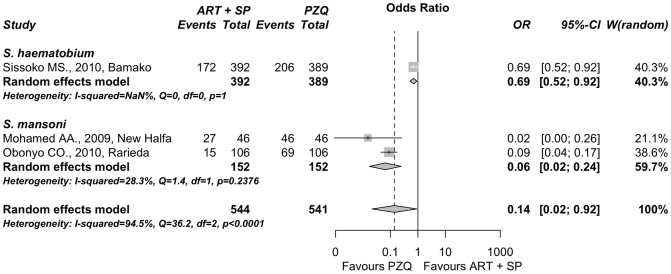
Figure 4. Forest plot of the random-effects subgroup meta-analysis comparing parasitological cure by artesunate plus sulfadoxine/pyrimethamine vs. praziquantel.
Points represent odds ratios with their corresponding 95% C.I. Intermediate diamonds are combined odds ratios for each subgroup and the diamond at the bottom is the overall combined odds ratio. The vertical line emphasizes an odds ratio = 1 (no difference) and the dashed vertical line shows the value of the overall combined odds ratio. The original reports are labeled with author name, year and location (for details see table 3).
Figure 5
Figure 5. Meta-analysis comparing artesunate vs. placebo for chemoprophylaxis against schistosomiasis japonica.
The mid-points of the lines represent the relative risk and the end-points of the lines show the corresponding 95% C.I. The diamond at the bottom is the overall relative risk. The vertical line emphasizes an relative risk = 1 (no difference) and the dashed vertical line shows the value of the overall relative risk. Relative risk <1 indicates a protective effect of artesunate. The original reports are labeled with author name, year, and location, number of dosis and interval of administration (for details see table 4).
Figure 6
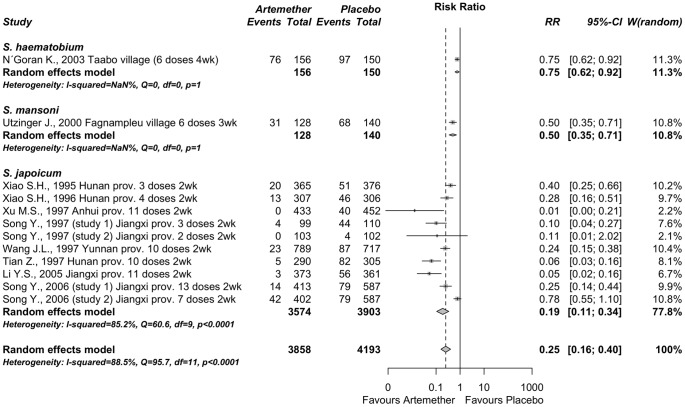
Figure 6. Subgroup meta-analysis comparing Artemether vs. placebo for chemoprophylaxis against schistosomiasis.
The mid-points of the lines represent the relative risk and the end-points of the lines show the corresponding 95% C.I. Intermediate diamond symbols are combined relative risks for each subgroup and the diamond at the bottom is the overall combined relative risk. The vertical line emphasizes an relative risk = 1 (no difference) and the dashed vertical line shows the value of the overall relative risk. Relative risk <1 indicates a protective effect of artemether. The original reports are labeled as follows: author name, year, and location, number of dosis and interval of administration, for details see table 5.
Figure 7
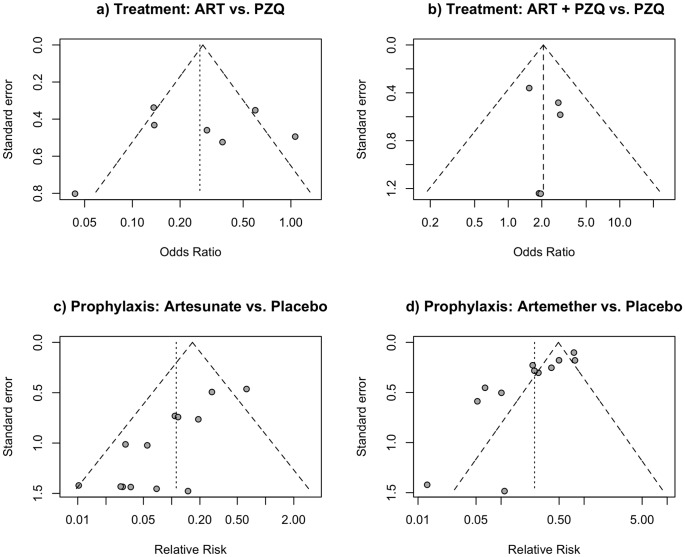
Figure 7. Funnel plots of differents subunits of analysis representing effect size against standard error.
A vertical line indicates the estimate summary effect based on each particular model. A pseudo confidence interval region is drawn around this value with bounds equal to ±1.96 · SE, where SE is the standard error value from the vertical axis.

References

    1. Steinmann P, Keiser J, Bos R, Tanner M, Utzinger J (2006) Schistosomiasis and water resources development: systematic review, meta-analysis, and estimates of people at risk. Lancet Infect Dis 6: 411–425. - PubMed
    1. Tchuem Tchuente LA, Southgate VR, Jourdane J, Webster BL, Vercruysse J (2003) Schistosoma intercalatum: an endangered species in Cameroon? Trends Parasitol 19: 389–393. - PubMed
    1. Muth S, Sayasone S, Odermatt-Biays S, Phompida S, Duong S, et al. (2010) Schistosoma mekongi in Cambodia and Lao People’s Democratic Republic. Adv Parasitol 72: 179–203. - PubMed
    1. Greer GJ, Ow-Yang CK, Yong HS (1988) Schistosoma malayensis n. sp.: a Schistosoma japonicum-complex schistosome from Peninsular Malaysia. J Parasitol 74: 471–480. - PubMed
    1. Utzinger J, Raso G, Brooker S, De Savigny D, Tanner M, et al. (2009) Schistosomiasis and neglected tropical diseases: towards integrated and sustainable control and a word of caution. Parasitology 136: 1859–1874. - PMC - PubMed

Publication types

MeSH terms