


Is physical activity able to modify oxidative damage in cardiovascular aging?
- PMID: 23029599
- PMCID: PMC3458405
- DOI: 10.1155/2012/728547
Is physical activity able to modify oxidative damage in cardiovascular aging?
Abstract
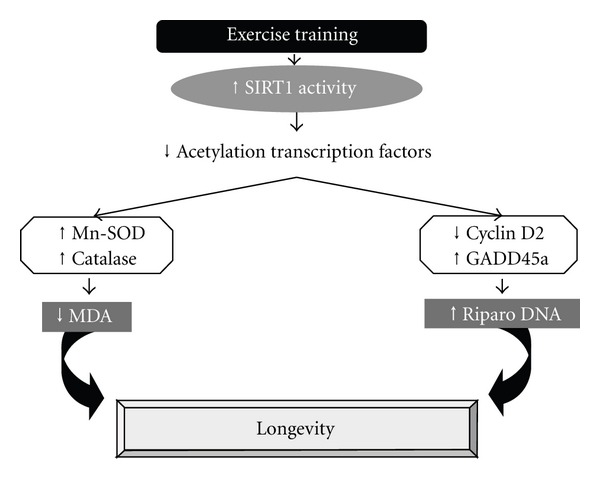
Aging is a multifactorial process resulting in damage of molecules, cells, and tissues. It has been demonstrated that the expression and activity of antioxidant systems (SOD, HSPs) are modified in aging, with reduced cell ability to counteract the oxidant molecules, and consequent weak resistance to ROS accumulation. An important mechanism involved is represented by sirtuins, the activity of which is reduced by aging. Physical activity increases the expression and the activity of antioxidant enzymes, with consequent reduction of ROS. Positive effects of physical exercise in terms of antioxidant activity could be ascribable to a greater expression and activity of SOD enzymes, HSPs and SIRT1 activity. The antioxidant effects could increase, decrease, or not change in relation to the exercise protocol. Therefore, some authors by using a new approach based on the in vivo/vitro technique demonstrated that the highest survival and proliferation and the lowest senescence were obtained by performing an aerobic training. Therefore, the in vivo/vitro technique described could represent a good tool to better understand how the exercise training mediates its effects on aging-related diseases, as elderly with heart failure that represents a special population in which the exercise plays an important role in the improvement of cardiovascular function, quality of life, and survival.
Figures
References
-
- Corbi G, Conti V, Scapagnini G, Filippelli A, Ferrara N. Role of sirtuins, calorie restriction and physical activity in aging. Frontiers in Bioscience (Elite Edition) 2012;4:768–778. - PubMed
-
- Vasto S, Scapagnini G, Bulati M, et al. Biomarkes of aging. Frontiers in Bioscience (Scholar Edition) 2010;2:392–402. - PubMed
-
- Galderisi M, Lomoriello VS, Santoro A, et al. Differences of myocardial systolic deformation and correlates of diastolic function in competitive rowers and young hypertensives: a speckle-tracking echocardiography study. Journal of the American Society of Echocardiography. 2010;23(11):1190–1198. - PubMed
-
- Davies CH, Ferrara N, Harding SE. β-Adrenoceptor function changes with age of subject in myocytes from non-failing human ventricle. Cardiovascular Research. 1996;31(1):152–156. - PubMed
-
- Abete P, Napoli C, Santoro G, et al. Age-related decrease in cardiac tolerance to oxidative stress. Journal of Molecular and Cellular Cardiology. 1999;31(1):227–236. - PubMed
