


Addressing the "other" health literacy competencies--knowledge, dispositions, and oral/aural communication: development of TALKDOC, an intervention assessment tool
- PMID: 23030568
- PMCID: PMC3579650
- DOI: 10.1080/10810730.2012.712613
Addressing the "other" health literacy competencies--knowledge, dispositions, and oral/aural communication: development of TALKDOC, an intervention assessment tool
Abstract
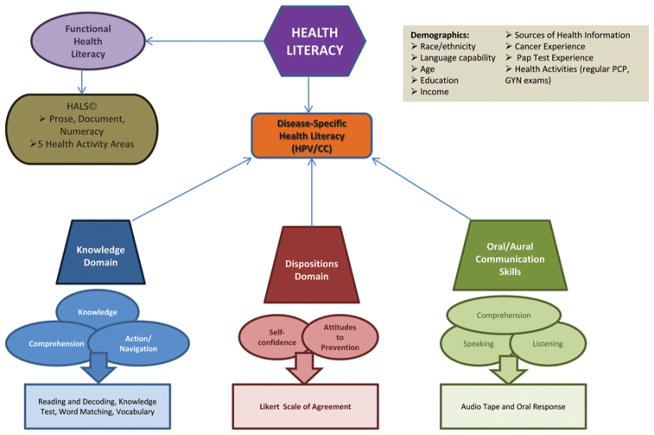
Most health literacy assessments evaluate literacy skills including reading, writing; numeracy and interpretation of tables, graphs, diagrams and charts. Some assess understanding of health systems, and the ability to adequately apply one's skills to specific health-related tasks or demands in health situations. However, to achieve functional health literacy, the ability to "obtain, process, and understand basic health information and services needed to make appropriate health decisions," other health literacy dimensions should be assessed: a person's knowledge and attitudes about a health issue affects his or her ability to and interest in participating in his or her own care. In patient care settings, the abilities to listen, ask questions and check one's understanding are crucial to making appropriate decisions and carrying out instructions. Although literacy is a skill associated with educational attainment and therefore difficult to change in a short time, health education interventions can address health literacy domains such as knowledge, attitudes and oral communication skills. For this reason, an instrument that can assess these constructs is a valuable part of a health educator's toolbox. The authors describe the development and process and outcomes of testing a novel instrument targeted to assess HPV and cervical cancer health literacy competencies, TALKDOC, including its validation with the Health Activities Literacy Scale.
Figures
References
-
- American Cancer Society. Cancer facts and figures 2010. 2010 Retrieved from http://www.cancer.org/Research/CancerFactsFigures/index.
-
- American Cancer Society. Global cancer facts and figures 2007. 2007 Retrieved from http://www.cancer.org/Research/CancerFactsFigures/GlobalCancerFactsFigur....
-
- Baur C, Brooks C, Harris L, Locke J, Neuhaus C, Robinson S, Hilfiker S. National action plan to improve health literacy, May 2010. Washington, DC: U.S. Department of Health and Human Services, Office of Disease Prevention and Health Promotion; 2010.
-
- Benjamin R. Health literacy improvement as a national priority. Journal of Health Communication. 2010;15(Suppl 2):1–3. - PubMed
Publication types
MeSH terms
Grants and funding
LinkOut - more resources
Full Text Sources
Medical