. 2013 Feb;38(3):437-45.
doi: 10.1038/npp.2012.198. Epub 2012 Oct 3.

Striatal adenosine signaling regulates EAAT2 and astrocytic AQP4 expression and alcohol drinking in mice

Affiliations

Striatal adenosine signaling regulates EAAT2 and astrocytic AQP4 expression and alcohol drinking in mice

Moonnoh R Lee et al. Neuropsychopharmacology. 2013 Feb.

Abstract

Adenosine signaling is implicated in several neuropsychiatric disorders, including alcoholism. Among its diverse functions in the brain, adenosine regulates glutamate release and has an essential role in ethanol sensitivity and preference. However, the molecular mechanisms underlying adenosine-mediated glutamate signaling in neuroglial interaction remain elusive. We have previously shown that mice lacking the ethanol-sensitive adenosine transporter, type 1 equilibrative nucleoside transporter (ENT1), drink more ethanol compared with wild-type mice and have elevated striatal glutamate levels. In addition, ENT1 inhibition or knockdown reduces glutamate transporter expression in cultured astrocytes. Here, we examined how adenosine signaling in astrocytes contributes to ethanol drinking. Inhibition or deletion of ENT1 reduced the expression of type 2 excitatory amino-acid transporter (EAAT2) and the astrocyte-specific water channel, aquaporin 4 (AQP4). EAAT2 and AQP4 colocalization was also reduced in the striatum of ENT1 null mice. Ceftriaxone, an antibiotic compound known to increase EAAT2 expression and function, elevated not only EAAT2 but also AQP4 expression in the striatum. Furthermore, ceftriaxone reduced ethanol drinking, suggesting that ENT1-mediated downregulation of EAAT2 and AQP4 expression contributes to excessive ethanol consumption in our mouse model. Overall, our findings indicate that adenosine signaling regulates EAAT2 and astrocytic AQP4 expressions, which control ethanol drinking in mice.


Figures
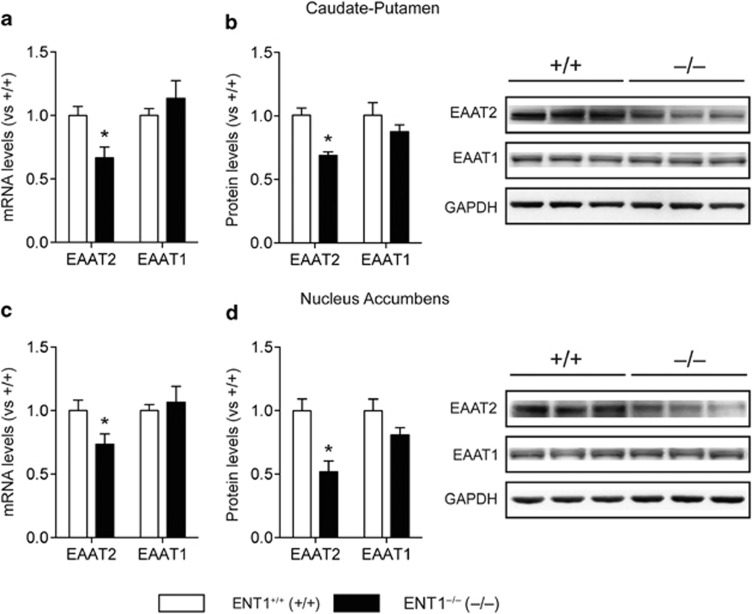
Figure 1
Figure 1
Excitatory amino-acid transporter 2 (EAAT2) is downregulated in the striatum of equilibrative nucleoside transporter 1 (ENT1) null mice. (a, b) EAAT2, but not EAAT1, (a) mRNA and (b) protein expression levels were reduced in the caudate-putamen (CPu) of ENT1 null mice (n=10∼12). (c, d) Similarly, EAAT2, but not EAAT1, (c) mRNA and (d) protein expression levels were reduced in the nucleus accumbens (NAc) of ENT1 null mice (n=10∼12). GAPDH was used as a control. *p<0.05, compared with wild-type mice by unpaired two-tailed t-test. All data are expressed as mean±SEM.
Figure 2
Figure 2
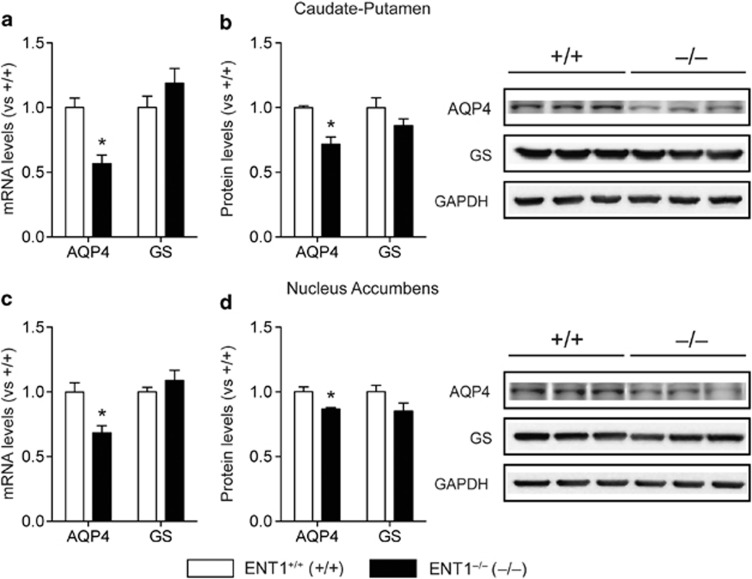
Astrocytic aquaporin 4 (AQP4) gene is downregulated in the striatum of equilibrative nucleoside transporter 1 (ENT1) null mice. (a, b) AQP4 (a) mRNA and (b) protein expression levels were reduced in the caudate-putamen (CPu) of ENT1 null mice, whereas glutamine synthetase (GS) expression was unaffected (n=10∼12). (c, d) Similarly, AQP4 (c) mRNA and (d) protein expression levels were reduced in the nucleus accumbens (NAc) of ENT1 null mice, whereas GS expression was unchanged between genotypes (n=10∼12). GAPDH was used as a control. *p<0.05, compared with wild-type mice by unpaired two-tailed t-test. All data are expressed as mean±SEM.
Figure 3
Figure 3
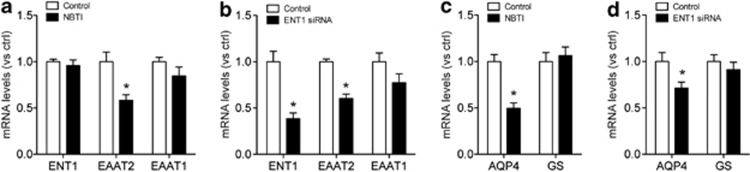
Inhibition of equilibrative nucleoside transporter 1 (ENT1) reduces excitatory amino-acid transporter 2 (EAAT2) and astrocytic aquaporin 4 (AQP4) gene expression in cultured astrocytes. (a, c) ENT1-specific inhibitor NBTI treatment (10 μM) for 24 h significantly reduced (a) EAAT2 and (c) AQP4 mRNA expression levels, but not EAAT1 or GS mRNA expression levels in cerebellar (C8-D1A) astrocytic cell line. (b, d) ENT1 siRNA treatment for 24 h significantly reduced (b) EAAT2 and (d) AQP4 mRNA expression levels, but not EAAT1 or glutamine synthetase (GS) mRNA expression levels in C8-D1A astrocytic cell line. GAPDH was used as a control. n=4∼6; *p<0.05 compared with control group by unpaired two-tailed t-test. All data are expressed as mean±SEM.
Figure 4
Figure 4
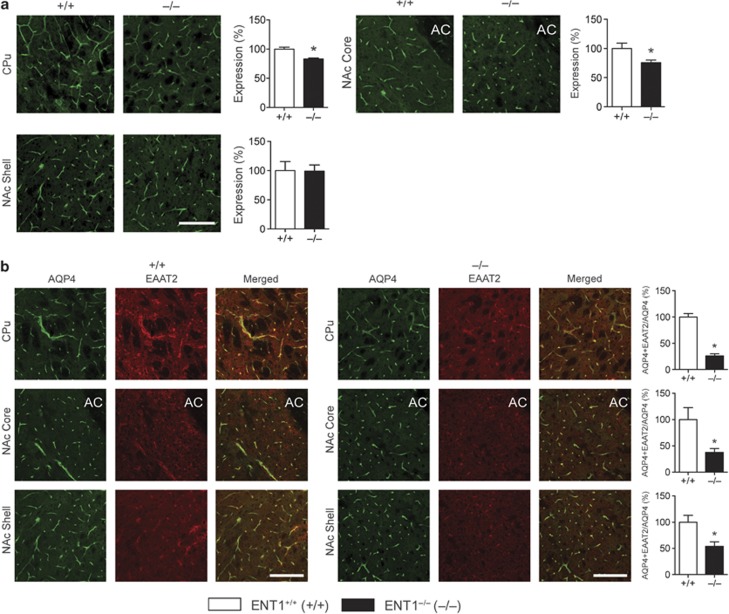
Immunofluorescence analysis of aquaporin 4 (AQP4) in the striatum of equilibrative nucleoside transporter 1 (ENT1) null mice. (a) AQP4 expression was reduced in the caudate-putamen (CPu) and nucleus accumbens (NAc) core, but not in the NAc shell of ENT1 null mice (n=6∼12). (b) Reduced colocalization of AQP4 and excitatory amino-acid transporter 2 (EAAT2) in ENT1 null mice. ENT1 null mice show reduced colocalization between AQP4 and EAAT2 in the CPu, NAc core, and shell (n=3∼6). Expression of colocalization was normalized with expression of AQP4 (AQP4+EAAT2/AQP4). Scale bar=100 μm. *p<0.05, compared with wild-type mice by unpaired two-tailed t-test. All data are expressed as mean±SEM.
Figure 5
Figure 5
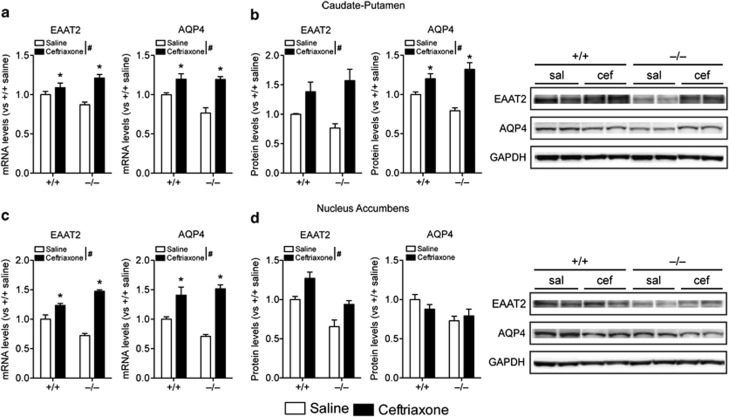
Ceftriaxone rescues downregulation of excitatory amino-acid transporter 2 (EAAT2) and astrocytic aquaporin 4 (AQP4) in equilibrative nucleoside transporter 1 (ENT1) null mice. (a, b) In the caudate-putamen (CPu), both (a) mRNA and (b) protein levels of EAAT2 and AQP4 were upregulated after ceftriaxone treatment (200 mg/kg, intraperitoneal) in ENT1 null and wild-type mice (n=4∼7). (c) However, in the nucleus accumbens (NAc), EAAT2, and AQP4 mRNA levels were upregulated, (d) whereas only EAAT2 protein levels were increased after the treatment (n=4∼7). GAPDH was used as a control. sal=saline; cef=ceftriaxone. *p<0.05 compared with the saline treatment groups (Tukey post-hoc test), and #p<0.05 for the main effect of treatment. All data are expressed as mean±SEM.
Figure 6
Figure 6
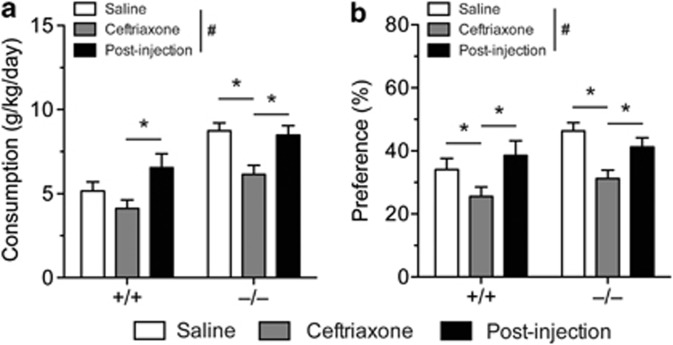
Ceftriaxone reduces alcohol drinking in equilibrative nucleoside transporter 1 (ENT1) null and wild-type mice. Ceftriaxone (200 mg/kg per day, 5 days, intraperitoneal) reduces (a) ethanol consumption and (b) preference during the 5-day injection period (n=19∼21). *p<0.05 compared with the saline-treated or post-injection period (Tukey post-hoc test), and #p<0.05 for the main effect of treatment. All data are expressed as mean±SEM.

References

    1. Abulseoud OA, Miller JD, Wu J, Choi DS, Holschneider DP. Ceftriaxone upregulates the glutamate transporter in medial prefrontal cortex and blocks reinstatement of methamphetamine seeking in a condition place preference paradigm. Brain Res. 2012;1456:14–21. - PMC - PubMed
    1. Alliot F, Pessac B. Astrocytic cell clones derived from established cultures of 8-day postnatal mouse cerebella. Brain Res. 1984;306:283–291. - PubMed
    1. Brodie C, Kuperstein I, Acs P, Blumberg PM. Differential role of specific PKC isoforms in the proliferation of glial cells and the expression of the astrocytic markers GFAP and glutamine synthetase. Brain Res Mol Brain Res. 1998;56:108–117. - PubMed
    1. Chen J, Nam HW, Lee MR, Hinton DJ, Choi S, Kim T, et al. Altered glutamatergic neurotransmission in the striatum regulates ethanol sensitivity and intake in mice lacking ENT1. Behav Brain Res. 2010;208:636–642. - PMC - PubMed
    1. Choi DS, Cascini MG, Mailliard W, Young H, Paredes P, McMahon T, et al. The type 1 equilibrative nucleoside transporter regulates ethanol intoxication and preference. Nat Neurosci. 2004;7:855–861. - PubMed

Publication types

MeSH terms