. 2013 Jan;37(1):122-9.
doi: 10.1002/gepi.21688. Epub 2012 Oct 2.

Genetic association test for multiple traits at gene level

Affiliations

Genetic association test for multiple traits at gene level

Xiaobo Guo et al. Genet Epidemiol. 2013 Jan.

Abstract

Genome-wide association studies (GWASs) at the gene level are commonly used to understand biological mechanisms underlying complex diseases. In general, one response or outcome is used to present a disease of interest in such studies. In this study, we consider a multiple traits association test from the gene level. We propose and examine a class of test statistics that summarizes the association information between single nucleotide polymorphisms (SNPs) and each of the traits. Our simulation studies demonstrate the advantage of gene-based multiple traits association tests when multiple traits share common genes. Using our proposed tests, we reanalyze the dataset from the Study of Addiction: Genetics and Environment (SAGE). Our result validates previous findings while presenting stronger evidence for consideration of multiple traits.


Conflict of interest statement

The authors have no conflict of interest.

Figures
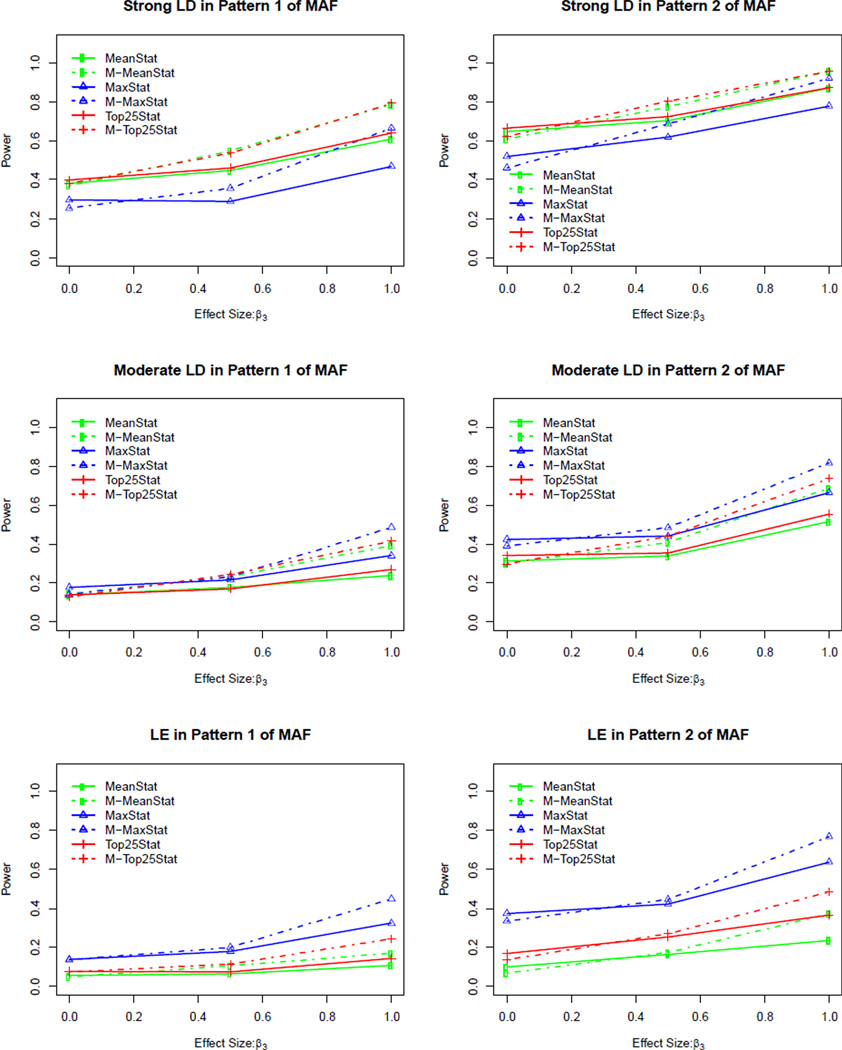
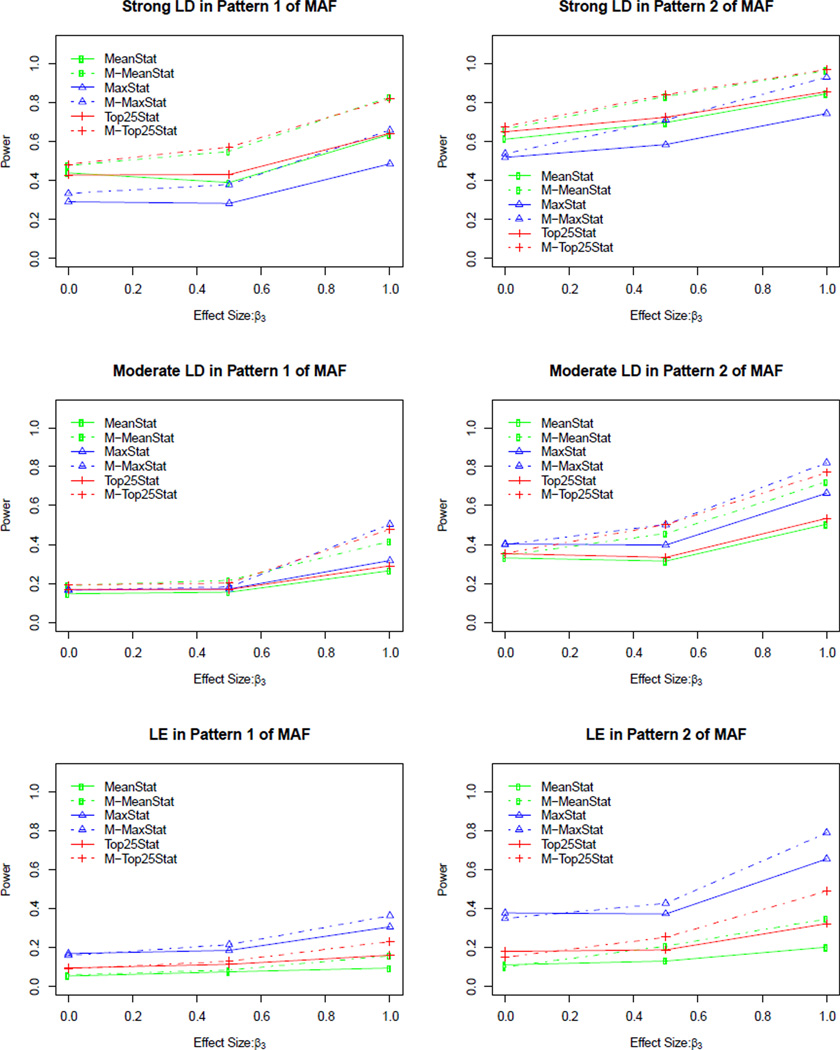
Figure 1
Figure 1
The power of the six gene-based association tests at the significance level 0.01 for the simulations with two traits. The solid lines represent the power of the single trait gene-based association test when the Bonferroni adjustment is used. The dash lines represent the power of the multiple trait gene-based tests.
Figure 2
Figure 2
The power of the six gene-based association tests at the significance level of 0.01 for the simulations with three traits. The solid lines represent the power of the single trait gene-based association test when the Bonferroni adjustment is used. The dash lines represent the power of the multiple trait gene-based tests.

References

    1. Bair E, Hastie T, Paul D, Tibshirani R. Prediction by Supervised Principal Components. Journal of the American Statistical Association. 2006;101(473):119–137.
    1. Bierut LJ, Strickland JR, Thompson JR, Afful SE, Cottler LB. Drug use and dependence in cocaine dependent subjects, community-based individuals, and their siblings. Drug Alcohol Depend. 2008;95(1–2):14–22. - PMC - PubMed
    1. Bierut LJ, Agrawal A, Bucholz KK, Doheny KF, Laurie C, Pugh E, Fisher S, Fox L, Howells W, Bertelsen S, et al. A genome-wide association study of alcohol dependence. Proceedings of the National Academy of Sciences. 2010;107(11):5082. - PMC - PubMed
    1. Burton PR, Clayton DG, Cardon LR, Craddock N, Deloukas P, Duncanson A, Kwiatkowski DP, McCarthy MI, Ouwehand WH, Samani NJ, et al. Genome-wide association study of 14,000 cases of seven common diseases and 3,000 shared controls. Nature. 2007;447(7145):661–678. - PMC - PubMed
    1. Chen X, Cho K, Singer BH, Zhang H. The nuclear transcription factor PKNOX2 is a candidate gene for substance dependence in European-origin women. PLoS ONE. 2011;6(1):e16002. - PMC - PubMed

Publication types