


Changes in bone structure and the muscle-bone unit in children with chronic kidney disease
- PMID: 23032560
- PMCID: PMC4040969
- DOI: 10.1038/ki.2012.347
Changes in bone structure and the muscle-bone unit in children with chronic kidney disease
Abstract
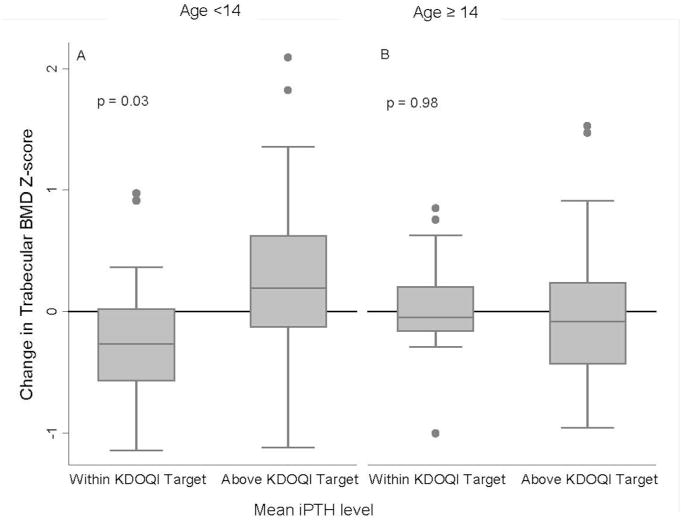
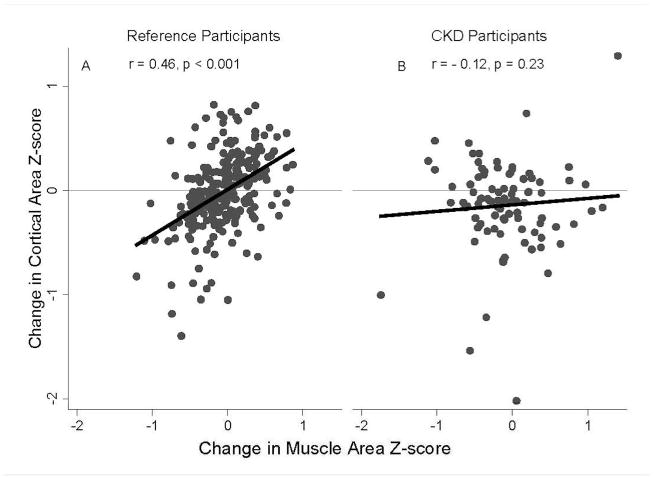
The impact of pediatric chronic kidney disease (CKD) on acquisition of volumetric bone mineral density (BMD) and cortical dimensions is lacking. To address this issue, we obtained tibia quantitative computed tomography scans from 103 patients aged 5-21 years with CKD (26 on dialysis) at baseline and 12 months later. Gender, ethnicity, tibia length, and/or age-specific Z-scores were generated for trabecular and cortical BMD, cortical area, periosteal and endosteal circumference, and muscle area based on over 700 reference subjects. Muscle area, cortical area, and periosteal and endosteal Z-scores were significantly lower at baseline compared with the reference cohort. Cortical BMD, cortical area, and periosteal Z-scores all exhibited a significant further decrease over 12 months. Higher parathyroid hormone levels were associated with significantly greater increases in trabecular BMD and decreases in cortical BMD in the younger patients (significant interaction terms for trabecular BMD and cortical BMD). The estimated glomerular filtration rate was not associated with changes in BMD Z-scores independent of parathyroid hormone. Changes in muscle and cortical area were significantly and positively associated in control subjects but not in CKD patients. Thus, children and adolescents with CKD have progressive cortical bone deficits related to secondary hyperparathyroidism and potential impairment of the functional muscle-bone unit. Interventions are needed to enhance bone accrual in childhood-onset CKD.
Figures
References
-
- Pluskiewicz W, Adamczyk P, Drozdzowska B, et al. Skeletal status in adolescents with end-stage renal failure: a longitudinal study. Osteoporos Int. 2005;16:289–295. - PubMed
-
- Swolin-Eide D, Magnusson P, Hansson S. Bone mass, biochemical markers and growth in children with chronic kidney disease: a 1-year prospective study. Acta Paediatr. 2007;96:720–725. - PubMed
-
- Johnson VL, Wang J, Kaskel FJ, et al. Changes in body composition of children with chronic renal failure on growth hormone. Pediatr Nephrol. 2000;14:695–700. - PubMed
Publication types
MeSH terms
Substances
Grants and funding
LinkOut - more resources
Full Text Sources
Other Literature Sources
Medical
