


Prognostic factors for predicting outcomes after intramedullary nailing of the tibia
- PMID: 23032589
- PMCID: PMC3448300
- DOI: 10.2106/JBJS.J.01418
Prognostic factors for predicting outcomes after intramedullary nailing of the tibia
Abstract
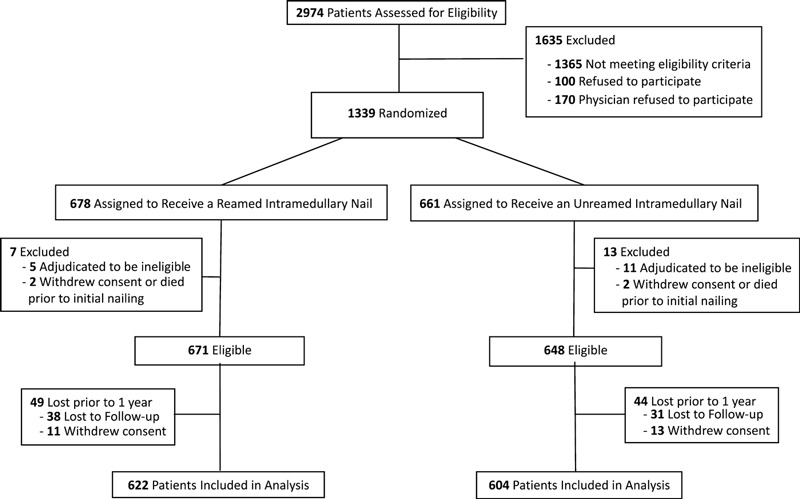
Background: Prediction of negative postoperative outcomes after long-bone fracture treatment may help to optimize patient care. We recently completed the Study to Prospectively Evaluate Reamed Intramedullary Nails in Patients with Tibial Fractures (SPRINT), a large, multicenter trial of reamed and unreamed intramedullary nailing of tibial shaft fractures in 1226 patients. Using the SPRINT data, we conducted an investigation of baseline and surgical factors to determine any associations with an increased risk of adverse events within one year of intramedullary nailing.
Methods: Using multivariable logistic regression analysis, we investigated fifteen baseline and surgical factors for any associations with an increased risk of negative outcomes.
Results: There was an increased risk of negative events in patients with a high-energy mechanism of injury (odds ratio [OR] = 1.57; 95% confidence interval [CI], 1.05 to 2.35), a stainless steel compared with a titanium nail (OR = 1.52; 95% CI, 1.10 to 2.13), a fracture gap (OR = 2.40; 95% CI, 1.47 to 3.94), and full weight-bearing status after surgery (OR = 1.63; 95% CI, 1.00 to 2.64). There was no increased risk with the use of nonsteroidal anti-inflammatory agents, late or early time to surgery, or smoking status. Open fractures had a higher risk of events among patients treated with reamed nailing (OR = 3.26; 95% CI, 2.01 to 5.28) but not in patients treated with unreamed nailing (OR = 1.50; 95% CI, 0.92 to 2.47). Patients with open fractures who had wound management either without any additional procedures or with delayed primary closure had a decreased risk of events compared with patients who required subsequent, more complex reconstruction (OR = 0.18 [95% CI, 0.09 to 0.35] and 0.29 [95% CI, 0.14 to 0.62], respectively).
Conclusions: We identified several baseline fracture and surgical characteristics that may increase the risk of adverse events in patients with tibial shaft fractures. Surgeons should consider the predictors identified in our analysis to inform patients treated for tibial shaft fractures.
Level of evidence: Prognostic Level II. See Instructions for Authors for a complete description of levels of evidence.
Figures
References
-
- Fracture and dislocation compendium Orthopaedic Trauma Association Committee for Coding and Classification. J Orthop Trauma. 1996;10 Suppl 1:v-ix, 1-154 - PubMed
-
- Anglen J. Tibial shaft fractures. : Sanders R, editor Core knowledge in orthopaedics: trauma. Philadelphia, PA: Mosby-Elsevier; 2007. p 326-43
-
- Appleton P, Court-Brown CM. Diaphyseal fractures of the tibia and fibula. : Elstrom JA, Virkus WW, Pankovich AM, Handbook of fractures. New York: McGraw-Hill; 2006. p 340-52
-
- Bhandari M, Guyatt GH, Swiontkowski MF, Schemitsch EH. Treatment of open fractures of the shaft of the tibia. J Bone Joint Surg Br. 2001 Jan;83(1):62-8 - PubMed
-
- Bhandari M, Guyatt GH, Tong D, Adili A, Shaughnessy SG. Reamed versus nonreamed intramedullary nailing of lower extremity long bone fractures: a systematic overview and meta-analysis. J Orthop Trauma. 2000 Jan;14(1):2-9 - PubMed
Publication types
MeSH terms
Grants and funding
LinkOut - more resources
Full Text Sources
Medical
Research Materials
Miscellaneous
