Clinical Trial
. 2012 Dec 15;18(24):6758-70.
doi: 10.1158/1078-0432.CCR-12-1177. Epub 2012 Oct 2.

Specific lymphocyte subsets predict response to adoptive cell therapy using expanded autologous tumor-infiltrating lymphocytes in metastatic melanoma patients

Affiliations
Clinical Trial

Specific lymphocyte subsets predict response to adoptive cell therapy using expanded autologous tumor-infiltrating lymphocytes in metastatic melanoma patients

Laszlo G Radvanyi et al. Clin Cancer Res. .

Abstract

Purpose: Adoptive cell therapy (ACT) using autologous tumor-infiltrating lymphocytes (TIL) is a promising treatment for metastatic melanoma unresponsive to conventional therapies. We report here on the results of an ongoing phase II clinical trial testing the efficacy of ACT using TIL in patients with metastatic melanoma and the association of specific patient clinical characteristics and the phenotypic attributes of the infused TIL with clinical response.

Experimental design: Altogether, 31 transiently lymphodepleted patients were treated with their expanded TIL, followed by two cycles of high-dose interleukin (IL)-2 therapy. The effects of patient clinical features and the phenotypes of the T cells infused on the clinical response were determined.

Results: Overall, 15 of 31 (48.4%) patients had an objective clinical response using immune-related response criteria (irRC) with 2 patients (6.5%) having a complete response. Progression-free survival of more than 12 months was observed for 9 of 15 (60%) of the responding patients. Factors significantly associated with the objective tumor regression included a higher number of TIL infused, a higher proportion of CD8(+) T cells in the infusion product, a more differentiated effector phenotype of the CD8(+) population, and a higher frequency of CD8(+) T cells coexpressing the negative costimulation molecule "B- and T-lymphocyte attenuator" (BTLA). No significant difference in the telomere lengths of TIL between responders and nonresponders was identified.

Conclusion: These results indicate that the immunotherapy with expanded autologous TIL is capable of achieving durable clinical responses in patients with metastatic melanoma and that CD8(+) T cells in the infused TIL, particularly differentiated effectors cells and cells expressing BTLA, are associated with tumor regression.


Figures
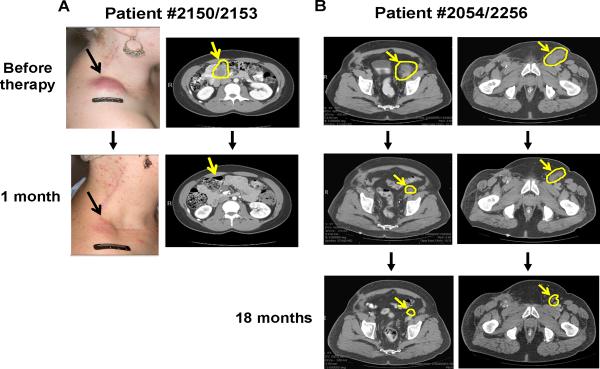
Fig. 1
Fig. 1. Objective tumor regression in patients receiving autologous TIL therapy
CT scans and photos of two representative patients (#2150/2153 and #2054/2256) before and after TIL therapy at different time points. Changes in a large subcutaneous mass in the right shoulder and of a large inguinal lymph node lesion after 1 month are shown for Patient #2150/2153 (A). Changes are shown in abdominal tumors after 1 month and 18 months post TIL infusion in Patient #2054/2256 (B).
Fig. 2
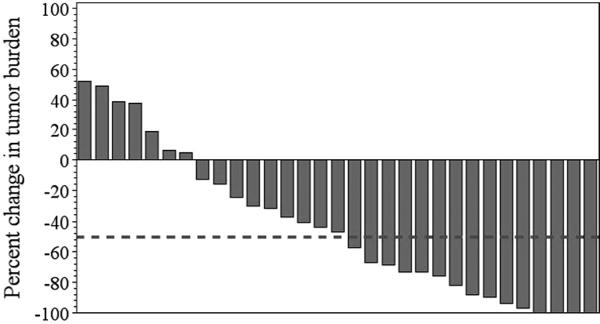
Fig. 2. Waterfall plot of percent change in measureable tumor burden in all treated patients (n=31)
The patients were treated between August 23, 2007 and October 6, 2010. Clinical responses were evaluated using the irRC criteria from whole body CT scans, as described in the Materials and Methods section. The percent change in tumor burden using the best overall irRC response after TIL infusion is shown for all patients. The dotted line indicates the −50% tumor burden reduction point needed to reach an objective clinical response according to irRC. Of the 15 patients who responded, 12 had ≥70% reduction in their tumor burden and 4 patients had a 100% reduction in measureable tumor burden. Two patients had non-measureable bony lesions that remained stable throughout the study period. This was not accounted for in determining the change in tumor burden shown.
Fig. 3
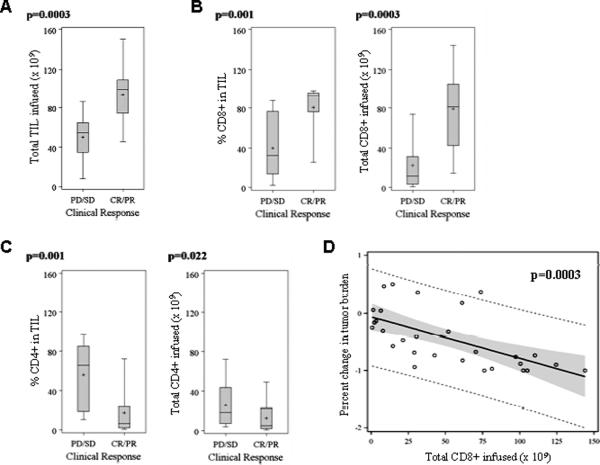
Fig. 3. Comparison of total cells infused and major T-cell subsets in the infused TIL product between responders and non-responders
Comparison of total TIL infused (A), the percentage and total number of infused CD8+ T cells (B), and the percentage and total number of CD4+ T cells (C) between responders and non-responders. Linear regression showing the relationship between total CD8+ infused and percentage change in tumor burden (p=0.0003), with the solid line in showing the best fit, the broken line representing the 95% prediction limits, and the grey area indicating the 95% confidence limits (D).
Fig. 4
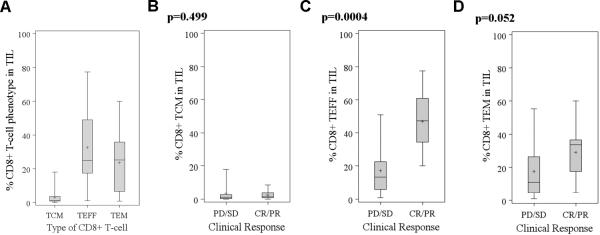
Fig. 4. Comparison of CD8+ T-cell memory phenotype in responders and non-responders
The percentage of TCM, TEM, and TEFF in the CD8+ TIL subset in all treated patients (A). Wilcoxon rank-sum tests showed significant differences at α=0.001 between the percentage of %CD8+ TIL between TCM and TEFF (p<0.0001) and TCM and TEM (p<0.0001). In the subsequent panels, the percentage of CD8+ T cells with a TCM (B), TEM (C), and TEFF (D) in the infused TIL was compared between responders and non-responders.
Fig. 5
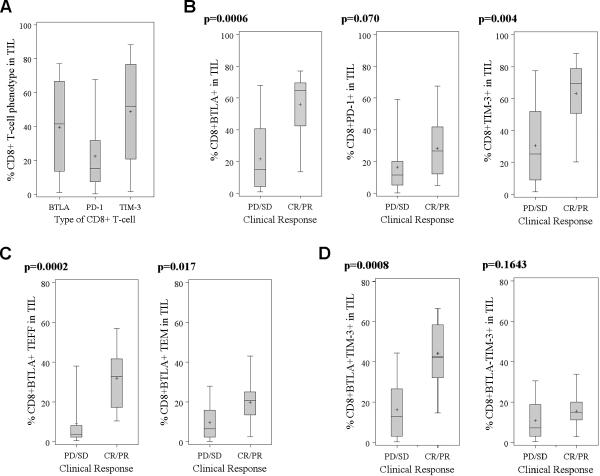
Fig. 5. Comparison of PD-1, BTLA, and TIM-3 on CD8+ TIL in responders and non-responders
The percentage of cells in the total CD8+ TIL population expressing PD-1, BTLA, and TIM-3 in all treated patients (A). Wilcoxon rank-sum tests showed significant differences at α=0.001 between the percentage of CD8+ TIL between PD-1 and TIM-3 (p=0.0006). The percentage of CD8+PD-1+, CD8+BTLA+, and CD8+TIM-3+ expression in the infused TIL was compared between responders and non-responders (B). The percentage of CD8+BTLA+ T cells in the infused TIL with a TEFF or TEM phenotype was compared between responders and non-responders (C). The percentage of CD8+TIM-3+ T cells in the infused TIL with or without BTLA co-expression was compared between responders and non-responders (D).

References

    1. Trinh VA. Current management of metastatic melanoma. Am J Health Syst Pharm. 2008;65:S3–8. - PubMed
    1. Quirt I, Verma S, Petrella T, Bak K, Charette M. Temozolomide for the treatment of metastatic melanoma: a systematic review. Oncologist. 2007;12:1114–23. - PubMed
    1. Fecher LA, Amaravadi RK, Flaherty KT. The MAPK pathway in melanoma. Curr Opin Oncol. 2008;20:183–9. - PubMed
    1. Flaherty KT, McArthur G. BRAF, a target in melanoma: implications for solid tumor drug development. Cancer. 2010;116:4902–13. - PubMed
    1. Flaherty KT, Yasothan U, Kirkpatrick P. Vemurafenib. Nat Rev Drug Discov. 10:811–2. - PubMed

Publication types

MeSH terms