


Adherence to a Mediterranean diet and Alzheimer's disease risk in an Australian population
- PMID: 23032941
- PMCID: PMC3565821
- DOI: 10.1038/tp.2012.91
Adherence to a Mediterranean diet and Alzheimer's disease risk in an Australian population
Abstract
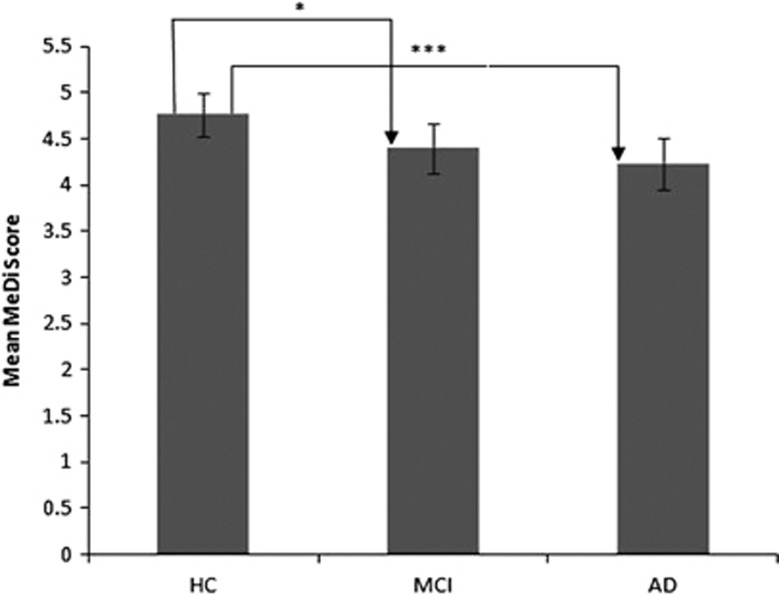
The Mediterranean diet (MeDi), due to its correlation with a low morbidity and mortality for many chronic diseases, has been widely recognised as a healthy eating model. We aimed to investigate, in a cross-sectional study, the association between adherence to a MeDi and risk for Alzheimer's disease (AD) and mild cognitive impairment (MCI) in a large, elderly, Australian cohort. Subjects in the Australian Imaging, Biomarkers and Lifestyle Study of Ageing cohort (723 healthy controls (HC), 98 MCI and 149 AD participants) completed the Cancer Council of Victoria Food Frequency Questionnaire. Adherence to the MeDi (0- to 9-point scale with higher scores indicating higher adherence) was the main predictor of AD and MCI status in multinominal logistic regression models that were adjusted for cohort age, sex, country of birth, education, apolipoprotein E genotype, total caloric intake, current smoking status, body mass index, history of diabetes, hypertension, angina, heart attack and stroke. There was a significant difference in adherence to the MeDi between HC and AD subjects (P < 0.001), and in adherence between HC and MCI subjects (P < 0.05). MeDi is associated with change in Mini-Mental State Examination score over an 18-month time period (P < 0.05) in HCs. We conclude that in this Australian cohort, AD and MCI participants had a lower adherence to the MeDi than HC participants.
Figures
References
Publication types
MeSH terms
Grants and funding
LinkOut - more resources
Full Text Sources
Medical
Molecular Biology Databases
