


Closed-loop insulin therapy improves glycemic control in children aged <7 years: a randomized controlled trial
- PMID: 23033237
- PMCID: PMC3554296
- DOI: 10.2337/dc12-1079
Closed-loop insulin therapy improves glycemic control in children aged <7 years: a randomized controlled trial
Abstract
Objective: To assess the possibility of improving nocturnal glycemic control as well as meal glycemic response using closed-loop therapy in children aged <7 years.
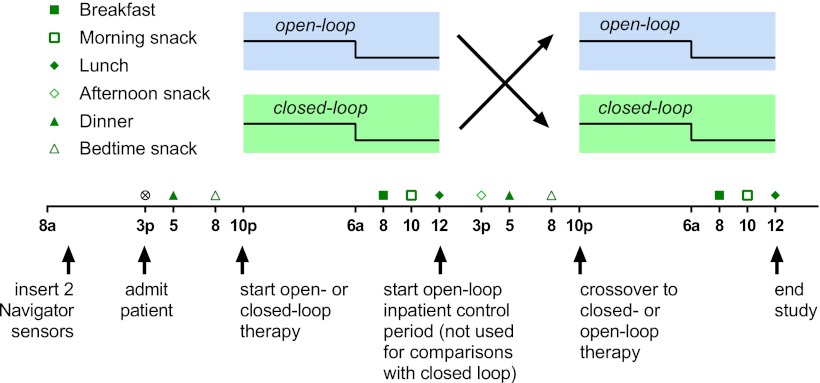
Research design and methods: This was a randomized controlled crossover trial comparing closed-loop with standard open-loop insulin pump therapy performed in an inpatient clinical research center. Ten subjects aged <7 years with type 1 diabetes for >6 months treated with insulin pump therapy were studied. Closed-loop therapy and standard open-loop therapy were compared from 10:00 p.m. to 12:00 p.m. on 2 consecutive days. The primary outcome was plasma glucose time in range (110-200 mg/dL) during the night (10:00 p.m.-8:00 a.m.). Secondary outcomes included peak postprandial glucose levels, incidence of hypoglycemia, degree of hyperglycemia, and prelunch glucose levels.
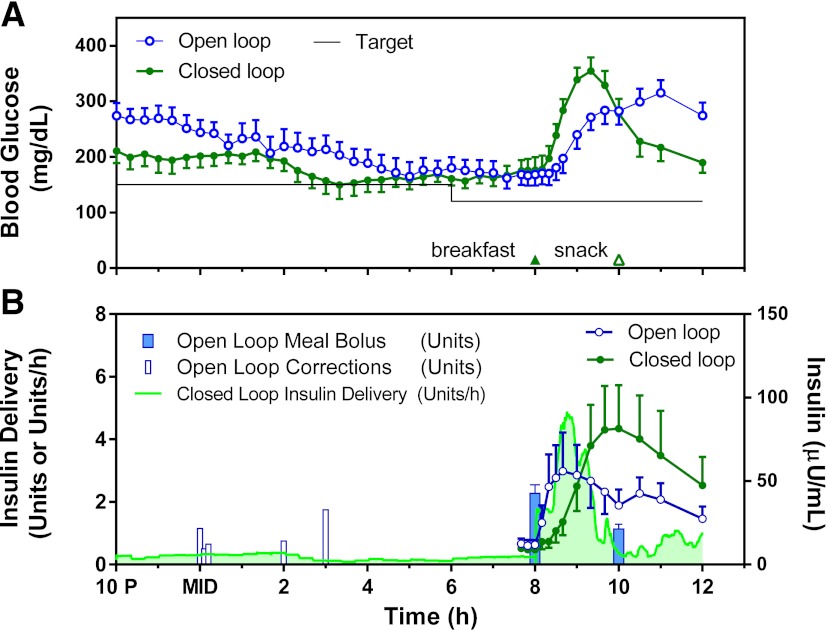
Results: A trend toward a higher mean nocturnal time within target range was noted for closed- versus open-loop therapy, although not reaching statistical significance (5.3 vs. 3.2 h, P = 0.12). There was no difference in peak postprandial glucose or number of episodes of hypoglycemia. There was significant improvement in time spent >300 mg/dL overnight with closed-loop therapy (0.18 vs. 1.3 h, P = 0.035) and the total area under the curve of glucose >200 mg/dL (P = 0.049). Closed-loop therapy returned prelunch blood glucose closer to target (189 vs. 273 mg/dL on open loop, P = 0.009).
Conclusions: Closed-loop insulin delivery decreases the severity of overnight hyperglycemia without increasing the incidence of hypoglycemia. The therapy is better able to reestablish target glucose levels in advance of a subsequent meal. Younger children with type 1 diabetes may reap significant benefits from closed-loop therapy.
Trial registration: ClinicalTrials.gov NCT01421225.
Figures
References
-
- The Diabetes Control and Complications Trial Research Group The effect of intensive treatment of diabetes on the development and progression of long-term complications in insulin-dependent diabetes mellitus. N Engl J Med 1993;329:977–986 - PubMed
-
- Hovorka R. Closed-loop insulin delivery: from bench to clinical practice. Nat Rev Endocrinol 2011;7:385–395 - PubMed
-
- Hovorka R, Allen JM, Elleri D, et al. Manual closed-loop insulin delivery in children and adolescents with type 1 diabetes: a phase 2 randomised crossover trial. Lancet 2010;375:743–751 - PubMed
