


Animal use and lessons learned in the U.S. High Production Volume Chemicals Challenge Program
- PMID: 23033452
- PMCID: PMC3548278
- DOI: 10.1289/ehp.1104666
Animal use and lessons learned in the U.S. High Production Volume Chemicals Challenge Program
Abstract
Background: Launched by the U.S. Environmental Protection Agency (EPA) in 1998, the High Production Volume (HPV) Challenge Program was developed to address the perceived gap in basic hazard information for the 2,800 chemicals produced or imported into the United States in quantities of ≥ 1 million pounds per year. Health and environmental effects data obtained from either existing information or through new vertebrate animal testing were voluntarily submitted by chemical companies (sponsors) to the U.S. EPA. Despite the potential for extensive animal testing, animal welfare guidelines were not provided until after the start of the program.
Objectives: We evaluated compliance with the animal welfare principles that arose from an agreement reached between the U.S. EPA and animal protection organizations and tracked the HPV program's use of animals for testing.
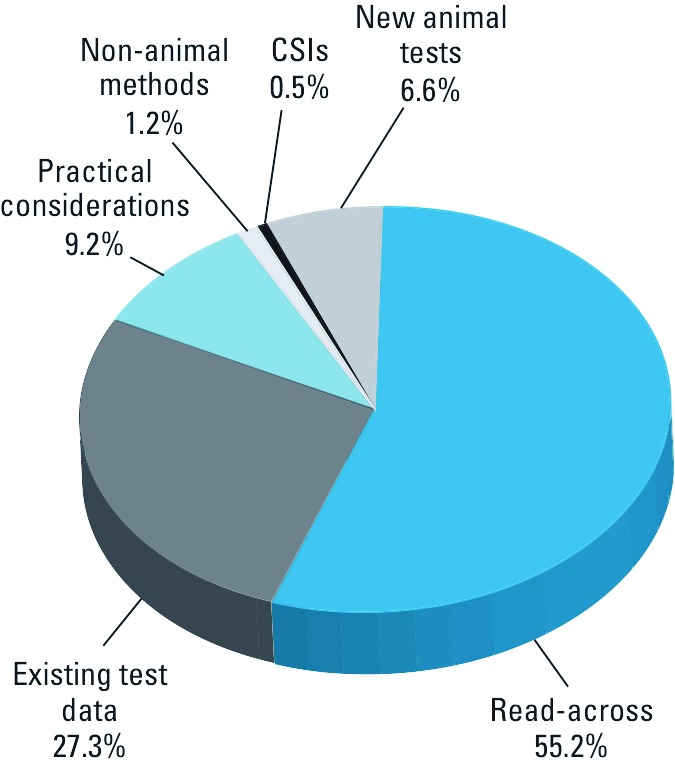
Discussion: Under a worst-case scenario, the HPV program had the potential to consume 3.5 million animals in new testing. After application of animal-saving measures, approximately 127,000 were actually used. Categorization of chemicals based on similar structure-activity and application of read-across, along with use of existing test data, were the most effective means of reducing animal testing. However, animal-saving measures were inconsistently used by both sponsors and the U.S. EPA.
Conclusions: Lessons learned from the HPV program can be applied to future programs to minimize animal testing and promote more human-relevant chemical risk assessment.
Conflict of interest statement
The authors are employees or consultants of PETA, a nonprofit organization that advocates for the replacement, reduction, and refinement of the use of animals in scientific endeavors, including chemical safety testing.
Figures
References
-
- ACC (American Chemistry Council) High Production Volume (HPV) Chemical Challenge Program: Test Plan for the Fuel Oils Category. 2001. Available: http://www.epa.gov/hpv/pubs/summaries/fueloils/c13435tp.pdf [accessed 8 June 2012]
-
- ACC (American Chemistry Council) Appendix II: Robust Summaries of Studies Used to Characterize the Fuel Oils Category. 2005. Available: http://www.epa.gov/HPV/pubs/summaries/fueloils/c13435rr3.pdf [accessed 8 June 2012]
-
- ACC (American Chemistry Council) Comments of the American Chemistry Council on Certain High Production Volume Chemicals; Test Rule and Significant New Use Rule; Fourth Group of Chemicals; Notice of Proposed Rulemaking; EPA Docket No. EPA-HQ-OPPT-2010-0520. 2012. Available: http://www.regulations.gov/#!documentDetail;D=EPA-HQ-OPPT-2010-0520-0056 [accessed 28 June 2012]
-
- BPD/BPA Coalition. BPD (Benzene Phosphorous Dichloride) and BPA (Benzene Phosphinic Acid) HPV Test Plan. 2003. Available: http://www.epa.gov/HPV/pubs/summaries/bnphosdi/c14874tp.pdf [accessed 5 June 2012]
-
- BPD/BPA Coalition. BPA (Benzene Phosphinic Acid) Robust Summaries. 2004. Available: http://www.epa.gov/hpv/pubs/summaries/bnphosdi/c14874rr.pdf [accessed 5 June 2012]
Publication types
MeSH terms
Substances
LinkOut - more resources
Full Text Sources
Research Materials
Miscellaneous