


Dietary intake and dietary quality of low-income adults in the Supplemental Nutrition Assistance Program
- PMID: 23034960
- PMCID: PMC3471209
- DOI: 10.3945/ajcn.112.040014
Dietary intake and dietary quality of low-income adults in the Supplemental Nutrition Assistance Program
Abstract
Background: The Supplemental Nutrition Assistance Program (SNAP) aims to alleviate hunger among its beneficiaries by providing benefits to purchase nutritious foods.
Objective: We conducted a comprehensive dietary analysis of low-income adults and examined differences in dietary intake between SNAP participants and nonparticipants.
Design: The study population comprised 3835 nonelderly adults with a household income ≤130% of the federal poverty level from the 1999-2008 NHANES. The National Cancer Institute method was used to estimate the distributions of usual intake for dietary outcomes. Relative differences in dietary intake by SNAP participation were estimated with adjustment for sociodemographic characteristics and household food security.
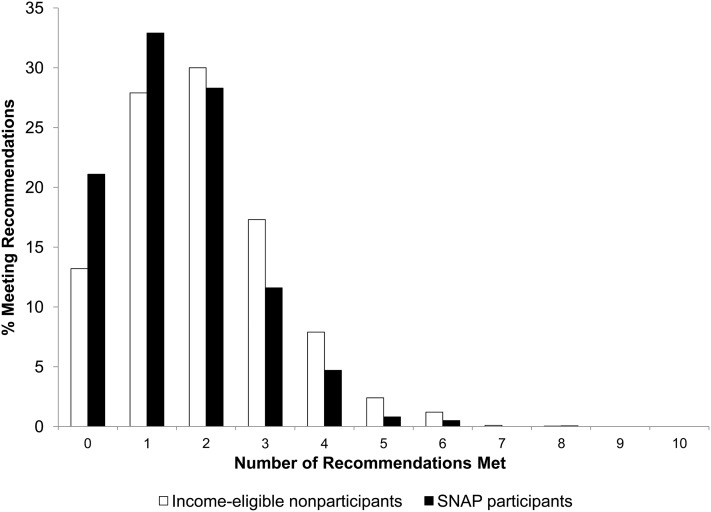
Results: Few low-income adults consumed recommended amounts of whole grains, fruit, vegetables, fish, and nuts/seeds/legumes. Conversely, many low-income adults exceeded recommended limits for processed meats, sweets, and bakery desserts and sugar-sweetened beverages. Approximately 13-22% of low-income adults did not meet any food and nutrient guidelines; virtually no adults met all of the guidelines. Compared with nonparticipants, SNAP participants consumed 39% fewer whole grains (95% CI: -57%, -15%), 44% more 100% fruit juice (95% CI: 0%, 107%), 56% more potatoes (95% CI: 18%, 106%), 46% more red meat (95% CI: 4%, 106%), and, in women, 61% more sugar-sweetened beverages (95% CI: 3%, 152%). SNAP participants also had lower dietary quality scores than did nonparticipants, as measured by a modified Alternate Healthy Eating Index.
Conclusion: Although the diets of all low-income adults need major improvement, SNAP participants in particular had lower-quality diets than did income-eligible nonparticipants.
Figures
References
-
- USDA FNS Supplemental Nutrition Assistance Program. Washington, DC: Food and Nutrition Service, USDA, 2010
-
- Eligibility. Supplemental Nutrition Assistance Program: Food and Nutrition Services, US Department of Agriculture, 2011.
-
- USDA Supplemental Nutrition Assistance Program participation and costs. Washington, DC: Food and Nutrition Service, USDA, 2012
-
- USDA. USDA Food and Nutrition Service Program quick facts—Supplemental Nutrition Assistance Program (SNAP). Washington, DC: Food and Nutrition Service, USDA, 2011.
-
- USDA. SNAP name change. Washington, DC: Food and Nutrition Service, USDA, 2011.
Publication types
MeSH terms
Grants and funding
LinkOut - more resources
Full Text Sources
Miscellaneous
