. 2012 Dec;86(24):13515-23.
doi: 10.1128/JVI.01824-12. Epub 2012 Oct 3.

Critical role for interferon regulatory factor 3 (IRF-3) and IRF-7 in type I interferon-mediated control of murine norovirus replication

Affiliations

Critical role for interferon regulatory factor 3 (IRF-3) and IRF-7 in type I interferon-mediated control of murine norovirus replication

Larissa B Thackray et al. J Virol. 2012 Dec.

Abstract

Human noroviruses (HuNoV) are the major cause of epidemic, nonbacterial gastroenteritis in the world. The short course of HuNoV-induced symptoms has implicated innate immunity in control of norovirus (NoV) infection. Studies using murine norovirus (MNV) confirm the importance of innate immune responses during NoV infection. Type I alpha and beta interferons (IFN-α/β) limit HuNoV replicon function, restrict MNV replication in cultured cells, and control MNV replication in vivo. Therefore, the cell types and transcription factors involved in antiviral immune responses and IFN-α/β-mediated control of NoV infection are important to define. We used mice with floxed alleles of the IFNAR1 chain of the IFN-α/β receptor to identify cells expressing lysozyme M or CD11c as cells that respond to IFN-α/β to restrict MNV replication in vivo. Furthermore, we show that the transcription factors IRF-3 and IRF-7 work in concert to initiate unique and overlapping antiviral responses to restrict MNV replication in vivo. IRF-3 and IRF-7 restrict MNV replication in both cultured macrophages and dendritic cells, are required for induction of IFN-α/β in macrophages but not dendritic cells, and are dispensable for the antiviral effects of IFN-α/β that block MNV replication. These studies suggest that expression of the IFN-α/β receptor on macrophages/neutrophils and dendritic cells, as well as of IRF-3 and IRF-7, is critical for innate immune responses to NoV infection.


Figures
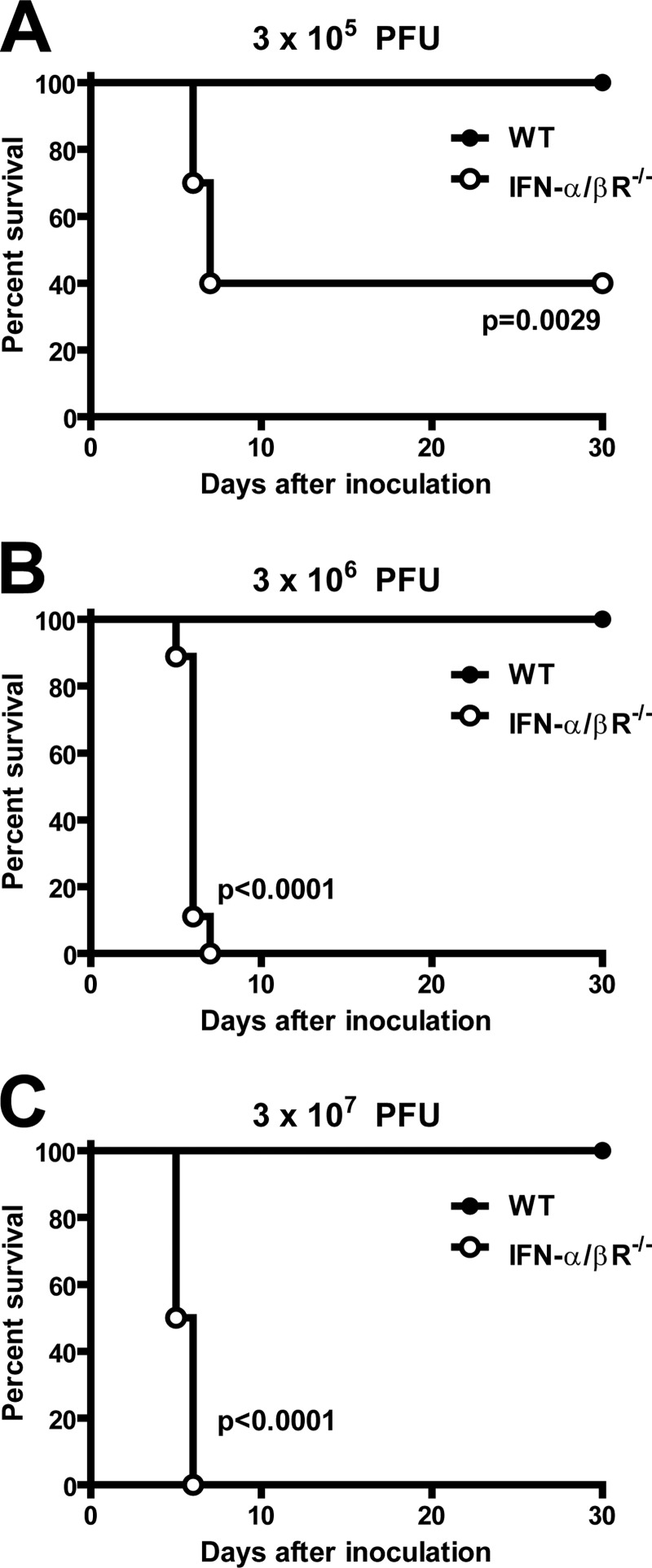
Fig 1
Fig 1
IFN-α/β responses prevent lethal MNV infection. Wild-type (WT) and IFN-α/βR−/− mice were inoculated with the indicated doses of MNV, and survival was recorded for two independent experiments of five mice each. Statistical significance was determined using the log-rank test.
Fig 2
Fig 2
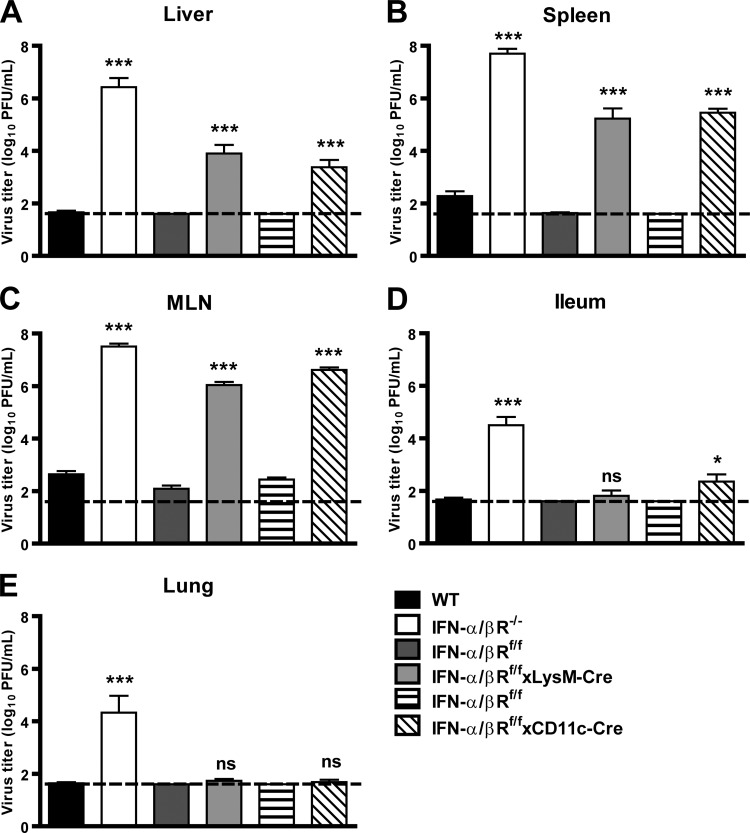
IFN-α/β responses restrict MNV replication in vivo. WT, IFN-α/βR−/−, IFN-α/βRf/f, IFN-α/βRf/f × LysM-Cre, and IFN-α/βRf/f × CD11c-Cre mice were inoculated with 3 × 10⁵ PFU of MNV and tissues were harvested 3 days postinfection (dpi). MLN, mesenteric lymph node. Data are the means and standard errors of the means from at least two independent experiments of at least four mice each. The dashed line represents the limit of detection. Titers from IFN-α/βR−/− mice were compared with those from wild-type controls; titers from IFN-α/βRf/f × LysM-Cre and IFN-α/βRf/f × CD11c-Cre mice were compared with those from IFN-α/βRf/f controls. Statistical significance was determined using the nonparametric Mann-Whitney test. ns, not significant; *, P < 0.05; **, P < 0.01; ***, P < 0.005.
Fig 3
Fig 3
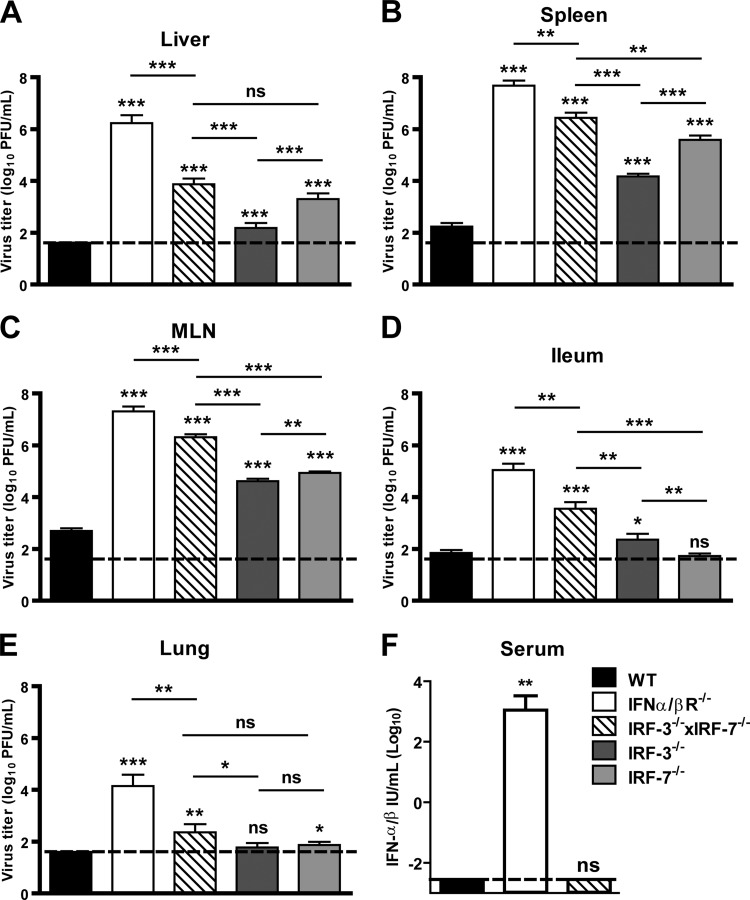
IRF-3 and IRF-7 restrict MNV replication in vivo. (A to E) WT, IFN-α/βR−/−, IRF-3−/− × IRF-7−/−, IRF-3−/− and IRF-7−/− mice were inoculated with 3 × 10⁵ PFU of MNV, and tissues were harvested 3 dpi. Virus titers shown are from three independent experiments of at least three mice each. Titers were compared with those from wild-type controls. ns, not significant; *, P < 0.05; **, P < 0.01; ***, P < 0.005. (F) WT, IRF-3−/− × IRF-7−/−, and IFN-α/βR−/− mice were mock inoculated or inoculated with 3 × 10⁵ PFU of MNV, and serum was harvested 3 dpi. Data are from two independent experiments of three mice each. Serum concentrations were compared with those from wild-type controls. Statistical significance was determined using the Mann-Whitney test. ns, not significant; **, P = 0.0043.
Fig 4
Fig 4
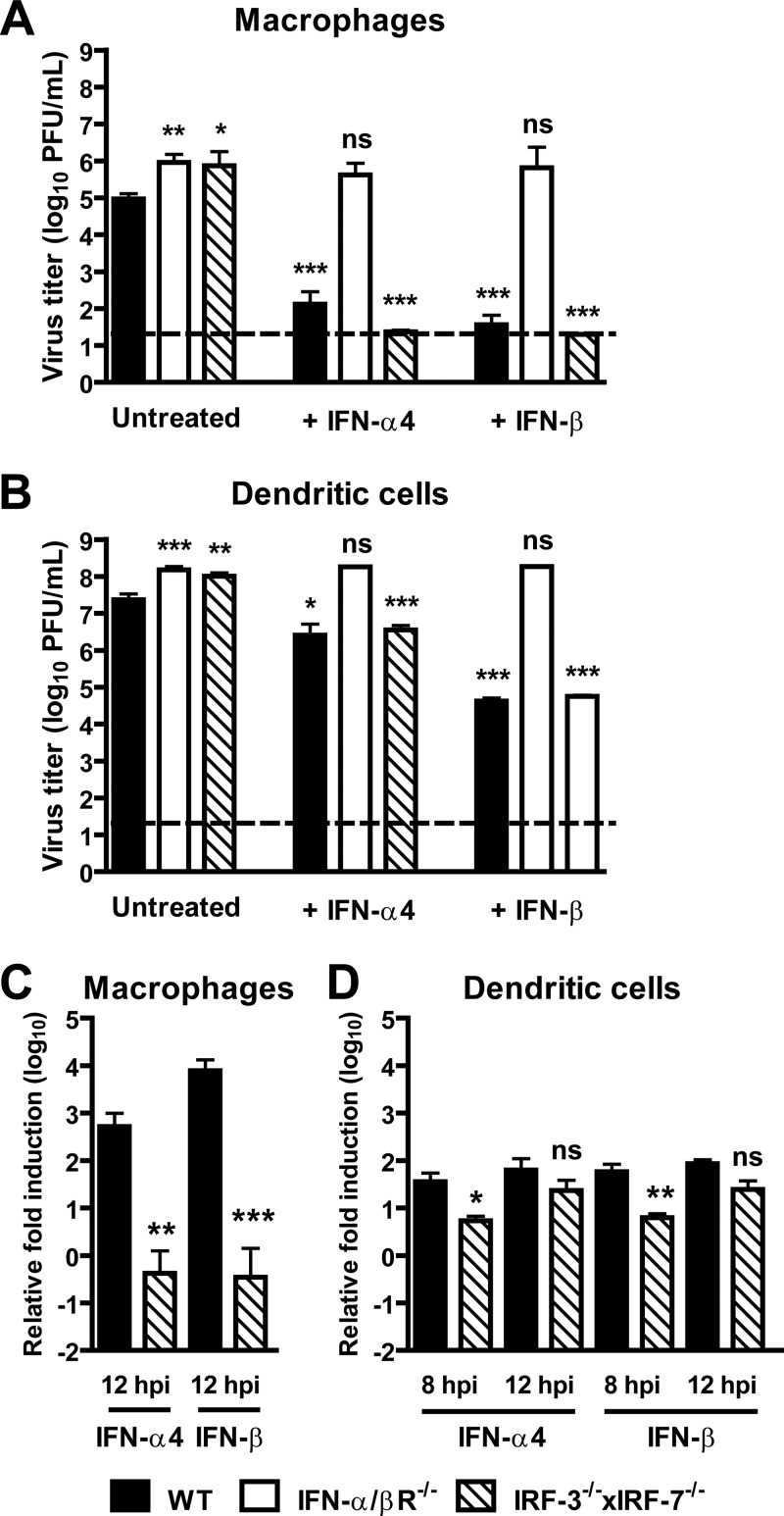
IRF-3 and IRF-7 are required for IFN-α/β induction during MNV infection but are dispensable for the antiviral activity of IFN-α/β. (A) Primary bone marrow-derived macrophages (macrophages) from WT, IRF-3−/− ×IRF-7−/−, and IFN-α/βR−/− mice were untreated or treated with recombinant IFN-α4 or recombinant IFN-β and inoculated with MNV (MOI of 0.05). Titers at 48 hpi are the mean and the standard error of the mean from four independent experiments. Titers from untreated IRF-3−/− × IRF-7−/− and IFN-α/βR−/− macrophages were compared with those from wild-type controls; titers from IFN-α4 or IFN-β treated wild-type, IRF-3−/− × IRF-7−/−, and IFN-α/βR−/− macrophages were compared with those from untreated controls. Statistical significance was determined using the unpaired t test. ns, not significant; *, P < 0.05; **, P < 0.01; ***, P < 0.005. (B) Primary bone-derived dendritic cells from WT, IRF-3−/− × IRF-7−/−, and IFN-α/βR−/− mice were untreated or treated with recombinant IFN-α4 or recombinant IFN-β and inoculated with MNV (MOI of 0.05). Virus titers at 24 hpi are from at least three independent experiments. Titers from untreated IRF-3−/− × IRF-7−/− and IFN-α/βR−/− dendritic cells were compared with those from wild-type controls; titers from IFN-α4 or IFN-β-treated wild-type, IRF-3−/− × IRF-7−/−, and IFN-α/βR−/− dendritic cells were compared with those from untreated controls. (C) Macrophages from WT and IRF-3−/− × IRF-7−/− mice were mock inoculated or inoculatedwith MNV (MOI of 10). Induction of IFN-α4 and IFN-β mRNA levels at 12 hpi was normalized to 18S RNA levels and calculated using the ΔΔCT method. Relative induction was determined from four independent experiments and compared to induction in wild-type controls. Statistical significance was determined using the unpaired t test. (D) Dendritic cells from WT and IRF-3−/− × IRF-7−/− mice were mock inoculated or inoculated with MNV (MOI of 10). Induction of IFN-α4 and IFN-β mRNA levels at 8 and 12 hpi was normalized to 18S RNA levels and calculated using the ΔΔCT method. Relative induction was determined from three independent experiments and compared to induction in wild-type controls.

References

    1. Abraham AK, Kagan L, Kumar S, Mager DE. 2010. Type I interferon receptor is a primary regulator of target-mediated drug disposition of interferon-beta in mice. J. Pharmacol. Exp. Ther. 334:327–332 - PMC - PubMed
    1. Atmar RL, et al. 2011. Norovirus vaccine against experimental human Norwalk virus illness. N. Engl. J. Med. 365:2178–2187 - PMC - PubMed
    1. Atmar RL, et al. 2008. Norwalk virus shedding after experimental human infection. Emerg. Infect. Dis. 14:1553–1557 - PMC - PubMed
    1. Au WC, Moore PA, Lafleur DW, Tombal B, Pitha PM. 1998. Characterization of the interferon regulatory factor-7 and its potential role in the transcription activation of interferon A genes. J. Biol. Chem. 273:29210–29217 - PubMed
    1. Bok K, et al. 2011. Chimpanzees as an animal model for human norovirus infection and vaccine development. Proc. Natl. Acad. Sci. U. S. A. 108:325–330 - PMC - PubMed

Publication types