


Toward attenuating the impact of arm positions on electromyography pattern-recognition based motion classification in transradial amputees
- PMID: 23036049
- PMCID: PMC3551659
- DOI: 10.1186/1743-0003-9-74
Toward attenuating the impact of arm positions on electromyography pattern-recognition based motion classification in transradial amputees
Abstract
Background: Electromyography (EMG) pattern-recognition based control strategies for multifunctional myoelectric prosthesis systems have been studied commonly in a controlled laboratory setting. Before these myoelectric prosthesis systems are clinically viable, it will be necessary to assess the effect of some disparities between the ideal laboratory setting and practical use on the control performance. One important obstacle is the impact of arm position variation that causes the changes of EMG pattern when performing identical motions in different arm positions. This study aimed to investigate the impacts of arm position variation on EMG pattern-recognition based motion classification in upper-limb amputees and the solutions for reducing these impacts.
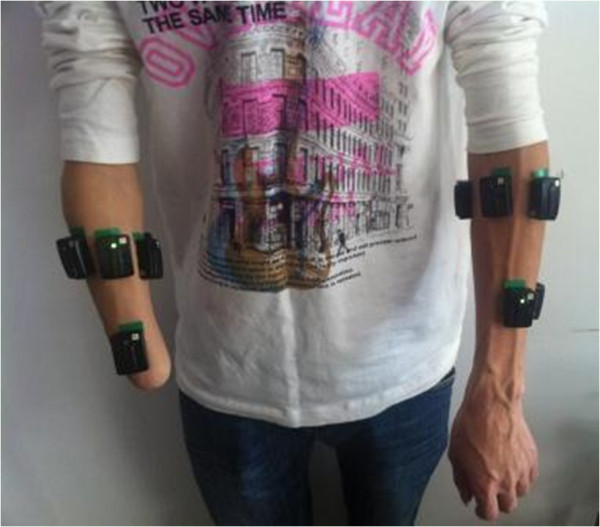
Methods: With five unilateral transradial (TR) amputees, the EMG signals and tri-axial accelerometer mechanomyography (ACC-MMG) signals were simultaneously collected from both amputated and intact arms when performing six classes of arm and hand movements in each of five arm positions that were considered in the study. The effect of the arm position changes was estimated in terms of motion classification error and compared between amputated and intact arms. Then the performance of three proposed methods in attenuating the impact of arm positions was evaluated.
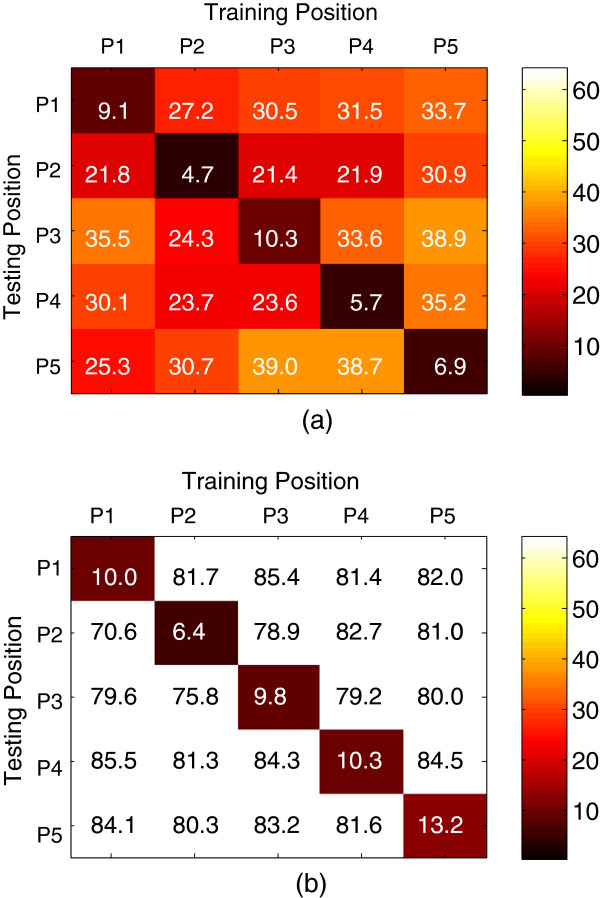
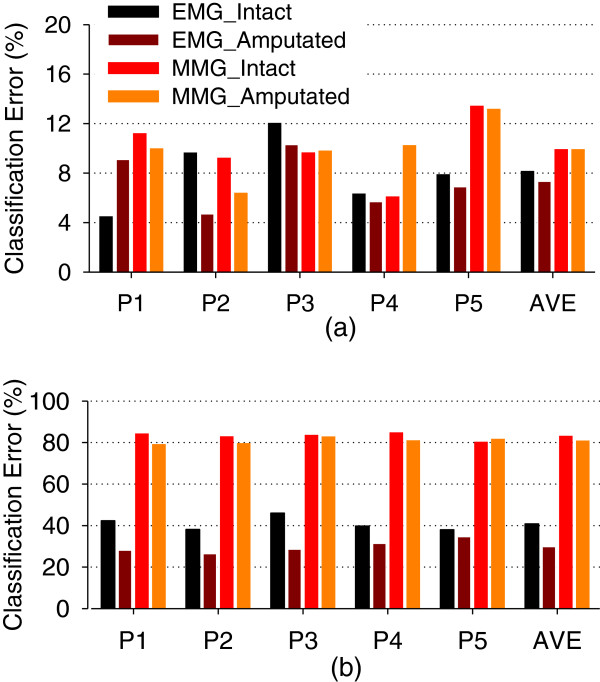
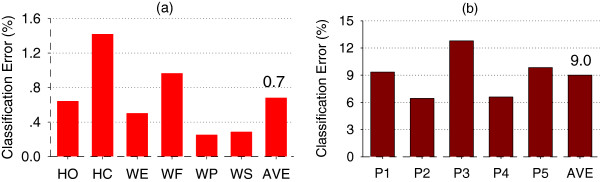
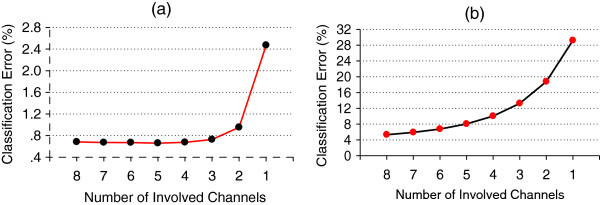
Results: With EMG signals, the average intra-position and inter-position classification errors across all five arm positions and five subjects were around 7.3% and 29.9% from amputated arms, respectively, about 1.0% and 10% low in comparison with those from intact arms. While ACC-MMG signals could yield a similar intra-position classification error (9.9%) as EMG, they had much higher inter-position classification error with an average value of 81.1% over the arm positions and the subjects. When the EMG data from all five arm positions were involved in the training set, the average classification error reached a value of around 10.8% for amputated arms. Using a two-stage cascade classifier, the average classification error was around 9.0% over all five arm positions. Reducing ACC-MMG channels from 8 to 2 only increased the average position classification error across all five arm positions from 0.7% to 1.0% in amputated arms.
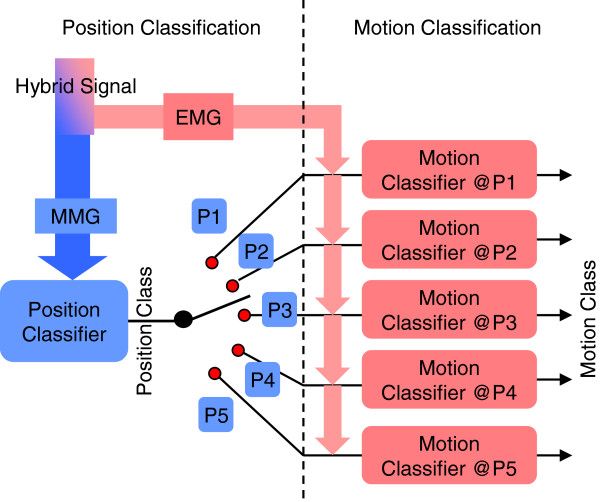
Conclusions: The performance of EMG pattern-recognition based method in classifying movements strongly depends on arm positions. This dependency is a little stronger in intact arm than in amputated arm, which suggests that the investigations associated with practical use of a myoelectric prosthesis should use the limb amputees as subjects instead of using able-body subjects. The two-stage cascade classifier mode with ACC-MMG for limb position identification and EMG for limb motion classification may be a promising way to reduce the effect of limb position variation on classification performance.
Figures


References
-
- Parker PA, Scott RN. Myoelectric control of prostheses. Crit Rev Biomed Eng. 1986;13:283–310. - PubMed
Publication types
MeSH terms
LinkOut - more resources
Full Text Sources
Other Literature Sources
