


Postacute rehabilitation care for hip fracture: who gets the most care?
- PMID: 23036079
- PMCID: PMC3470736
- DOI: 10.1111/j.1532-5415.2012.04149.x
Postacute rehabilitation care for hip fracture: who gets the most care?
Abstract
Objectives: To determine the extent to which demographic and geographic disparities exist in postacute rehabilitation care (PARC) use after hip fracture.
Design: Cross-sectional analysis of 2 years (2005-06) of population-based hospital discharge data.
Setting: All short-term acute care hospitals in four demographically and geographically diverse states (AZ, FL, NJ, WI).
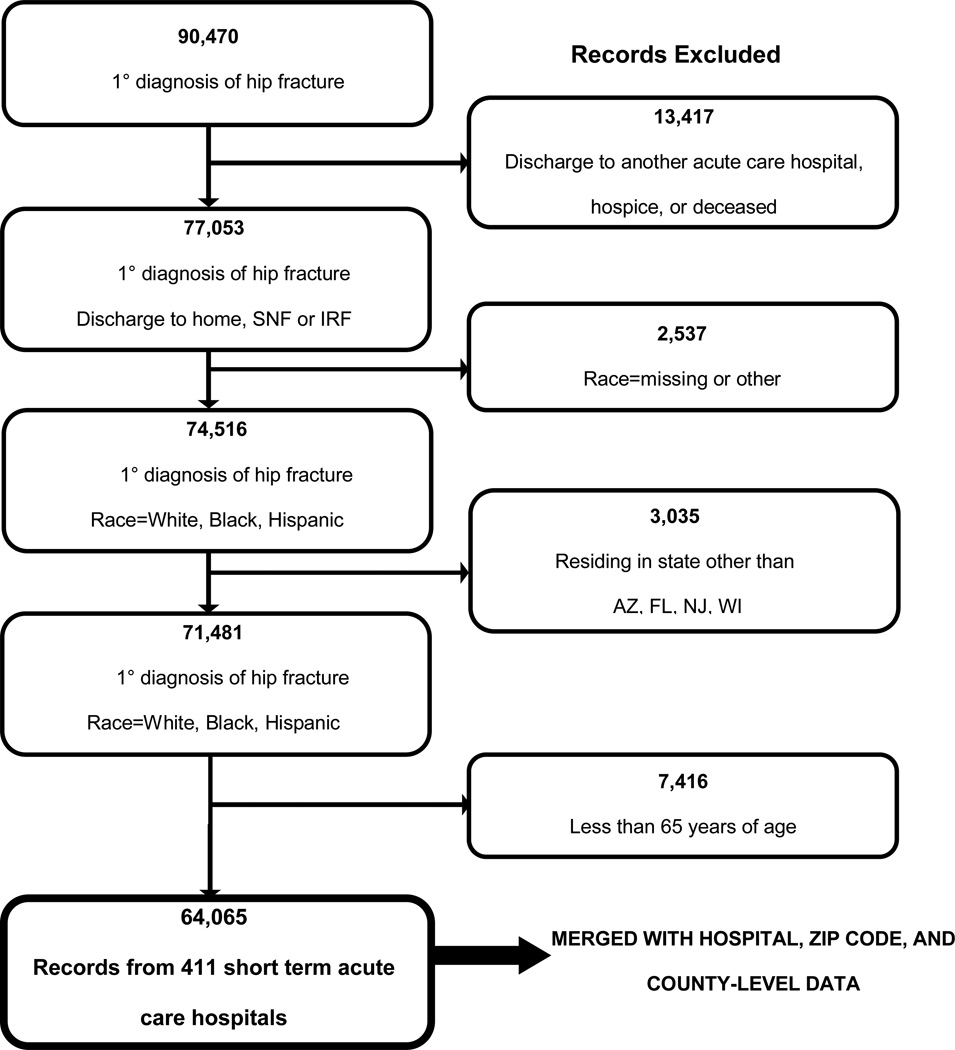
Participants: Individuals aged 65 and older (mean 82.9) admitted to the hospital with a hip fracture who survived their inpatient stay (N = 64,065). The sample was 75.1% female and 91.5% white, 5.8% Hispanic, and 2.7% black.
Measurements: Whether the participant received institutional PARC; for participants who did not receive institutional care, whether they received home health (HH) care; and for participants who received institutional care, whether they received skilled nursing facility (SNF) or inpatient rehabilitation facility (IRF) care. Multilevel logistic regression analyses were conducted to identify demographic and geographic disparities in PARC use.
Results: Considering PARC on a continuum from more to fewer hours of care per day (IRF→SNF→HH→no HH), minorities and individuals of lower socioeconomic status (SES) generally received a lower volume of care. Individuals on Medicaid or who were uninsured were less likely to receive institutional care (odds ratio (OR) = 0.23, 95% confidence interval (CI) = 0.18-0.30) and to receive HH (OR = 0.46, 95% CI = 0.30-0.70) and more likely to receive SNF than IRF care (OR = 2.03, 95% CI = 1.36-3.05). Hispanics were less likely to receive institutional care (OR = 0.70, 95% CI = 0.62-0.79), and Hispanics (OR = 1.31) and blacks (OR = 1.49) were more likely to receive SNF than IRF care. There were also geographic differences in PARC.
Conclusion: Several demographic and geographic disparities in PARC use were identified. Future research should confirm these findings and further elucidate factors that contribute to the observed disparities.
© 2012, Copyright the Authors Journal compilation © 2012, The American Geriatrics Society.
References
-
- [Accessed September 8, 2011];Hip Fractures Among Older Adults. Centers for Disease Control and Prevention (online) Available at http://www.cdc.gov/HomeandRecreationalSafety/Falls/adulthipfx.html.
-
- Gullberg B, Johnell O, Kanis JA. World-wide projections for hip fracture. Osteoporos Int. 1997;7:407–413. - PubMed
-
- Leibson CL, Tosteson AN, Gabriel SE, et al. Mortality, disability, and nursing home use for persons with and without hip fracture: A population-based study. J Am Geriatr Soc. 2002;50:1644–1650. - PubMed
-
- Zuckerman JD. Hip fracture. N Engl J Med. 1996;334:1519–1525. - PubMed
Publication types
MeSH terms
Grants and funding
LinkOut - more resources
Full Text Sources
Medical
