. 2012 Oct 4:7:34.
doi: 10.1186/1745-6150-7-34.

Proteorhodopsin genes in giant viruses

Affiliations

Proteorhodopsin genes in giant viruses

Natalya Yutin et al. Biol Direct. .

Abstract

Viruses with large genomes encode numerous proteins that do not directly participate in virus biogenesis but rather modify key functional systems of infected cells. We report that a distinct group of giant viruses infecting unicellular eukaryotes that includes Organic Lake Phycodnaviruses and Phaeocystis globosa virus encode predicted proteorhodopsins that have not been previously detected in viruses. Search of metagenomic sequence data shows that putative viral proteorhodopsins are extremely abundant in marine environments. Phylogenetic analysis suggests that giant viruses acquired proteorhodopsins via horizontal gene transfer from proteorhodopsin-encoding protists although the actual donor(s) could not be presently identified. The pattern of conservation of the predicted functionally important amino acid residues suggests that viral proteorhodopsin homologs function as sensory rhodopsins. We hypothesize that viral rhodopsins modulate light-dependent signaling, in particular phototaxis, in infected protists.


Figures
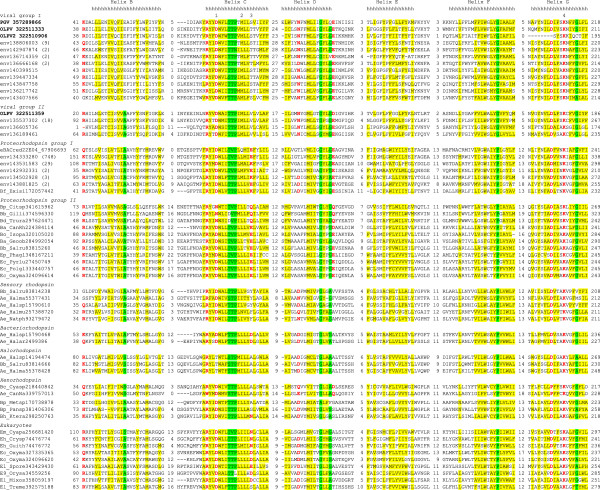
Figure 1
Figure 1
Conserved sequence blocks in the rhodopsin superfamily. The conserved blocks are separated by numbers that indicate the length of less well conserved sequence segments which are not shown (see Additional File 1). The alignment columns are colored on the basis of the respective position conservation throughout the superfamily: yellow background indicates hydrophobic residues (ACFILMVWY), red letters indicate polar residues (DEHKNQR), and green background indicates small residues (ACGNPSTV). The transmembrane helices are indicated following transmembrane helix prediction for PGV sequence (helix A is not shown; see Additional File 2 for all 7 predicted transmembrane helices). The functionally important residues are numbered: 1, proton acceptor; 2, position important for spectral tuning; 3, proton donor; 4, retinal-binding amino acid residue. Each sequence is denoted by the corresponding taxon abbreviation followed by the species abbreviation and GenBank Identification (GI) number. Taxa abbreviations: A, Archaea; B, Bacteria; E, Eukaryota; Ae, Euryarchaeota; Ba, Actinobacteria; Bb, Bacteroidetes/Chlorobi group; Bc, Cyanobacteria; Bd, Deinococcus-Thermus; Bf, Firmicutes; Bh, Chloroflexi; Bo, Planctomycetes; Bp, Proteobacteria; E9, Viridiplantae; Ec, Alveolata; Eh, Cryptophyta; El, Opisthokonta; Em, Glaucocystophyceae; Ep, Haptophyceae. Species abbreviations: are listed in Additional File 3.
Figure 2
Figure 2
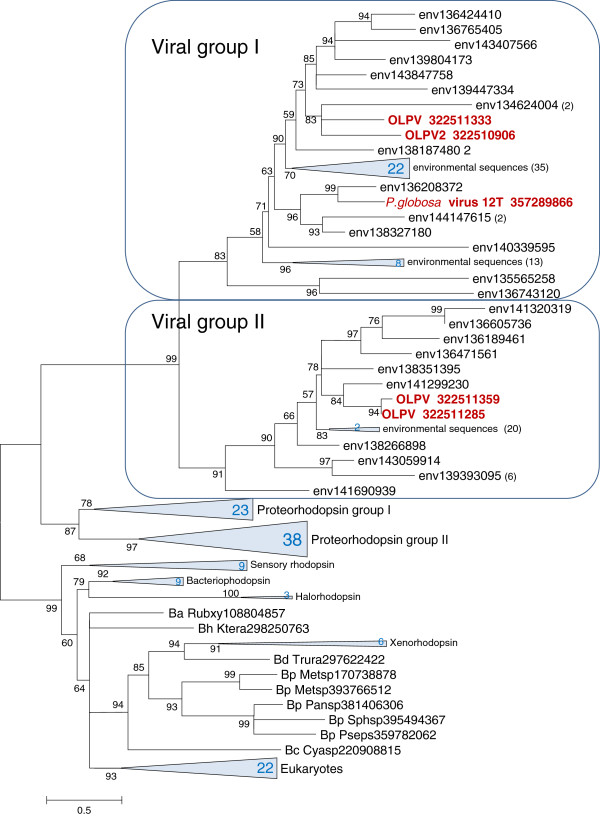
Phylogenetic tree of the rhodopsin superfamily. Branches with bootstrap support less than 50 were collapsed. Several large clades are shown by triangles with the number of the collapsed branches shown within the triangle. Numbers in parentheses represent number of environmental sequences clustered into the branch. Each sequence is denoted by the corresponding species abbreviation and GenBank Identification (GI) number. Abbreviations: OLPV, Organic Lake Phycodnavirus; OLPV2, Organic Lake Phycodnavirus 2; env, environmental sequence (marine metagenome); Ba, Actinobacteria; Bc, Cyanobacteria; Bd, Deinococcus-Thermus; Bh, Chloroflexi; Bp, Proteobacteria; Cyasp, Cyanothece sp. PCC 7424; Ktera, Ktedonobacter racemifer DSM 44963; Metsp, Methylobacterium sp. 4–46; Pansp, Pantoea sp. Sc1; Pseps, Pseudomonas psychrotolerans L19; Rubxy, Rubrobacter xylanophilus DSM 9941; Sphsp, Sphingomonas sp. PAMC 26617; Trura, Truepera radiovictrix DSM 17093. Expanded subtrees for Proteorhodopsin group I and II are shown in Additional file 4.

References

    1. Agol VI, Gmyl AP. Viral security proteins: counteracting host defences. Nat Rev Microbiol. 2010;8(12):867–878. doi: 10.1038/nrmicro2452. - DOI - PMC - PubMed
    1. Wei H, Zhou MM. Viral-encoded enzymes that target host chromatin functions. Biochim Biophys Acta. 2010;1799(3–4):296–301. - PMC - PubMed
    1. de Souza RF, Iyer LM, Aravind L. Diversity and evolution of chromatin proteins encoded by DNA viruses. Biochim Biophys Acta. 2010;1799(3–4):302–318. - PMC - PubMed
    1. Werden SJ, Rahman MM, McFadden G. Poxvirus host range genes. Adv Virus Res. 2008;71:135–171. - PubMed
    1. Bugert JJ, Darai G. Poxvirus homologues of cellular genes. Virus Genes. 2000;21(1–2):111–133. - PubMed

Publication types

LinkOut - more resources