


Comment
doi: 10.1038/nsmb.2398.
Making the cut: intramembrane cleavage by a rhomboid protease promotes ERAD
Affiliations
- PMID: 23037595
- PMCID: PMC3616633
- DOI: 10.1038/nsmb.2398
Item in Clipboard
Comment
Making the cut: intramembrane cleavage by a rhomboid protease promotes ERAD
Nat Struct Mol Biol.
2012 Oct.
Abstract
Endoplasmic reticulum–associated degradation (ERAD) is a cellular protein quality-control process that disposes of proteasomal substrates from the early secretory pathway. Recent work shows that the endoplasmic reticulum–resident rhomboid protease RHBDL4 facilitates ERAD by recognizing and cleaving integral membrane substrates. The work indicates that intramembrane proteolysis may have a general role in the extraction of misfolded membrane proteins from the endoplasmic reticulum.
Figures
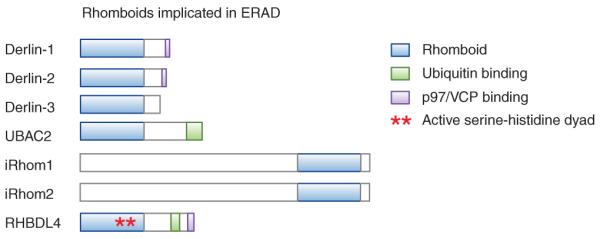
Domain structure of ERAD-implicated rhomboid family members.
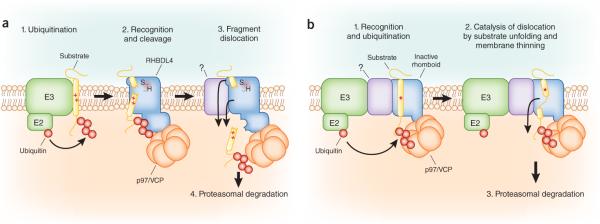
Roles for the rhomboid family in ERAD. (a) Model of the RHBDL4 ERAD pathway. RHBDL4 recognizes integral membrane substrates bearing transmembrane helices destabilized by an exposed positively charged residue(s) (red + symbols). Ubiquitination by an upstream E3 ligase provides a critical signal that is recognized by the RHBDL4 UIM and commits the substrate for RHBDL4-mediated proteolytic cleavage. The resulting substrate fragments are subsequently dislocated in a p97/VCP-dependent manner and targeted to the proteasome for degradation. (b) Model of a potential mechanism for inactive rhomboids in ERAD. Inactive rhomboids may function in the recognition and recruitment of misfolded substrates (red * symbols) to dislocation complexes. Structural features within inactive rhomboids may catalyze p97/VCP-dependent substrate dislocation by destabilizing substrates through a combination of a-helical transmembrane-domain unwinding and local membrane thinning.
Comment on
-
Ubiquitin-dependent intramembrane rhomboid protease promotes ERAD of membrane proteins.Mol Cell. 2012 Aug 24;47(4):558-69. doi: 10.1016/j.molcel.2012.06.008. Epub 2012 Jul 12. Mol Cell. 2012. PMID: 22795130
References
Publication types
MeSH terms
Substances
Grants and funding
LinkOut - more resources
Full Text Sources
Other Literature Sources
Research Materials
