


Lifting the lid on unborn lethal Mendelian phenotypes through exome sequencing
- PMID: 23037934
- PMCID: PMC3908556
- DOI: 10.1038/gim.2012.130
Lifting the lid on unborn lethal Mendelian phenotypes through exome sequencing
Abstract
Purpose: Mendelian phenotypes in humans vary from benign variants to lethal disorders. Embryonic lethal phenotypes that are similar to what has been known for a long time in mice have remained largely unknown because of the difficulty in arriving at a molecular diagnosis. The purpose of this study is to test whether next generation sequencing can reveal the underlying etiology of recurrent fetal loss.
Methods: We hypothesized that exome sequencing combined with autozygome analysis can reveal the underlying mutation in a family in which recurrent fetal loss was likely to be autosomal recessive in origin.
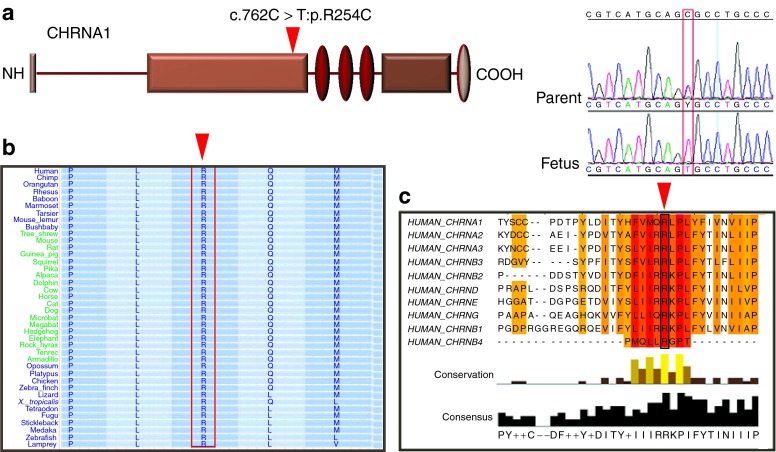
Results: A novel mutation in CHRNA1 was identified. This gene is known to cause multiple pterygium and fetal akinesia syndrome.
Conclusion: This is the first report of exome sequencing to identify the cause of recurrent fetal loss and reveal the diagnosis of a lethal human phenotype. Our results should inspire a systematic examination of the extent of "unborn" Mendelian phenotypes in humans using next-generation sequencing.
Figures
References
-
- Ku CS, Naidoo N, Pawitan Y. Revisiting Mendelian disorders through exome sequencing. Hum Genet. 2011;129:351–370. - PubMed
Publication types
MeSH terms
Substances
LinkOut - more resources
Full Text Sources
