Review
. 2012 Dec;137(4):271-81.
doi: 10.1111/imm.12009.

Role of recombination activating genes in the generation of antigen receptor diversity and beyond

Affiliations
Review

Role of recombination activating genes in the generation of antigen receptor diversity and beyond

Mayilaadumveettil Nishana et al. Immunology. 2012 Dec.

Abstract

V(D)J recombination is the process by which antibody and T-cell receptor diversity is attained. During this process, antigen receptor gene segments are cleaved and rejoined by non-homologous DNA end joining for the generation of combinatorial diversity. The major players of the initial process of cleavage are the proteins known as RAG1 (recombination activating gene 1) and RAG2. In this review, we discuss the physiological function of RAGs as a sequence-specific nuclease and its pathological role as a structure-specific nuclease. The first part of the review discusses the basic mechanism of V(D)J recombination, and the last part focuses on how the RAG complex functions as a sequence-specific and structure-specific nuclease. It also deals with the off-target cleavage of RAGs and its implications in genomic instability.


Figures

Figure 1
Figure 1
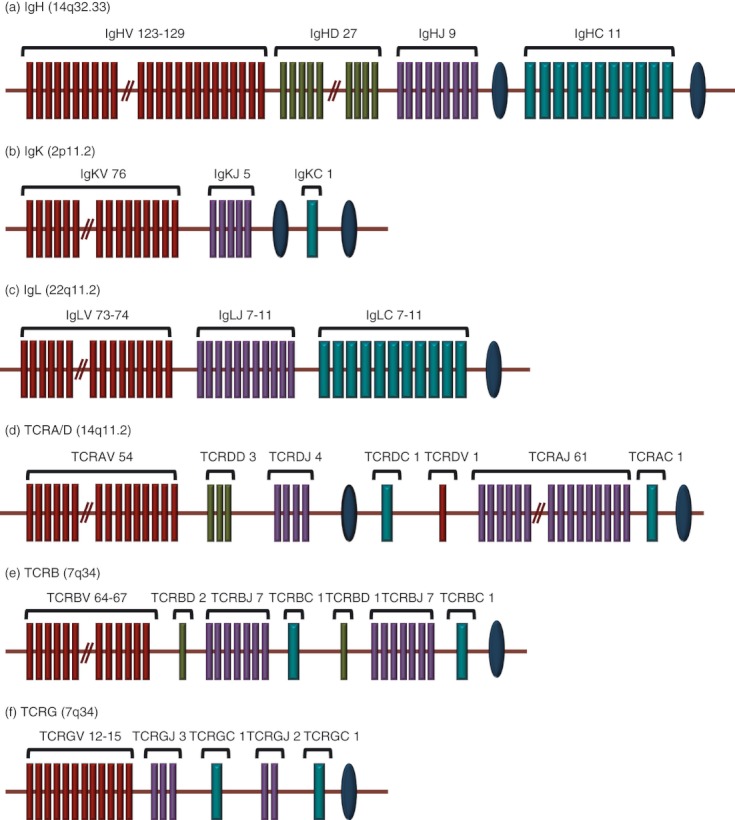
Genomic organization of the antigen receptor loci in human beings. The maroon, green, purple and blue rectangles represent V, D, J and C segments, respectively and the blue ovals indicate enhancers. (a) The human IgH locus, located on chromosome 14 at band 14q32.33. It has 123 to 129 IgHV genes depending on haplotypes, 27 IgHD segments, and nine IgHJ segments and in the most frequent haplotype, 11 IgHC genes. (b) The human IgK locus located on the chromosome 2, at band 2p11.2. It consists of 76 IgKV genes, five IgKJ segments, and a unique IgKC gene. (c) The human IgL locus located on chromosome 22 at band 22q11.2. It consists of 73 to 74 IgLV genes, 7 to 11 IgLJ and 7 to 11 IgLC genes depending on the haplotypes. (d) The human TCRA locus located on chromosome 14 at band 14q11.2. It consists of 116 genes: 54 TCRAV, 61 TCRAJ and a unique TCRAC gene. TCRD locus is embedded in the TCRA locus, between the TCRAV and TCRAJ genes. Though represented in the figure as ‘TCRAV 54’, among the 54 V genes, five can be rearranged to either TCRAJ or TCRDD genes and therefore can be used in the synthesis of α or δ chains. (e) The human TCRB locus on chromosome 7 at 7q34, consisting of 64–67 TCRBV, 2 TCRBD, 14 TCRBJ and two TCRBC genes. (f) The human TCRG locus is on chromosome 7 at 7p14 and consists of 12–15 TCRGV, five TCRGJ and two TCRGC1 genes. The data presented are in accordance with IMGT (http://www.imgt.org).
Figure 2
Figure 2
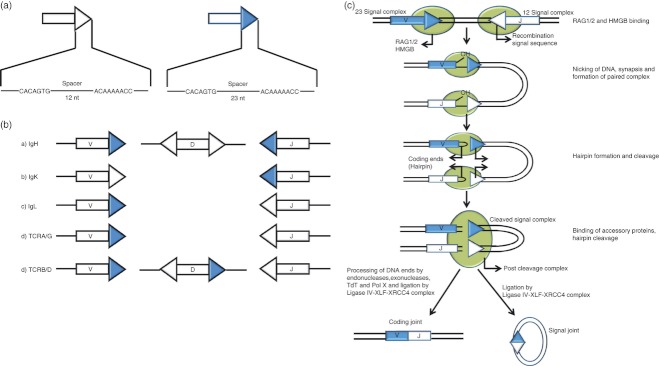
Mechanism of the V(D)J recombination. (a). Recombination Signal Sequence (RSS). In 12RSS (represented by open triangle), the heptamer is separated from nonamer by 12 bp and in 23RSS (represented by closed triangle) by 23 bp. (b). Distribution of RSS at the seven antigen receptor loci in human beings and the 12/23 rule. The V, D and J regions of the coding segments are depicted as rectangles; the flanking 12RSS is represented by an open triangle and 23RSS by a closed triangle. As per the ‘12/23 rule’, V(D)J recombination is restricted to gene segments that are flanked by signals of different spacer lengths. (c). Mechanism of V(D)J recombination. Schematic model of the protein–DNA complexes in V(D)J recombination. The 12RSS and 23RSS are represented as white and blue triangles, respectively. Coding segments are shown as rectangles and proteins as shaded ovals. ‘V’ stands for variable and ‘J’ for joining gene segments. Recombination activating genes (RAGs; shaded ovals) bind the RSS and introduce a single-strand nick in the DNA precisely at the border between the heptamer of RSS and the coding segment. This nick generates a free 3′-OH group on the coding end which is then covalently linked to the opposing phosphodiester bond, leaving a covalently closed hairpin on the coding end and a blunt 5′ phosphorylated signal end. The ends remain associated with RAGs; constituting a transitory structure referred to as ‘post-cleavage complex’. Following this, the coding ends are processed and joined by NHEJ to create the exon, which forms the antigen-binding region of antigen receptors. Signal end remains bound to RAGs constituting a ‘signal end complex’ that forms the signal joint.
Figure 3
Figure 3
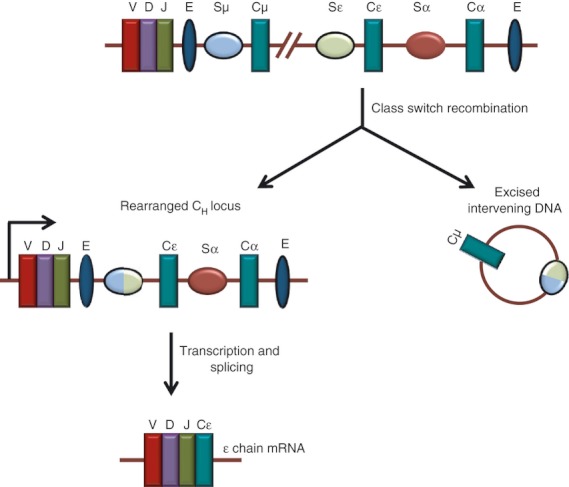
Mechanism of generation of the antigen receptor diversity by class switch recombination (CSR). CSR determines the type of constant region of antigen receptor by exchanging the gene encoding the immunoglobulin heavy chain constant region (CH) with one of the downstream CH genes. The figure depicts CSR between Sμ and Sα in the human immunoglobulin heavy chain locus. V, D and J segments of antigen receptor loci are represented as maroon, purple and green rectangles. The ovals represent the switch region and enhancers are marked by ‘E’. During the process, DNA double-strand breaks are introduced at the switch (S) regions followed by their rejoining. This leads to the deletion of the intervening sequence between S regions and juxtaposition of rearranged VDJ segment with the downstream CH fragment.
Figure 4
Figure 4
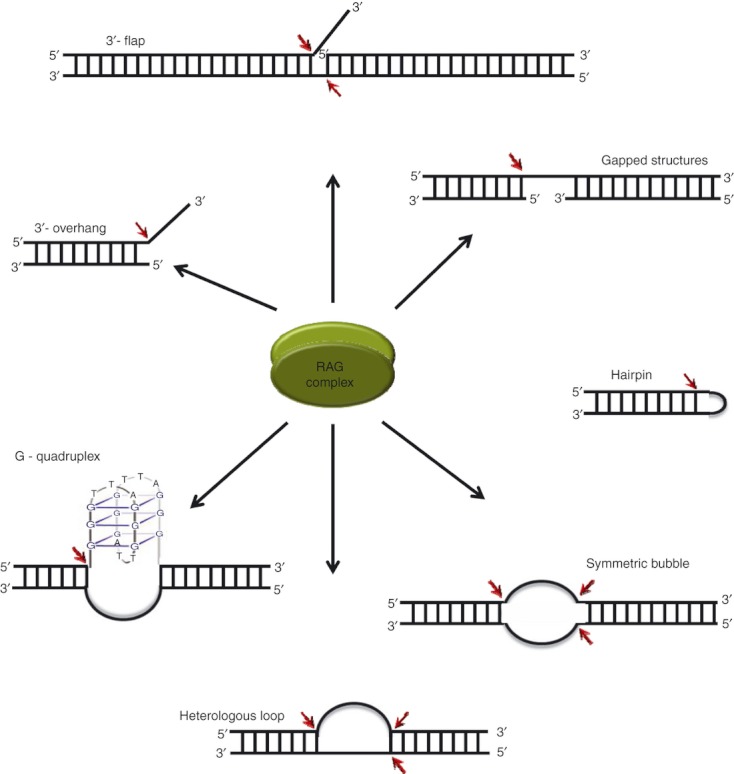
Structure-specific nuclease action of recombination activating genes (RAGs). The cleavage targets of the RAG complex when it acts as a structure-specific nuclease. The shaded ovals represent the RAG complex and the cleavage sites are indicated by red arrows.

References

    1. Lederberg J. Genes and antibodies. Science. 1959;129:1649–53. - PubMed
    1. Dreyer WJ, Bennett JC. The molecular basis of antibody formation: a paradox. Proc Natl Acad Sci U S A. 1965;54:864–9. - PMC - PubMed
    1. Schatz DG, Oettinger MA, Baltimore D. The V(D)J recombination activating gene, RAG-1. Cell. 1989;59:1035–48. - PubMed
    1. Oettinger MA, Schatz DG, Gorka C, Baltimore D. RAG-1 and RAG-2, adjacent genes that synergistically activate V(D)J recombination. Science. 1990;248:1517–23. - PubMed
    1. Schatz DG, Baltimore D. Stable expression of immunoglobulin gene V(D)J recombinase activity by gene transfer into 3T3 fibroblasts. Cell. 1988;53:107–15. - PubMed

Publication types

Substances

LinkOut - more resources