


Catalytic enantioselective cross-couplings of secondary alkyl electrophiles with secondary alkylmetal nucleophiles: Negishi reactions of racemic benzylic bromides with achiral alkylzinc reagents
- PMID: 23039358
- PMCID: PMC3474870
- DOI: 10.1021/ja308460z
Catalytic enantioselective cross-couplings of secondary alkyl electrophiles with secondary alkylmetal nucleophiles: Negishi reactions of racemic benzylic bromides with achiral alkylzinc reagents
Abstract
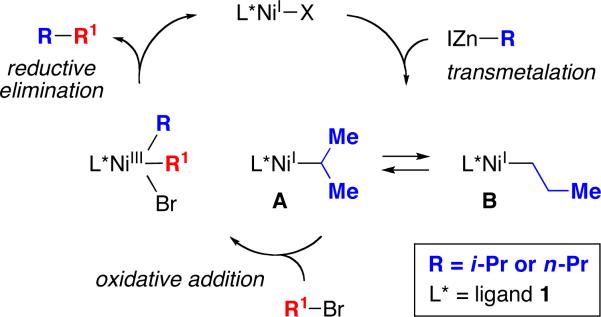
We have developed a nickel-catalyzed method for the asymmetric cross-coupling of secondary electrophiles with secondary nucleophiles, specifically, stereoconvergent Negishi reactions of racemic benzylic bromides with achiral cycloalkylzinc reagents. In contrast to most previous studies of enantioselective Negishi cross-couplings, tridentate pybox ligands are ineffective in this process; however, a new, readily available bidentate isoquinoline-oxazoline ligand furnishes excellent ee's and good yields. The use of acyclic alkylzinc reagents as coupling partners led to the discovery of a highly unusual isomerization that generates a significant quantity of a branched cross-coupling product from an unbranched nucleophile.
Figures
References
-
-
For some reviews and leading references, see: Glasspoole BW, Crudden CM. Nature Chem. 2011;3:912–913.Jana R, Pathak TP, Sigman MS. Chem. Rev. 2011;111:1417–1492.Rudolph A, Lautens M. Angew. Chem., Int. Ed. 2009;48:2656–2670.Glorius F. Angew. Chem., Int. Ed. 2008;47:8347–8349.
-
-
-
For examples of secondary–secondary coupling reactions, see: Copper-catalyzed (activated electrophile): Malosh CF, Ready JM. J. Am. Chem. Soc. 2004;126:10240–10241. Nickel-catalyzed (activated electrophile): Smith SW, Fu GC. Angew. Chem., Int. Ed. 2008;47:9334–9336. Copper-catalyzed (unactivated electrophile): Yang C-T, Zhang Z-Q, Liang J, Liu J-H, Lu X-Y, Chen H-H, Liu L. J. Am. Chem. Soc. 2012;134:11124–11127.
-
-
-
For recent examples of reactions of secondary electrophiles (as a function of their organometallic coupling partner) and leading references, see: Boron: Wilsily A, Tramutola F, Owston NA, Fu GC. J. Am. Chem. Soc. 2012;134:5794–5797. Zinc: Choi J, Fu GC. J. Am. Chem. Soc. 2012;134:9102–9105. Magnesium: Lou S, Fu GC. J. Am. Chem. Soc. 2010;132:1264–1266. Silicon: Dai X, Strotman NA, Fu GC. J. Am. Chem. Soc. 2008;130:3302–3303. Zirconium: Lou S, Fu GC. J. Am. Chem. Soc. 2010;132:5010–5011. Indium: Caeiro J, Sestelo JP, Sarandeses LA. Chem. Eur. J. 2008;14:741–746.
-
-
-
For a recent application in the total synthesis of carolacton (enantioselective Negishi cross-coupling of a racemic allylic chloride), see: Schmidt T, Kirschning A. Angew. Chem., Int. Ed. 2012;51:1063–1066.
-
-
-
For an example of a cobalt-catalyzed asymmetric coupling of a tertiary alkyl bromide with an allylmagnesium reagent that proceeds in 22% ee and 49% yield, see: Tsuji T, Yorimitsu H, Oshima K. Angew. Chem., Int. Ed. 2002;41:4137–4139.
-
Publication types
MeSH terms
Substances
Grants and funding
LinkOut - more resources
Full Text Sources
