


Review
doi: 10.1074/jbc.R112.406272.
Epub 2012 Oct 5.
HIV entry and envelope glycoprotein-mediated fusion
Affiliations
- PMID: 23043104
- PMCID: PMC3510787
- DOI: 10.1074/jbc.R112.406272
Item in Clipboard
Review
HIV entry and envelope glycoprotein-mediated fusion
J Biol Chem.
.
Abstract
HIV entry involves binding of the trimeric viral envelope glycoprotein (Env) gp120/gp41 to cell surface receptors, which triggers conformational changes in Env that drive the membrane fusion reaction. The conformational landscape that the lipids and Env navigate en route to fusion has been examined by biophysical measurements on the microscale, whereas electron tomography, x-rays, and NMR have provided insights into the process on the nanoscale and atomic scale. However, the coupling between the lipid and protein pathways that give rise to fusion has not been resolved. Here, we discuss the known and unknown about the overall HIV Env-mediated fusion process.
Figures

HIV Env protein structure: atomic scale and nanoscale.
A, x-ray crystallographic structure of gp120 with the V3 loop (Protein Data Bank code 2B4C) (19). The inner domain is in blue, the bridging sheet is in yellow, and the outer domain with the V3 loop is in red. B, crystallographic structure of the gp41 ectodomain in the 6HB conformation (Protein Data Bank code 2X7R) (30). The advantage of this recent structure is the inclusion of the FP proximal region and MPER segments. Although refolding of gp41 into this more stable conformation facilitates fusion, it is still unclear what stage of the process is driven by the released energy. C and D, cryo-electron microscopy tomogram density maps of HIV-1 Env gp120/gp41 trimers in the closed and soluble CD4-triggered open states (98), respectively. The fitted atomic coordinates of gp120 are shown in red, and those of soluble CD4 are shown in yellow. The same color code applies for the schematic insets, with the addition of cyan for gp41.

Microscale determination of the HIV fusion cascade. Shown is a schematic representation of the experimentally determined sequence of events in HIV Env-mediated fusion determined on the micrometer scale. A, the viral membrane is labeled with a lipid dye (light blue). It contains Env trimers (gp120, dark blue; and gp41, red) and accessory proteins, such as HLA-DR (purple). It encapsulates the viral core, Vpr-BlaM (green), and small aqueous dyes (yellow). Although the target membrane may contain various attachment molecules (99), only the most important ones, CD4 (gray) and CR (CXCR4 or CCR5; red violet), are indicated. Specific lipids in the viral and target cell membranes are not indicated. B, docking of the virus via gp120 to the cell surface receptor gives rise to Env conformational changes (72, 73) and aggregation of Env proteins (1, 43). C, further conformational changes lead to lipid mixing (47) and redistribution of small aqueous dyes (53, 100). These data were gathered in HIV Env-mediated cell fusion experiments. The 6HB (orange) is on its way to formation at this stage. D, fusion pore expansion indicated by movement of larger molecules, Vpr-BlaM and GFP-Gag (green) (60, 61), as well as the viral core (brown), into the cytosol. At this point, viral membrane-embedded proteins redistribute over the cell surface (57).

Lipid rearrangements in fusion. The starting point of the fusion process is the formation of a contact site (i) between two apposed membranes (“docking”). Fusion is initiated in the contact site when two apposed membranes each locally protrude as “nipples” toward each other (ii) (15). In pure lipid bilayers, the required energy for structural changes comes from thermal fluctuations, whereas in viral fusion, (part of) this energy comes from work exerted by viral envelope proteins on the lipid bilayer (16). The point-like membrane protrusions minimize the energy of the hydration repulsion between the proximal leaflets of the membranes coming into immediate contact. Nipple formation results in transient displacements of polar headgroups from each other, yielding small hydrophobic patches at the tip of the nipple. Because hydrophobic surfaces attract each other, cis-leaflets can merge to create a hemifusion stalk (iii), with proximal leaflets fused and distal leaflets unfused. On the nanoscale, stalk structures have been determined in pure lipids by x-ray diffraction (36). Stalk expansion yields the hemifusion diaphragm (iv). A fusion pore forms either in the hemifusion diaphragm bilayer or directly from the stalk (v). Dashed lines show the boundaries of the hydrophobic surfaces of monolayers. This figure was reprinted by permission from Ref. .
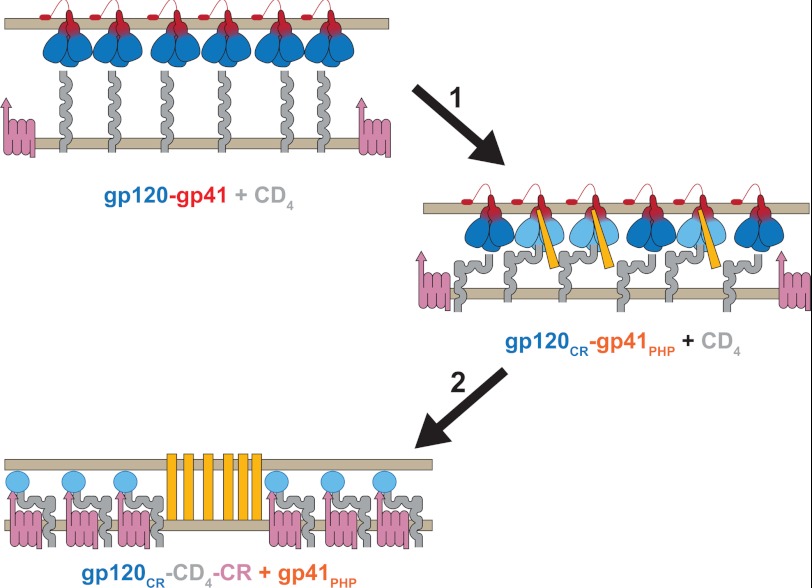
HIV Env conformational changes during fusion. Shown is a schematic representation of experimentally determined conformational changes during the initial stages of HIV Env-mediated fusion. HIV Env trimers (gp120, blue; and gp41, red) on the viral membrane (top) are poised to interact with CD4 (gray) on the target membrane (bottom). Binding of gp120 to CD4 (step 1) leads to conformational changes in gp120 that involve exposure of its CR-binding site (gp120CR; light blue) and formation of the gp41 prehairpin (gp41PHP; orange). Upon engagement of CR (red violet; step 2), gp120 dissociates into subunits (blue oval), allowing gp41PHP to engage with the target membrane (27, 28) and/or viral membrane (16). The mechanism of coupling between HIV Env refolding and lipid rearrangements in Fig. 3 leading to fusion is unresolved.
References
-
- Esser M. T., Graham D. R., Coren L. V., Trubey C. M., Bess J. W., Jr., Arthur L. O., Ott D. E., Lifson J. D. (2001) Differential incorporation of CD45, CD80 (B7-1), CD86 (B7-2), and major histocompatibility complex class I and II molecules into human immunodeficiency virus type 1 virions and microvesicles: implications for viral pathogenesis and immune regulation. J. Virol. 75, 6173–6182 - PMC - PubMed
Publication types
MeSH terms
Substances
Grants and funding
LinkOut - more resources
Full Text Sources
Medical
Research Materials
