


Exome sequencing: an efficient diagnostic tool for complex neurodegenerative disorders
- PMID: 23043354
- PMCID: PMC4669564
- DOI: 10.1111/j.1468-1331.2012.03883.x
Exome sequencing: an efficient diagnostic tool for complex neurodegenerative disorders
Abstract
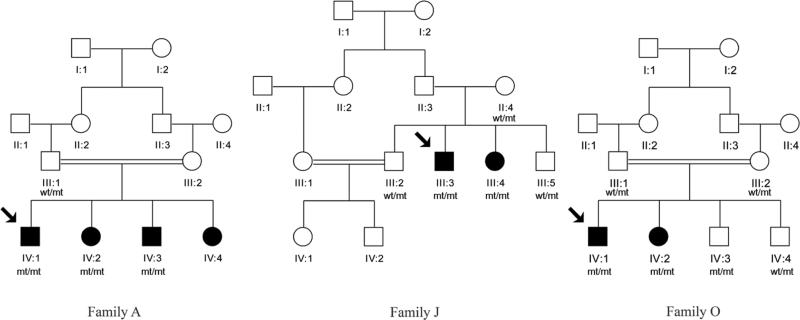
Background and purpose: Autosomal recessive cerebellar ataxia (ARCA) comprises a large and heterogeneous group of neurodegenerative disorders. We studied three families diagnosed with ARCA.
Methods: To determine the gene lesions responsible for their disorders, we performed high-density single-nucleotide polymorphism genotyping and exome sequencing.
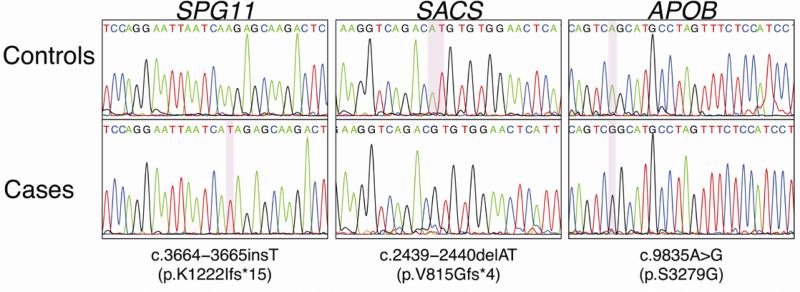
Results: We identified a new mutation in the SACS gene and a known mutation in SPG11. Notably, we also identified a homozygous variant in APOB, a gene previously associated with ataxia.
Conclusions: These findings demonstrate that exome sequencing is an efficient and direct diagnostic tool for identifying the causes of complex and genetically heterogeneous neurodegenerative diseases, early-stage disease or cases with limited clinical data.
Published 2012. This article is a U.S. Government work and is in the public domain in the USA. European Journal of Neurology © 2012 EFNS.
Figures
References
-
- Manto M, Marmolino D. Cerebellar ataxias. Curr Opin Neurol. 2009;22:419–429. doi:10.1097/WCO.0b013e32832b9897. - PubMed
-
- Harding AE. Classification of the hereditary ataxias and paraplegias. Lancet. 1983;1:1151–1155. - PubMed
-
- De Michele G, Coppola G, Cocozza S, Filla A. A pathogenetic classification of hereditary ataxias: is the time ripe? J Neurol. 2004;251:913–922. doi:10.1007/s00415-004-0484-2. - PubMed
-
- Klockgether T. Parkinsonism & related disorders. Ataxias. Parkinsonism Relat Disord. 2007;13(Suppl 3):S391–394. doi:10.1016/S1353-8020(08)70036-1. - PubMed
Publication types
MeSH terms
Substances
Grants and funding
LinkOut - more resources
Full Text Sources
Miscellaneous
