


Novel polyoxins generated by heterologously expressing polyoxin biosynthetic gene cluster in the sanN inactivated mutant of Streptomyces ansochromogenes
- PMID: 23043373
- PMCID: PMC3520715
- DOI: 10.1186/1475-2859-11-135
Novel polyoxins generated by heterologously expressing polyoxin biosynthetic gene cluster in the sanN inactivated mutant of Streptomyces ansochromogenes
Abstract
Background: Polyoxins are potent inhibitors of chitin synthetases in fungi and insects. The gene cluster responsible for biosynthesis of polyoxins has been cloned and sequenced from Streptomyces cacaoi and tens of polyoxin analogs have been identified already.
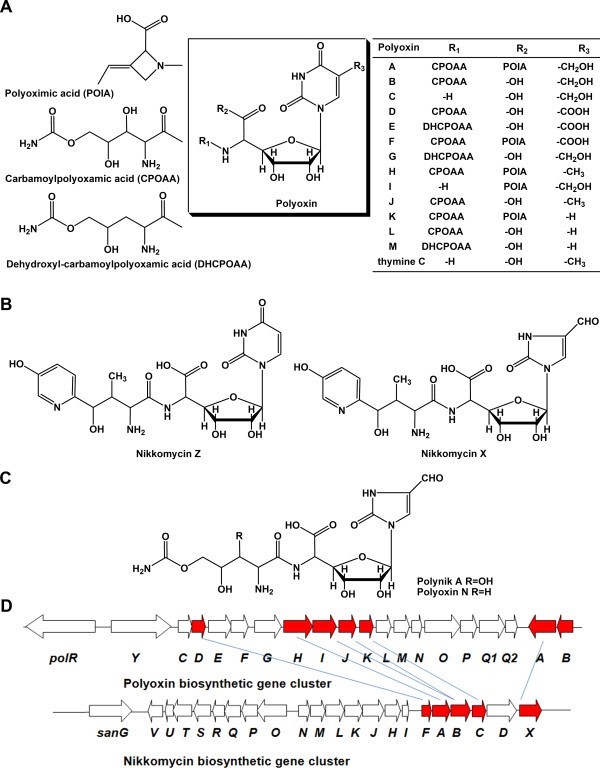
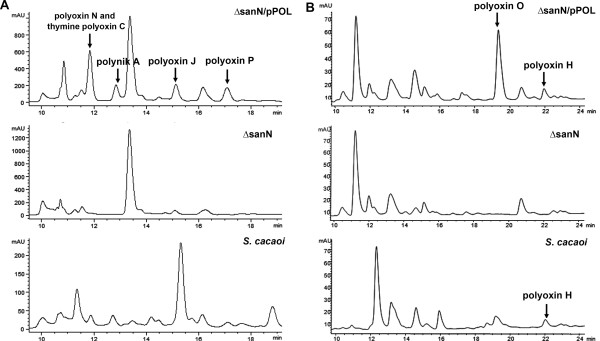
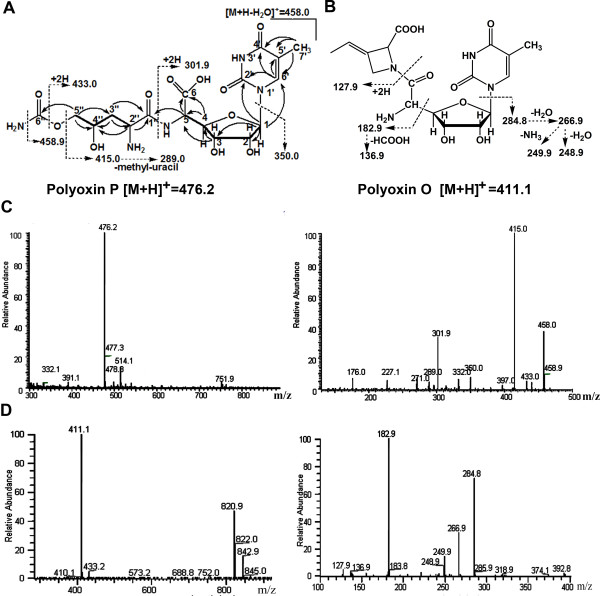
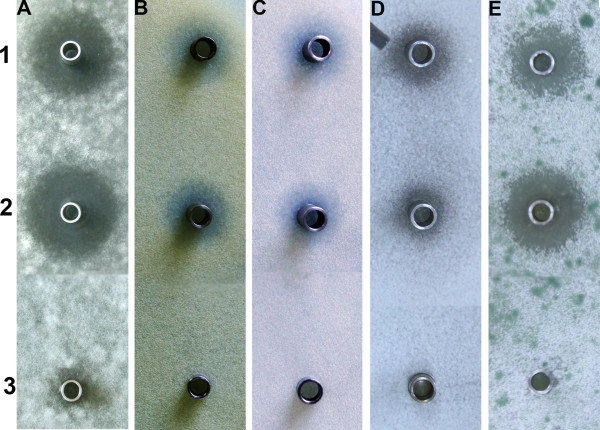
Results: The polyoxin biosynthetic gene cluster from Streptomyces cacaoi was heterologously expressed in the sanN inactivated mutant of Streptomyces ansochromogenes as a nikkomycin producer. Besides hybrid antibiotics (polynik A and polyoxin N) and some known polyoxins, two novel polyoxin analogs were accumulated. One of them is polyoxin P that has 5-aminohexuronic acid with N-glycosidically bound thymine as the nucleoside moiety and dehydroxyl-carbamoylpolyoxic acid as the peptidyl moiety. The other analog is polyoxin O that contains 5-aminohexuronic acid bound thymine as the nucleoside moiety, but recruits polyoximic acid as the sole peptidyl moiety. Bioassay against phytopathogenic fungi showed that polyoxin P displayed comparatively strong inhibitory activity, whereas the inhibitory activity of polyoxin O was weak under the same testing conditions.
Conclusion: Two novel polyoxin analogs (polyoxin P and O) were generated by the heterologous expression of polyoxin biosynthetic gene cluster in the sanN inactivated mutant of Streptomyces ansochromogenes. Polyoxin P showed potent antifungal activity,while the activity of polyoxin O was weak. The strategy presented here may be available for other antibiotics producers.
Figures
References
-
- Isono K, Asahi K, Suzuki S. Studies on polyoxins, antifungal antibiotics. 13. The structure of polyoxins. J Am Chem Soc. 1969;91(26):7490–7505. - PubMed
-
- Hori M, Eguchi J, Kakiki K, Misato T. Studies on the mode of action of polyoxins. VI. Effect of polyoxin B on chitin synthesis in polyoxin-sensitive and resistant strains of Alternaria kikuchiana. J Antibiot. 1974;27(4):260–266. - PubMed
-
- Hori M, Kakiki K, Suzuki S, Misato T. Studies on the mode of action of polyoxins. Part III. Relation of polyoxin structure to chitin synthetase inhibition. Agr Biol Chem. 1971;35(8):1280–1291.
-
- Endo A, Misato T. Polyoxin D, a competitive inhibitor of UDP-N-acetylglucosamine: chitin N-acetylglucosaminyltransferase in Neurospora crassa. Biochem Biophys Res Commun. 1969;37(4):718–722. - PubMed
-
- Isono K, Suzuki S. The structures of polyoxins A and B. Tetrahedron Lett. 1968;9:1133–1137. - PubMed
Publication types
MeSH terms
Substances
LinkOut - more resources
Full Text Sources
Molecular Biology Databases
