


Finding parasites and finding challenges: improved diagnostic access and trends in reported malaria and anti-malarial drug use in Livingstone district, Zambia
- PMID: 23043557
- PMCID: PMC3496597
- DOI: 10.1186/1475-2875-11-341
Finding parasites and finding challenges: improved diagnostic access and trends in reported malaria and anti-malarial drug use in Livingstone district, Zambia
Abstract
Background: Understanding the impact of malaria rapid diagnostic test (RDT) use on management of acute febrile disease at a community level, and on the consumption of anti-malarial medicines, is critical to the planning and success of scale-up to universal parasite-based diagnosis by health systems in malaria-endemic countries.
Methods: A retrospective study of district-wide community-level RDT introduction was conducted in Livingstone District, Zambia, to assess the impact of this programmed on malaria reporting, incidence of mortality and on district anti-malarial consumption.
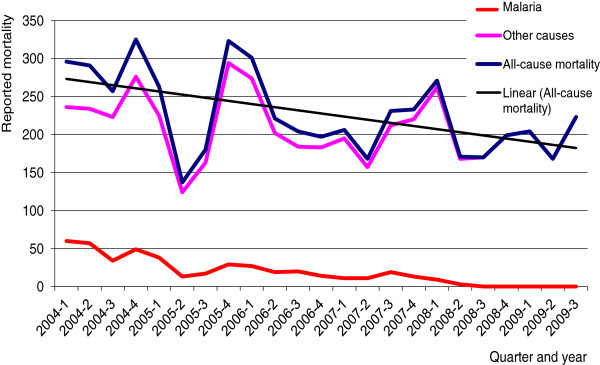
Results: Reported malaria declined from 12,186 cases in the quarter prior to RDT introduction in 2007 to an average of 12.25 confirmed and 294 unconfirmed malaria cases per quarter over the year to September 2009. Reported malaria-like fever also declined, with only 4,381 RDTs being consumed per quarter over the same year. Reported malaria mortality declined to zero in the year to September 2009, and all-cause mortality declined. Consumption of artemisinin-based combination therapy (ACT) dropped dramatically, but remained above reported malaria, declining from 12,550 courses dispensed by the district office in the quarter prior to RDT implementation to an average of 822 per quarter over the last year. Quinine consumption in health centres also declined, with the district office ceasing to supply due to low usage, but requests for sulphadoxine-pyrimethamine (SP) rose to well above previous levels, suggesting substitution of ACT with this drug in RDT-negative cases.
Conclusions: RDT introduction led to a large decline in reported malaria cases and in ACT consumption in Livingstone district. Reported malaria mortality declined to zero, indicating safety of the new diagnostic regime, although adherence and/or use of RDTs was still incomplete. However, a deficiency is apparent in management of non-malarial fever, with inappropriate use of a low-cost single dose drug, SP, replacing ACT. While large gains have been achieved, the full potential of RDTs will only be realized when strategies can be put in place to better manage RDT-negative cases.
Figures


References
-
- WHO. Guidelines for the treatment of malaria. 2. Geneva: World Health Organization; 2010. - PubMed
-
- WHO. Malaria microscopy quality assurance manual - version 1. Version 1. Manila: World Health Organization - Regional Office for the Western Pacific; 2009.
-
- RBM MMV. Tracking Progress in Scaling-Up Diagnosis and Treatment for Malaria. Geneva: Roll Back Malaria Partnership; 2009.
Publication types
MeSH terms
Substances
LinkOut - more resources
Full Text Sources
Medical
