


Review
doi: 10.1038/nrg3335.
Epub 2012 Oct 9.
Genome-wide association studies in mice
Affiliations
- PMID: 23044826
- PMCID: PMC3625632
- DOI: 10.1038/nrg3335
Item in Clipboard
Review
Genome-wide association studies in mice
Nat Rev Genet.
2012 Nov.
Abstract
Genome-wide association studies (GWASs) have transformed the field of human genetics and have led to the discovery of hundreds of genes that are implicated in human disease. The technological advances that drove this revolution are now poised to transform genetic studies in model organisms, including mice. However, the design of GWASs in mouse strains is fundamentally different from the design of human GWASs, creating new challenges and opportunities. This Review gives an overview of the novel study designs for mouse GWASs, which dramatically improve both the statistical power and resolution compared to classical gene-mapping approaches.
Conflict of interest statement
The authors declare no competing financial interests.
Figures
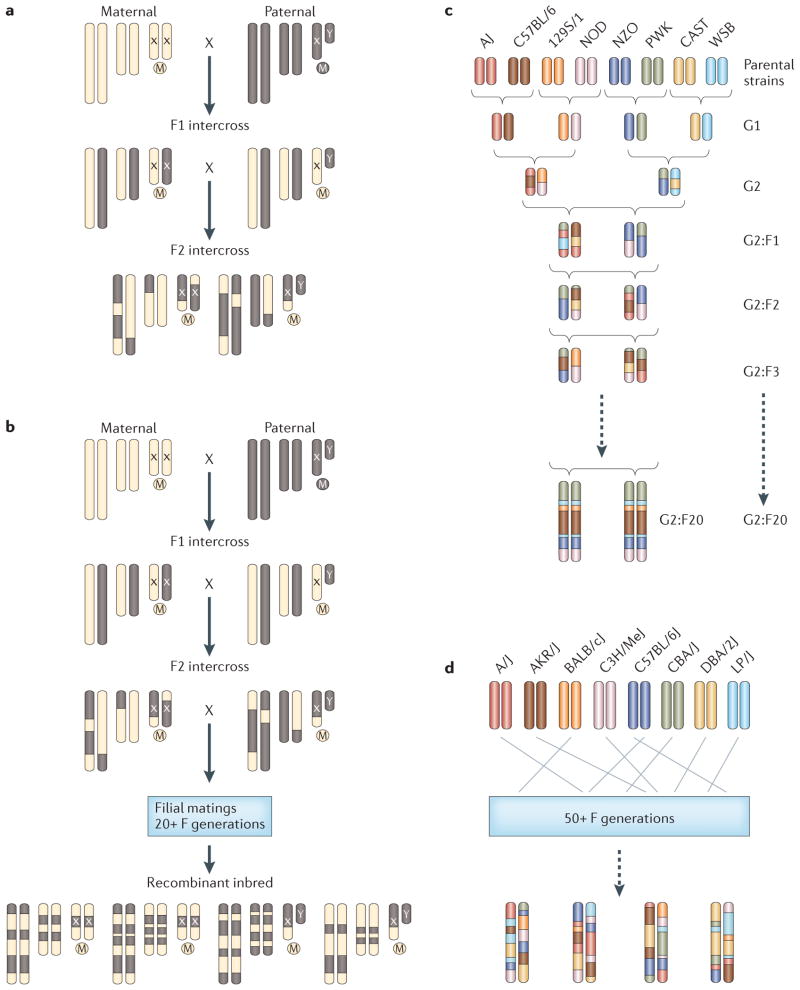
a | In the classic F2 generation cross, two parental strains are mated to generate F1 strains. The F1 strains are then either mated to each other (intercross) or to one of the parental strains (backcross; not shown) to generate F2 offspring. These offspring are then genotyped and phenotyped. b | Recombinant inbred strains are generated by sibling mating F2 intercross animals until the resulting progeny, at least 20 generations later, is fully inbred. These inbred lines are maintained in breeding colonies and can be purchased from commercial vendors. Strategies that use recombinant inbred strains do not require genotyping as the genotypes of each animal in such a strain are identical and available in public databases. c | The Collaborative Cross is a large-scale project for generating recombinant inbred strains from eight parental strains using a breeding scheme that leads to inbred strains with, on average, equal genome content from each parental strain. Because the Collaborative Cross strains are inbred, strategies that use the strains do not require genotyping of the animals as the genotypes are available from public databases. d | Heterogeneous stock animals are the outbred offspring of eight parental strains. The breeding scheme generates animal offspring with, on average, equal genome content from each parental strain. Unlike inbred strains, these animals are genetically unique, and studies that use heterogeneous stock animals require genotyping of each animal included in the study. Panels a–c are reproduced, with permission, from REF. © (2012) Macmillan Publishers Ltd. All rights reserved.
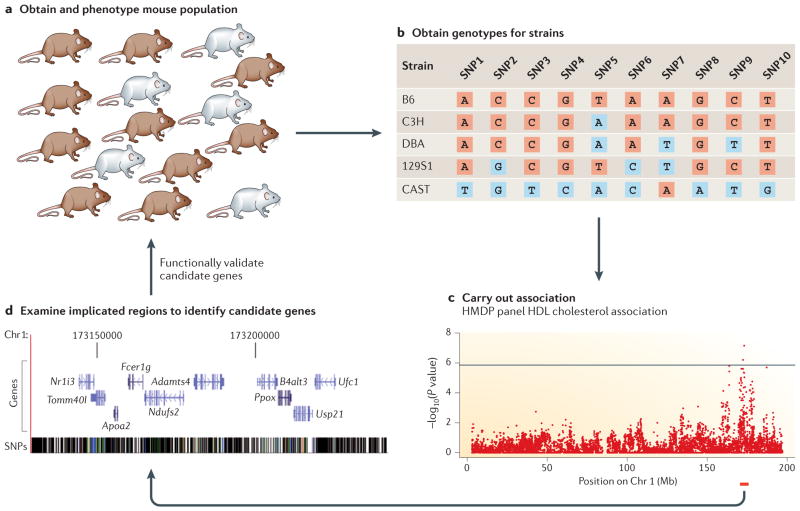
Mouse genome-wide association studies (GWASs) follow a common general approach. a | Mice in the study population are phenotyped for the traits of interest. Deciding which mice and their corresponding genetic structure to include in the study population is a key design consideration in a mouse GWAS. b | Genotypes for each mouse are then obtained either by direct genotyping for outbred animals or by sourcing them from publicly available SNP maps for inbred strains. c | Association testing is then carried out, typically using a statistical method for correcting for population structure such as efficient mixed-model association (EMMA) or resample model averaging (RMA). d | Implicated regions are then examined for candidate genes, which are then functionally validated. Apoa2, apolipoprotein A2; Chr, chromosome; HDL, high-density lipoprotein; HMDP, Hybrid Mouse Diversity Panel. The data in part c are derived from REF. .
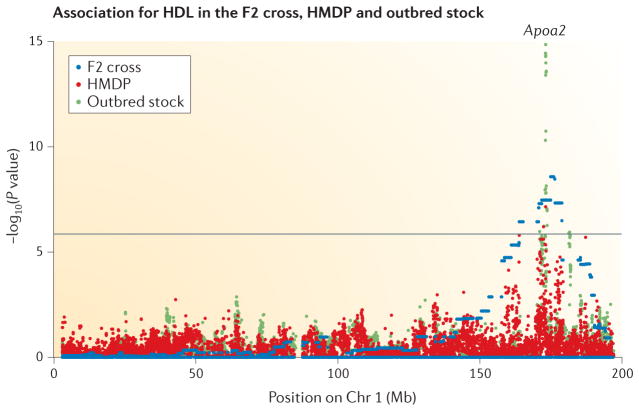
The figure highlights differences in resolution of genome-wide association studies (GWASs) of high-density lipoprotein (HDL) between the strategies of the F2 generation genetic cross, the Hybrid Mouse Diversity Panel (HMDP) and commercial outbred stocks. The results are shown for chromosome 1, in which a known gene, apolipoprotein A2 (Apoa2), has been previously linked to HDL levels and is likely to drive the association signal in all three studies. All three strategies successfully identify an association in the region. However, as shown in the figure, the genetic cross study implicates a very broad region covering a substantial fraction of the chromosome owing to the limited number of recombinations between the parental strains of the cross. The HMDP study narrows down the association signal to a much smaller region owing to the larger number of generations that separate the inbred strains. The outbred stock study localizes the association even further owing to the large number of generations since the founding of the stocks. Chr, chromosome. The data sets presented are from REFS ,,.
References
-
- Silver LM. Mouse Genetics: Concepts and Applications. Oxford Univ. Press; 1995. This book is the classic resource on mouse genetics.
Publication types
MeSH terms
Grants and funding
LinkOut - more resources
Full Text Sources
