Review
. 2012 Dec;32(24):4892-7.
doi: 10.1128/MCB.01127-12. Epub 2012 Oct 8.

Distant activation of transcription: mechanisms of enhancer action

Affiliations
Review

Distant activation of transcription: mechanisms of enhancer action

Olga I Kulaeva et al. Mol Cell Biol. 2012 Dec.

Abstract

Enhancers are regulatory DNA sequences that activate transcription over long distances. Recent studies revealed a widespread role of distant activation in eukaryotic gene regulation and in development of various human diseases, including cancer. Genomic and gene-targeted studies of enhancer action revealed novel mechanisms of transcriptional activation over a distance. They include formation of stable, inactive DNA-protein complexes at the enhancer and target promoter before activation, facilitated distant communication by looping of the spacer chromatin-covered DNA, and promoter activation by mechanisms that are different from classic recruiting. These studies suggest the similarity between the looping mechanisms involved in enhancer action on DNA in bacteria and in chromatin of higher organisms.


Figures
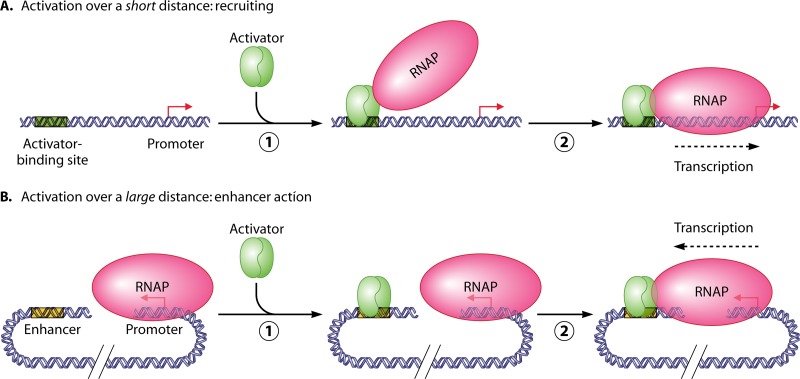
Fig 1
Fig 1
Mechanisms of transcriptional activation over short and long distances: recruiting versus DNA looping. (A) Recruiting. As an activator binds to DNA (step 1), it recruits (increases the local concentration of) another protein (e.g., RNA polymerase), the binding of which is a rate-limiting step during transcription initiation (step 2). (B) Enhancer action. Binding of an activator (or a recruited protein, not shown) to the enhancer (step 1) does not automatically increase its local concentration at the target promoter because the promoter and enhancer do not colocalize. Thus, enhancer-bound protein has to (i) efficiently explore surrounding DNA/chromatin regions, (ii) identify the target promoter (e.g., marked by RNAP), and (iii) interact with and activate the promoter by a mechanism that is different from recruiting (step 2). This interaction is typically accompanied by looping of the spacer DNA or chromatin.
Fig 2
Fig 2
Slithering mechanism of facilitated distant communication on DNA (6). Two identical promoters (P1 and P2) are differently positioned relative to an enhancer (E) on a plasmid and are separated by a protein bridge (insulator) formed by the lac repressor (lacI). Sliding of intertwined DNA helices within branches formed on supercoiled DNA (slithering; dashed arrows) greatly increases the probability of E juxtaposition with the promoter P1 positioned within the same topological DNA domain (6, 43). In contrast, the P2 promoter positioned on a different domain of the same DNA molecule cannot efficiently communicate with the E because slithering through the protein bridge is impossible.
Fig 3
Fig 3
Proposed mechanisms of highly efficient EPC in chromatin. (A) DNA uncoiling mechanism. Partial spontaneous uncoiling of the ends of nucleosomal DNA from the octamer occurs at a high rate (27, 42). Thus, each nucleosome in an array can provide two points of dynamic histone-induced DNA flexibility at the positions where DNA enters and exits nucleosomes. (B) The hypothetical mechanisms of long-range EPC involving histone N-tails. In mechanism 1, termed brachiation, transient internucleosomal interactions mediated by histone tails could keep chromatin arrays or fibers in close proximity and allow relocation of the interacting partners relative to each other at a high rate. In mechanism 2, termed transient collapse, multiple intrafiber interactions mediated by histone tails could be fully disrupted and reestablished in a different register (36).

References

    1. Akhtar-Zaidi B, et al. 2012. Epigenomic enhancer profiling defines a signature of colon cancer. Science 336:736–739 - PMC - PubMed
    1. Ameres SL, et al. 2005. Inducible DNA-loop formation blocks transcriptional activation by an SV40 enhancer. EMBO J. 24:358–367 - PMC - PubMed
    1. Bagga R, Michalowski S, Sabnis R, Griffith JD, Emerson BM. 2000. HMG I/Y regulates long-range enhancer-dependent transcription on DNA and chromatin by changes in DNA topology. Nucleic Acids Res. 28:2541–2550 - PMC - PubMed
    1. Bellomy GR, Record MT., Jr 1990. Stable DNA loops in vivo and in vitro: roles in gene regulation at a distance and in biophysical characterization of DNA. Prog. Nucleic Acid Res. Mol. Biol. 39:81–128 - PubMed
    1. Bondarenko V, Liu Y, Ninfa A, Studitsky VM. 2002. Action of prokaryotic enhancer over a distance does not require continued presence of promoter-bound sigma54 subunit. Nucleic Acids Res. 30:636–642 - PMC - PubMed

Publication types

LinkOut - more resources
