Patient navigation for breast and colorectal cancer treatment: a randomized trial
- PMID: 23045542
- PMCID: PMC3724524
- DOI: 10.1158/1055-9965.EPI-12-0506
Patient navigation for breast and colorectal cancer treatment: a randomized trial
Abstract
Background: There is limited high-quality evidence about the impact of patient navigation (PN) on outcomes for patients with diagnosed cancer.
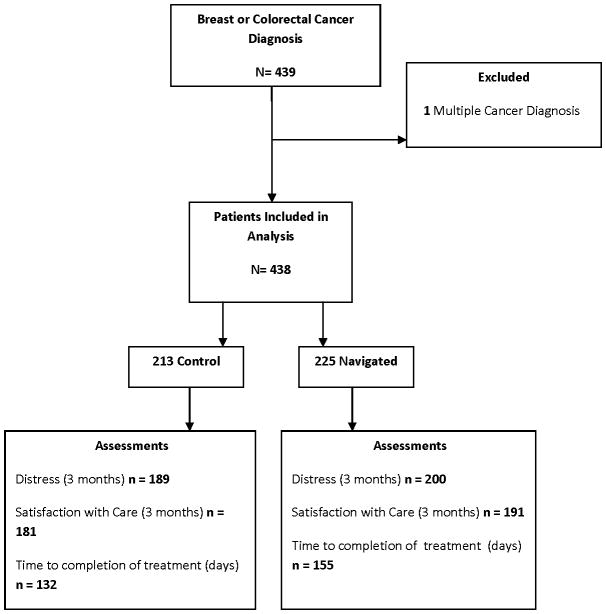
Methods: We pooled data from two sites from the national Patient Navigation Research Program. Patients (n = 438) with newly diagnosed breast (n = 353) or colorectal cancer (n = 85) were randomized to PN or usual care. Trained lay navigators met with patients randomized to PN to help them assess treatment barriers and identify resources to overcome barriers. We used intent-to-treat analysis to assess time to completion of primary treatment, psychologic distress (impact of events scale), and satisfaction (patient satisfaction with cancer-related care) within 3 months after initiation of cancer treatment.
Results: The sample was predominantly middle-aged (mean age = 57) and female (90%); 44% were race-ethnic minorities (44%), 46% reported lower education levels, 18% were uninsured, and 9% reported a non-English primary language. The randomized groups were comparable in baseline characteristics. Primary analysis showed no statistically significant group differences in time to completion of primary cancer treatment, satisfaction with cancer-related care, or psychologic distress. Subgroup analysis showed that socially disadvantaged patients (i.e., uninsured, low English proficiency, and non-English primary language) who received PN reported higher satisfaction than those receiving usual care (all P < 0.05). Navigated patients living alone reported greater distress than those receiving usual care.
Conclusions: Although the primary analysis showed no overall benefit, the subgroup analysis suggests that PN may improve satisfaction with care for certain disadvantaged individuals.
Impact: PN for cancer patients may not necessarily reduce treatment time nor distress.
2012 AACR
Conflict of interest statement
References
-
- Nguyen TT, McPhee SJ, Gildengorin G, Nguyen T, Wong C, Lai KQ, et al. Papanicolaou testing among Vietnamese Americans: results of a multifaceted intervention. Am J Prev Med. 2006;31:1–9. - PubMed
-
- Ahmed NU, Haber G, Semenya KA, Hargreaves MK. Randomized controlled trial of mammography intervention in insured very low-income women. Cancer Epidem Biomar. 2010;19:1790–8. - PubMed
Publication types
MeSH terms
Grants and funding
LinkOut - more resources
Full Text Sources
Medical
Miscellaneous