. 2012 Nov;22(11):796-802.
doi: 10.1097/FPC.0b013e3283589c50.

A genome-wide association analysis of temozolomide response using lymphoblastoid cell lines shows a clinically relevant association with MGMT

Affiliations

A genome-wide association analysis of temozolomide response using lymphoblastoid cell lines shows a clinically relevant association with MGMT

Chad C Brown et al. Pharmacogenet Genomics. 2012 Nov.

Abstract

Objective: Recently, lymphoblastoid cell lines (LCLs) have emerged as an innovative model system for mapping gene variants that predict the dose response to chemotherapy drugs.

Methods: In the current study, this strategy was expanded to the in-vitro genome-wide association approach, using 516 LCLs derived from a White cohort to assess the cytotoxic response to temozolomide.

Results: Genome-wide association analysis using ∼2.1 million quality-controlled single-nucleotide polymorphisms (SNPs) identified a statistically significant association (P<10(-8)) with SNPs in the O(6)-methylguanine-DNA methyltransferase (MGMT) gene. We also show that the primary SNP in this region is significantly associated with the differential gene expression of MGMT (P<10(-26)) in LCLs and differential methylation in glioblastoma samples from The Cancer Genome Atlas.

Conclusion: The previously documented clinical and functional relationships between MGMT and temozolomide response highlight the potential of well-powered genome-wide association studies of the LCL model system to identify meaningful genetic associations.


Figures
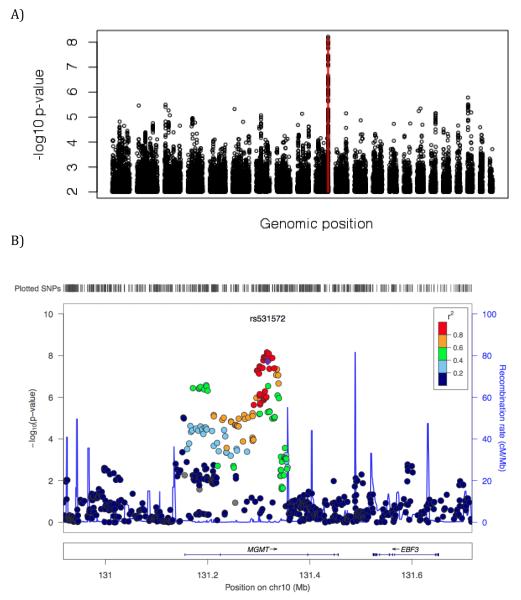
Figure 1
Figure 1
(A) Whole genome Manhattan plot of temozolomide for all SNPs with NLPVs above 2.0. Negative log10 p-values greater than 5.5 are indicated with red vertical lines. Locus View LD structure for SNPs nearby rs531572 are shown in (B).
Figure 2
Figure 2
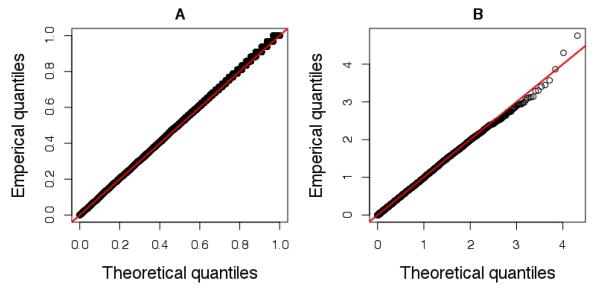
Quantile-quantile plot for a random sample of over 20k empirical p-values from association testing. Any loci near MGMT were removed. Panel (A) is of untransformed p-values and (B) is of negative log10 p-values.
Figure 3
Figure 3
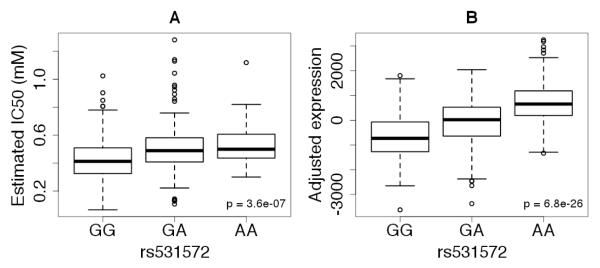
(A) Box plots for the estimated IC50 for temozolomide by genotype for rs531572. (B) Boxplots of MGMT transcript levels differ by rs531572 genotype. For each boxplot, outliers were noted as those values that are above or below 1.5 times the interquartile range from the median.
Figure 4
Figure 4
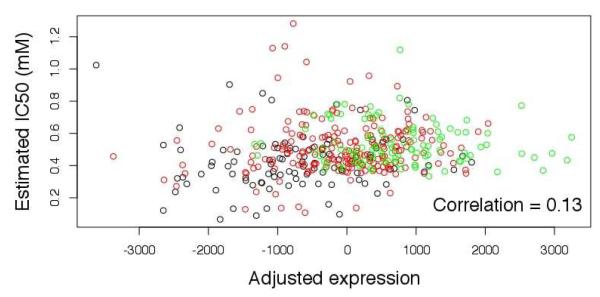
Scatter plot of estimated IC50 values and adjusted expression levels. Genotypes are color coded, where black, red and green are for GG, GA and AA, respectively.
Figure 5
Figure 5
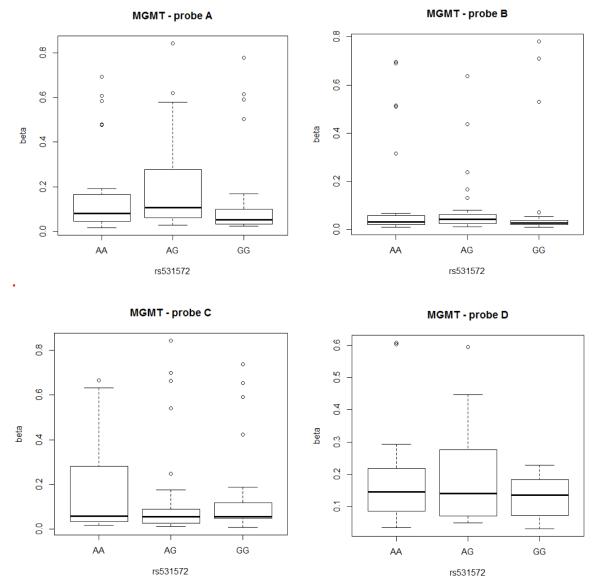
Boxplots of MGMT methylation beta values for the 4 probes in the promoter region. Probe A is located at Chr10: 131155063, Probe B at Chr10: 131155199, Probe C at Chr10: 131155565 and Probe D at Chr10: 131155686

References

    1. Bleibel WK, et al. Identification of genomic regions contributing to etoposide-induced cytotoxicity. Hum Genet. 2009;125(2):173–80. - PMC - PubMed
    1. Welsh M, et al. Pharmacogenomic discovery using cell-based models. Pharmacol Rev. 2009;61(4):413–29. - PMC - PubMed
    1. Watters JW, et al. Genome-wide discovery of loci influencing chemotherapy cytotoxicity. Proc Natl Acad Sci U S A. 2004;101(32):11809–14. - PMC - PubMed
    1. Peters EJ, et al. Pharmacogenomic characterization of US FDA-approved cytotoxic drugs. Pharmacogenomics. 2011;12(10):1407–15. - PMC - PubMed
    1. Simon JA, et al. Phenotypic predictors of response to simvastatin therapy among African-Americans and Caucasians: the Cholesterol and Pharmacogenetics (CAP) Study. Am J Cardiol. 2006;97(6):843–50. - PubMed

Publication types

MeSH terms