. 2012 Oct 23;109(43):17472-7.
doi: 10.1073/pnas.1203106109. Epub 2012 Oct 9.

In vivo, Pikfyve generates PI(3,5)P2, which serves as both a signaling lipid and the major precursor for PI5P

Affiliations

In vivo, Pikfyve generates PI(3,5)P2, which serves as both a signaling lipid and the major precursor for PI5P

Sergey N Zolov et al. Proc Natl Acad Sci U S A. .

Abstract

Mutations that cause defects in levels of the signaling lipid phosphatidylinositol 3,5-bisphosphate [PI(3,5)P(2)] lead to profound neurodegeneration in mice. Moreover, mutations in human FIG4 predicted to lower PI(3,5)P(2) levels underlie Charcot-Marie-Tooth type 4J neuropathy and are present in selected cases of amyotrophic lateral sclerosis. In yeast and mammals, PI(3,5)P(2) is generated by a protein complex that includes the lipid kinase Fab1/Pikfyve, the scaffolding protein Vac14, and the lipid phosphatase Fig4. Fibroblasts cultured from Vac14(-/-) and Fig4(-/-) mouse mutants have a 50% reduction in the levels of PI(3,5)P(2), suggesting that there may be PIKfyve-independent pathways that generate this lipid. Here, we characterize a Pikfyve gene-trap mouse (Pikfyve(β-geo/β-geo)), a hypomorph with ~10% of the normal level of Pikfyve protein. shRNA silencing of the residual Pikfyve transcript in fibroblasts demonstrated that Pikfyve is required to generate all of the PI(3,5)P(2) pool. Surprisingly, Pikfyve also is responsible for nearly all of the phosphatidylinositol-5-phosphate (PI5P) pool. We show that PI5P is generated directly from PI(3,5)P(2), likely via 3'-phosphatase activity. Analysis of tissues from the Pikfyve(β-geo/β-geo) mouse mutants reveals that Pikfyve is critical in neural tissues, heart, lung, kidney, thymus, and spleen. Thus, PI(3,5)P(2) and PI5P have major roles in multiple organs. Understanding the regulation of these lipids may provide insights into therapies for multiple diseases.


Conflict of interest statement

The authors declare no conflict of interest.

Figures

Fig. 1.
Fig. 1.
The Pikfyveβ-geo/β-geo mutant has low levels of Pikfyve protein. (A) Schematic of the Pikfyve coding region indicating position of the β-Geo insert, the 5′ and 3′ regions with primers spanning exons 2 and 3 and exons 41 and 42 used for quantitative RT-PCR (green arrows), the shRNA target site (red arrow), and peptide (asterisk) used to produce the mouse monoclonal antibody. (B) Western blots show that Pikfyveβ-geo/β-geo fibroblasts have reduced Pikfyve protein but no difference in Vac14 and Fig4 protein levels.
Fig. 2.
Fig. 2.
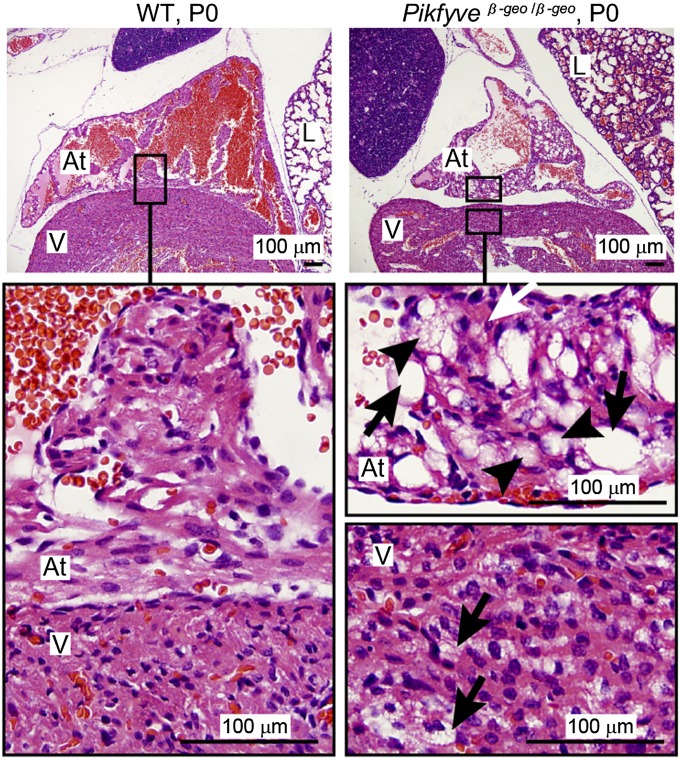
Spongiform degeneration of the neonatal Pikfyveβ-geo/β-geo mouse heart. Sagittal sections of neonatal wild-type (WT) and Pikfyveβ-geo/β-geo mice stained with H&E. The atria (At), ventricles (V), and lung (L) of wild-type littermates exhibit normal morphology. At higher magnification, atrial and ventricular myocytes strongly stain with H&E. There is no apparent vacuolation. Pikfyveβ-geo/β-geo mice have reduced H&E staining of atrial myocytes consistent with reduced myofibrillar content. In the Pikfyveβ-geo/β-geo mutants, both atria and ventricles have vacuoles (arrows), with a high level of vacuolation in the atria. Smaller vacuoles (arrowheads) give the myocytes [identified by heavily stained myofibrils (white arrow)] a foamy appearance.
Fig. 3.
Fig. 3.
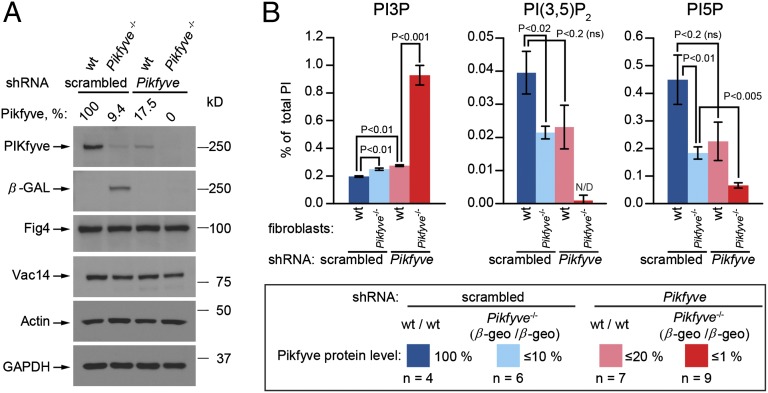
Generation of PI(3,5)P2 and most of the PI5P requires Pikfyve. Lentiviral expression of Pikfyve shRNA for 4 d. Scrambled sequence was used as a negative control. (A) After shRNA, Pikfyve protein levels in the wild-type and Pikfyveβ-geo/β-geo mouse fibroblasts were decreased or were below detectable levels, respectively. (B) Depletion of Pikfyve in Pikfyveβ-geo/β-geo fibroblasts resulted in a fivefold elevation of PI3P, a loss of 85% of PI5P, and nearly complete loss of PI(3,5)P2.
Fig. 4.
Fig. 4.
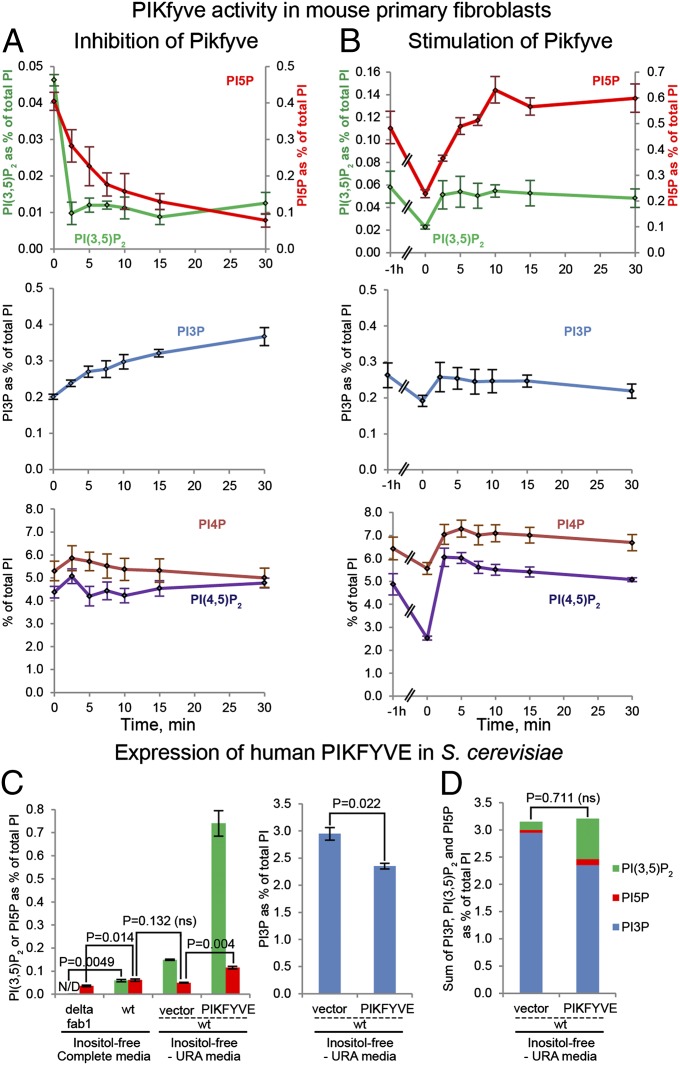
Perturbation of Pikfyve activity suggests that the PI5P derives from PI(3,5)P2. (A) Inhibition of Pikfyve in mouse primary fibroblasts by 1.6 μM YM201636 for the times specified results in a rapid depletion of PI(3,5)P2 and PI5P (n = 4). (B) Stimulation of mouse fibroblasts by refeeding with normal growth medium, insulin, and transferrin following 1-h starvation in HBSS with Mg2+ and Ca2+ reveals that within 2.5 min all lipids, with the exception of PI5P, increased and plateaued at a new steady-state level. PI5P plateaued at its new steady-state level at 10 min (n = 3). (C) Expression of human PIKFYVE in wild-type yeast resulted in a large elevation in PI(3,5)P2, a small increase in PI5P, and a corresponding reduction in PI3P. (D) The sum of PI3P, PI(3,5)P2, and PI5P was the same in wild-type yeast with PIKFYVE overexpression and with vector control (n = 3). This result suggests that PI5P levels are dependent on PI3P via dephosphorylation of PI(3,5)P2.
Fig. 5.
Fig. 5.
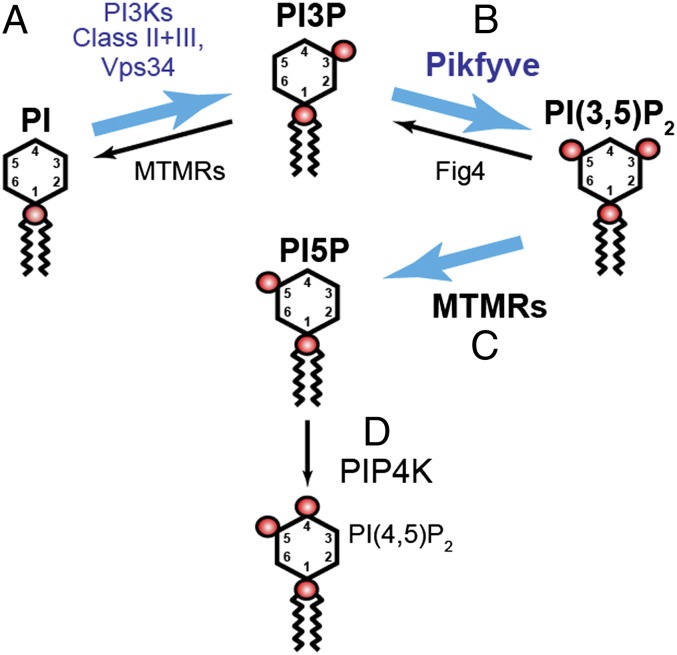
Model in which most of the PI5P pool derives from PI(3,5)P2 that is generated via Pikfyve. PI is converted to PI3P by Vps34 and possibly other PI3Ks (A) (48). Some PI3P is converted to PI(3,5)P2 by Pikfyve (Fab1) (B) (1, 2, 13). Fig4 is both a lipid 3′-phosphatase and an activator of Fab1 (6, 7). Pikfyve generates all of the PI(3,5)P2 pool (Fig. 3). Most of the PI5P pool indirectly requires Pikfyve (C). The Pikfyve-dependent pool of PI(3,5)P2 is dephosphorylated to produce PI5P. The most likely 3′-phosphatases are myotubularins (MTMRs) (, –38). Blue arrows denote the indirect generation of PI5P from PI3P through dephosphorylation of PI(3,5)P2. PI5P also may serve as a precursor for some of the PI(4,5)P2 pool (ref. and Fig. S8D) (D).

References

    1. Cooke FT, et al. The stress-activated phosphatidylinositol 3-phosphate 5-kinase Fab1p is essential for vacuole function in S. cerevisiae. Curr Biol. 1998;8(22):1219–1222. - PubMed
    1. Gary JD, Wurmser AE, Bonangelino CJ, Weisman LS, Emr SD. Fab1p is essential for PtdIns(3)P 5-kinase activity and the maintenance of vacuolar size and membrane homeostasis. J Cell Biol. 1998;143(1):65–79. - PMC - PubMed
    1. Bonangelino CJ, et al. Osmotic stress-induced increase of phosphatidylinositol 3,5-bisphosphate requires Vac14p, an activator of the lipid kinase Fab1p. J Cell Biol. 2002;156(6):1015–1028. - PMC - PubMed
    1. Dove SK, et al. Vac14 controls PtdIns(3,5)P(2) synthesis and Fab1-dependent protein trafficking to the multivesicular body. Curr Biol. 2002;12(11):885–893. - PubMed
    1. Jin N, et al. VAC14 nucleates a protein complex essential for the acute interconversion of PI3P and PI(3,5)P(2) in yeast and mouse. EMBO J. 2008;27(24):3221–3234. - PMC - PubMed

Publication types

MeSH terms

Substances