


Implementation of the quality management system improves postoperative pain treatment: a prospective pre-/post-interventional questionnaire study
- PMID: 23048069
- PMCID: PMC3520148
- DOI: 10.1093/bja/aes352
Implementation of the quality management system improves postoperative pain treatment: a prospective pre-/post-interventional questionnaire study
Abstract
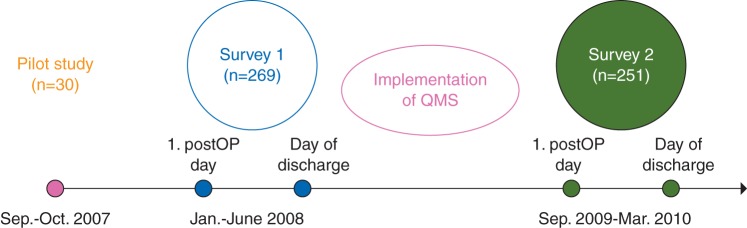
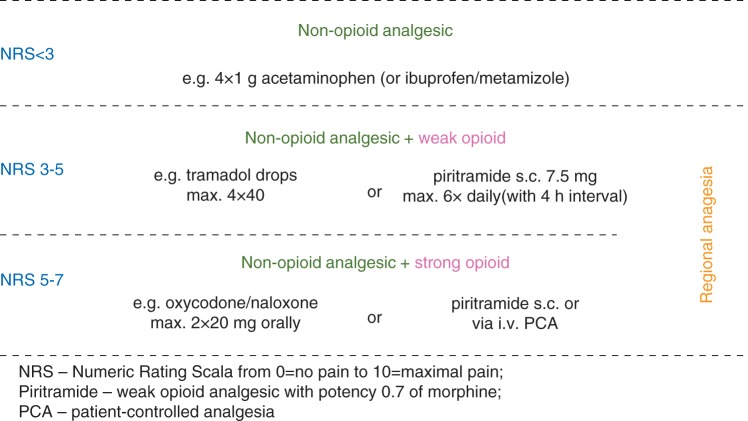
Background: An organizational approach is proposed as an immediate solution for improving postoperative pain (POP) management. The aim was to evaluate the clinical effectiveness of a quality management system (QMS), based on procedure-specific, multimodal analgesic protocols, modified to meet the individual patients' requirements.
Methods: Patients from the orthopaedic, gynaecological, visceral, and trauma surgery departments of the university hospital were involved in two prospective surveys. Survey 1 was performed at baseline and survey 2 was performed after the implementation of QMS within an interval of 1 year. The patients were asked to report pain intensity on the visual rating scale, incidence of analgesia-related side-effects, and incidence of pain interference with the items of life quality and their satisfaction with the treatment of POP.
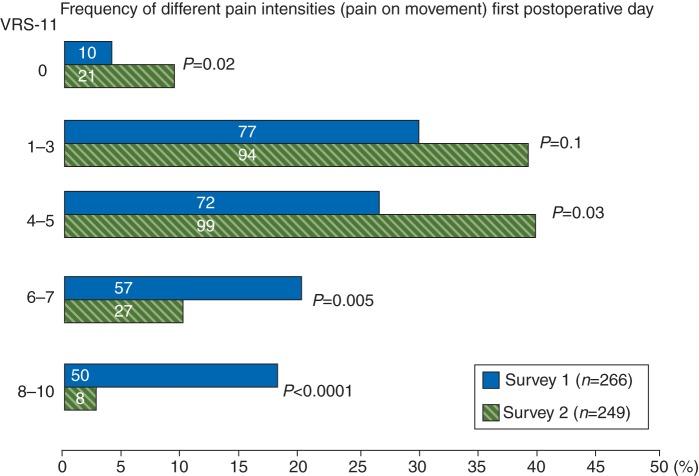
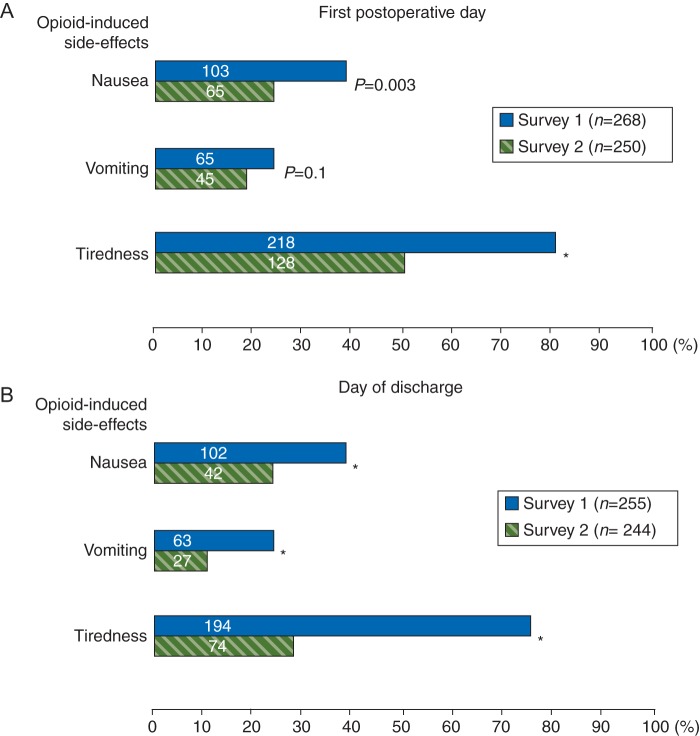
Results: Patients from Survey 2 (n=251) reported 25-30% less pain than those from Survey 1 (n=269) (P<0.0001). Nausea was reported by 40% of the patients from Survey 1 vs 17% from Survey 2, vomiting by 25 vs 11% and fatigue by 76% in Survey 1 vs 30% in Survey 2 (P<0.0001). Life quality and patients' satisfaction improved in Survey 2 vs Survey 1 (P<0.001).
Conclusions: The implementation of QMS allowed the reduction in POP intensity with a simultaneous decrease in analgesia-related side-effects. This has led to an increased quality of life and patient satisfaction.
Figures
Comment in
-
The Hawthorne effect: can it be measured and utilized?Br J Anaesth. 2013 Apr;110(4):658-9. doi: 10.1093/bja/aet035. Br J Anaesth. 2013. PMID: 23508495 No abstract available.
-
'Yes, we can' utilize the Hawthorne effect to improve postoperative analgesia.Br J Anaesth. 2013 Apr;110(4):659. doi: 10.1093/bja/aet040. Br J Anaesth. 2013. PMID: 23508496 No abstract available.
References
-
- Dahl JB, Mathiesen O, Kehlet H. An expert opinion on postoperative pain management, with special reference to new developments. Expert Opin Pharmacother. 2010;11:2459–70. doi:10.1517/14656566.2010.499124. - DOI - PubMed
-
- Dolin SJ, Cashman JN, Bland JM. Effectiveness of acute postoperative pain management: I. Evidence from published data. Br J Anaesth. 2002;89:409–23. - PubMed
-
- Dolin SJ, Cashman JN. Tolerability of acute postoperative pain management: nausea, vomiting, sedation, pruritus, and urinary retention. Evidence from published data. Br J Anaesth. 2005;95:584–91. - PubMed
-
- Apfelbaum JL, Chen C, Mehta SS, Gan TJ. Postoperative pain experience: results from a national survey suggest postoperative pain continues to be undermanaged. Anesth Analg. 2003;97:534–40. doi:10.1213/01.ANE.0000068822.10113.9E. - DOI - PubMed
-
- Sommer M, de Rijke JM, van Kleef M, et al. The prevalence of postoperative pain in a sample of 1490 surgical inpatients. Eur J Anaesthesiol. 2008;25:267–74. doi:10.1017/S0265021507003031. - DOI - PubMed
Publication types
MeSH terms
Substances
LinkOut - more resources
Full Text Sources
Other Literature Sources
Medical
