


Chaos, Poverty, and Parenting: Predictors of Early Language Development
- PMID: 23049162
- PMCID: PMC3463131
- DOI: 10.1016/j.ecresq.2011.11.001
Chaos, Poverty, and Parenting: Predictors of Early Language Development
Abstract
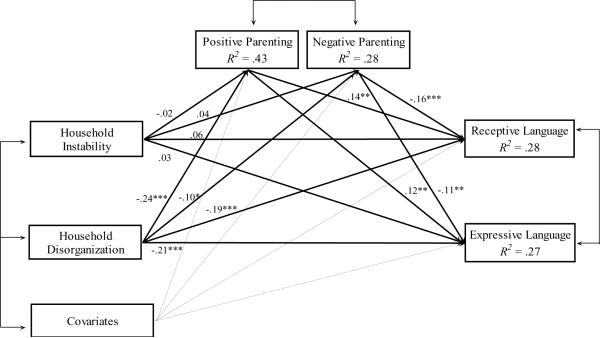
Studies have shown that distal family risk factors like poverty and maternal education are strongly related to children's early language development. Yet, few studies have examined these risk factors in combination with more proximal day-to-day experiences of children that might be critical to understanding variation in early language. Young children's exposure to a chronically chaotic household may be one critical experience that is related to poorer language, beyond the contribution of SES and other demographic variables. In addition, it is not clear whether parenting might mediate the relationship between chaos and language. The purpose of this study was to understand how multiple indicators of chaos over children's first three years of life, in a representative sample of children living in low wealth rural communities, were related to child expressive and receptive language at 36 months. Factor analysis of 10 chaos indicators over five time periods suggested two factors that were named household disorganization and instability. Results suggested that after accounting for thirteen covariates like maternal education and poverty, one of two chaos composites (household disorganization) accounted for significant variance in receptive and expressive language. Parenting partially mediated this relationship although household disorganization continued to account for unique variance in predicting early language.
Figures
References
-
- Adam E. Beyond quality: Parental and residential stability and children's adjustment. Current Directions in Psychological Science. 2004;13(5):210–213.
-
- Aiken LS, West SG. Multiple regression: Testing and interpreting interactions. Sage; Thousand Oaks, CA: 1991.
-
- Arterberry ME, Midgett C, Putnick DL, Bornstein MH. Early attention and literacy experiences predict adaptive communication. First Language. 2007;27(2):175–189.
-
- Allison PD. Missing data. Sage; Thousand Oaks, CA: 2001.
-
- Bradley RH, Corwyn RF. Caring for children around the world: A view from HOME. International Journal of Behavioral Development. 2005;29(6):468–478.
Grants and funding
LinkOut - more resources
Full Text Sources