


The privileged immunity of immune privileged organs: the case of the eye
- PMID: 23049533
- PMCID: PMC3448293
- DOI: 10.3389/fimmu.2012.00296
The privileged immunity of immune privileged organs: the case of the eye
Abstract
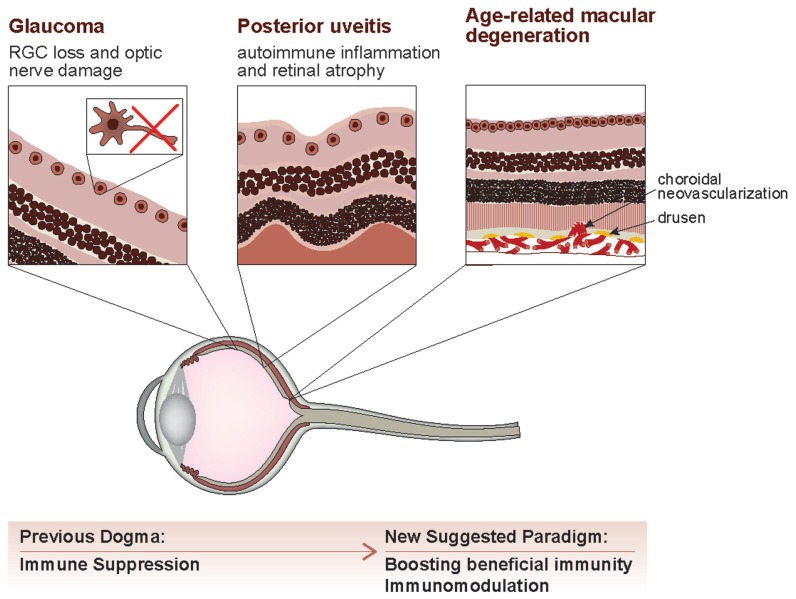
Understanding of ocular diseases and the search for their cure have been based on the common assumption that the eye is an immune privileged site, and the consequent conclusion that entry of immune cells to this organ is forbidden. Accordingly, it was assumed that when immune cell entry does occur, this reflects an undesired outcome of breached barriers. However, studies spanning more than a decade have demonstrated that acute insults to the retina, or chronic conditions resulting in retinal ganglion cell loss, such as in glaucoma, result in an inferior outcome in immunocompromised mice; likewise, steroidal treatment was found to be detrimental under these conditions. Moreover, even conditions that are associated with inflammation, such as age-related macular degeneration, are not currently believed to require immune suppression for treatment, but rather, are thought to benefit from immune modulation. Here, we propose that the immune privilege of the eye is its ability to enable, upon need, the entry of selected immune cells for its repair and healing, rather than to altogether prevent immune cell entry. The implications for acute and chronic degenerative diseases, as well as for infection and inflammatory diseases, are discussed.
Keywords: immune privilege; immunomodulation; inflammation; neuroprotection and neuronal repair; visual system.
Figures
References
-
- Anderson D. H., Radeke M. J., Gallo N. B., Chapin E. A., Johnson P. T., Curletti C. R., Hancox L. S., Hu J., Ebright J. N., Malek G., Hauser M. A., Rickman C. B., Bok D., Hageman G. S., Johnson L. V. (2010). The pivotal role of the complement system in aging and age-related macular degeneration: hypothesis re-visited. Prog. Retin. Eye Res. 29 95–112 - PMC - PubMed
-
- Auffray C., Sieweke M. H., Geissmann F. (2009). Blood monocytes: development, heterogeneity, and relationship with dendritic cells. Annu. Rev. Immunol. 27 669–692 - PubMed
-
- Bakalash S., Kessler A., Mizrahi T., Nussenblatt R., Schwartz M. (2003). Antigenic specificity of immunoprotective therapeutic vaccination for glaucoma. Invest. Ophthalmol. Vis. Sci. 44 3374–3381 - PubMed
LinkOut - more resources
Full Text Sources
