. 2012;7(9):e46076.
doi: 10.1371/journal.pone.0046076. Epub 2012 Sep 25.

SPC-Cre-ERT2 transgenic mouse for temporal gene deletion in alveolar epithelial cells

Affiliations

SPC-Cre-ERT2 transgenic mouse for temporal gene deletion in alveolar epithelial cells

Yao-Song Gui et al. PLoS One. 2012.

Abstract

Although several Cre-loxP-based gene knockout mouse models have been generated for the study of gene function in alveolar epithelia in the lung, their applications are still limited. In this study, we developed a SPC-Cre-ER(T2) mouse model, in which a tamoxifen-inducible Cre recombinase (Cre-ER(T2)) is under the control of the human surfactant protein C (SPC) promoter. The specificity and efficiency of Cre-ER(T2) activity was first evaluated by crossing SPC-Cre-ER(T2) mouse with ROSA26R mouse, a β-galactosidase reporter strain. We found that Cre-ER(T2) was expressed in 30.7% type II alveolar epithelial cells of SPC-Cre-ER(T2)/ROSA26R mouse lung tissues in the presence of tamoxifen. We then tested the tamoxifen-inducible recombinase activity of Cre-ER(T2) in a mouse strain bearing TSC1 conditional knockout alleles (TSC1(fx/fx)). TSC1 deletion was detected in the lungs of tamoxifen treated SPC-Cre-ER(T2)/TSC1(fx/fx) mice. Therefore this SPC-Cre-ER(T2) mouse model may be a valuable tool to investigate functions of genes in lung development, physiology and disease.


Conflict of interest statement

Competing Interests: The authors have declared that no competing interests exist.

Figures

Figure 1
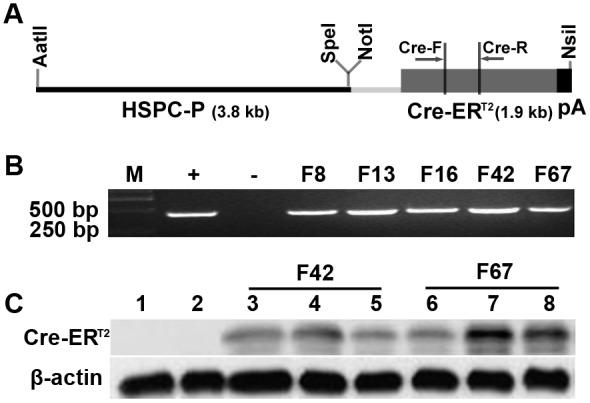
Figure 1. Generation of SPC-Cre-ERT2 mice.
A) Schematic map of SPC-Cre-ERT2 expression cassette. HSPC-P, human surfactant protein C promoter; Cre-ERT2, Cre coding sequence fused with a tamoxifen-inducible estrogen receptor. pA, a polyA sequence from SV40 virus. Cre-F primer binding sites, 561–579 bp of Cre-ERT2 transgene; Cre-R primer binding sites, 976–997 bp of Cre-ERT2 transgene. The map is drawn in scale. B) Screening SPC-Cre-ERT2 transgenic mice using PCR. Genomic DNA from each mouse tail was used as template to specifically PCR-amplify the Cre-ERT2 transgene. M, DNA marker; +, SPC-Cre-ERT2 plasmid DNA control; -, water control; F8, F13, F16, F42, F67 are five representative founder transgenic mice generated by microinjection of SPC-Cre-ERT2 expression cassette into fertilized embryos. C) Cre-ERT2 fusion proteins were detected using Western blot in lung tissues of SPC-Cre-ERT2 transgenic mice. Lane 1, C57BL/6J mouse; Lane 2, an offspring of F42 founder without Cre-ERT2 transgene when genotyped using PCR; Lane 3, 4, 5, offspring of F42 founder; Lane 6, 7, 8, offspring of F67 founder. Notice the variable expression levels of Cre-ERT2 in offspring from the same founder.
Figure 2
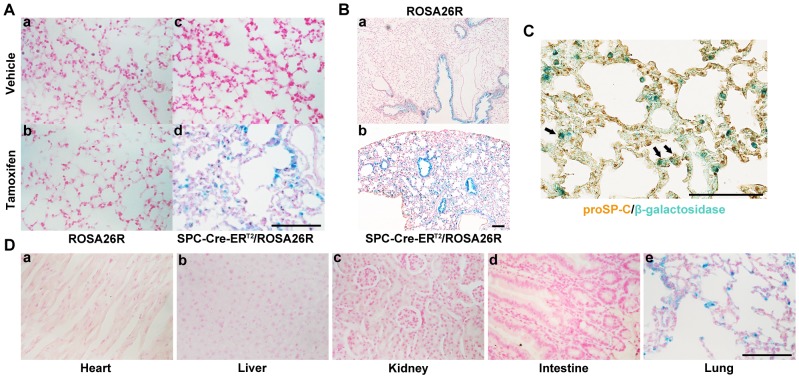
Figure 2. Tamoxifen-inducible and tissue-specific recombinase activity of Cre-ERT2 in SPC-Cre-ERT2/ROSA26R transgenic mice.
A) β-galactosidase activity was detected in the lung alveolar epithelia from a SPC-Cre-ERT2/ROSA26R transgenic mouse receiving tamoxifen treatment. a & b, lung tissue sections from ROSA26R mice (without Cre-ERT2 transgene) receiving vehicle (a) or tamoxifen (b); c & d, lung tissue sections from SPC-Cre-ERT2/ROSA26R transgenic mice receiving vehicle (c) or tamoxifen (d). B) Endogenous β-galactosidase activity was found in lung bronchial epithelia of ROSA26R mouse receiving vehicle (a) and SPC-Cre-ERT2/ROSA26R transgenic mouse after tamoxifen treatment (b). C) X-gal stained lung tissues of SPC-Cre-ERT2/ROSA26R transgenic mouse receiving tamoxifen were also immune-stained for proSP-C, an alveolar type II cell-specific marker. Arrows indicate three representative alveolar type II cells co-expressing proSP-C (brown) and β-galactosidase (blue). D) β-galactosidase activity was detected only in the lung alveolar epithelium, but not in other organs from a SPC-Cre-ERT2/ROSA26R transgenic mouse receiving tamoxifen treatment. a, heart; b, liver; c, kidney; d, intestine; e, lung. All scale bars in this figure equal 100 µm.
Figure 3
Figure 3. Tamoxifen-induced recombinase activity of Cre-ERT2 in the lung tissues of SPC-Cre-ERT2/TSC1fx/fx transgenic mice.
DNAs from the lung tissues of SPC-Cre-ERT2/TSC1fx/fx transgenic mice treated with vehicle or tamoxifen were examined by PCR to detect TSC1 deletion as an indication of Cre-ERT2 recombinase activity. M, DNA marker; +, a transgenic mouse with TSC1 deletion; -, C57BL/6J mouse. Other lanes, offspring from F42 and F67 founders treated with vehicle (vehi) or tamoxifen (tam).

References

    1. Nagy A (2000) Cre recombinase: the universal reagent for genome tailoring. Genesis 26: 99–109. - PubMed
    1. Mura M, Binnie M, Han B, Li C, Andrade CF, et al. (2010) Functions of type II pneumocyte-derived vascular endothelial growth factor in alveolar structure, acute inflammation, and vascular permeability. Am J Pathol 176: 1725–1734. - PMC - PubMed
    1. Sun J, Chen H, Chen C, Whitsett JA, Mishina Y, et al. (2008) Prenatal lung epithelial cell-specific abrogation of Alk3-bone morphogenetic protein signaling causes neonatal respiratory distress by disrupting distal airway formation. Am J Pathol 172: 571–582. - PMC - PubMed
    1. Tafel O, Latzin P, Paul K, Winter T, Woischnik M, et al. (2008) Surfactant proteins SP-B and SP-C and their precursors in bronchoalveolar lavages from children with acute and chronic inflammatory airway disease. BMC Pulm Med 8: 6. - PMC - PubMed
    1. Morimoto M, Kopan R (2009) rtTA toxicity limits the usefulness of the SP-C-rtTA transgenic mouse. Dev Biol 325: 171–178. - PMC - PubMed

Publication types

LinkOut - more resources