. 2012 Oct 10:13:546.
doi: 10.1186/1471-2164-13-546.

The adjacent positioning of co-regulated gene pairs is widely conserved across eukaryotes

Affiliations

The adjacent positioning of co-regulated gene pairs is widely conserved across eukaryotes

James T Arnone et al. BMC Genomics. .

Abstract

Background: Coordinated cell growth and development requires that cells regulate the expression of large sets of genes in an appropriate manner, and one of the most complex and metabolically demanding pathways that cells must manage is that of ribosome biogenesis. Ribosome biosynthesis depends upon the activity of hundreds of gene products, and it is subject to extensive regulation in response to changing cellular conditions. We previously described an unusual property of the genes that are involved in ribosome biogenesis in yeast; a significant fraction of the genes exist on the chromosomes as immediately adjacent gene pairs. The incidence of gene pairing can be as high as 24% in some species, and the gene pairs are found in all of the possible tandem, divergent, and convergent orientations.

Results: We investigated co-regulated gene sets in S. cerevisiae beyond those related to ribosome biogenesis, and found that a number of these regulons, including those involved in DNA metabolism, heat shock, and the response to cellular stressors were also significantly enriched for adjacent gene pairs. We found that as a whole, adjacent gene pairs were more tightly co-regulated than unpaired genes, and that the specific gene pairing relationships that were most widely conserved across divergent fungal lineages were correlated with those genes that exhibited the highest levels of transcription. Finally, we investigated the gene positions of ribosome related genes across a widely divergent set of eukaryotes, and found a significant level of adjacent gene pairing well beyond yeast species.

Conclusion: While it has long been understood that there are connections between genomic organization and transcriptional regulation, this study reveals that the strategy of organizing genes from related, co-regulated pathways into pairs of immediately adjacent genes is widespread, evolutionarily conserved, and functionally significant.


Figures
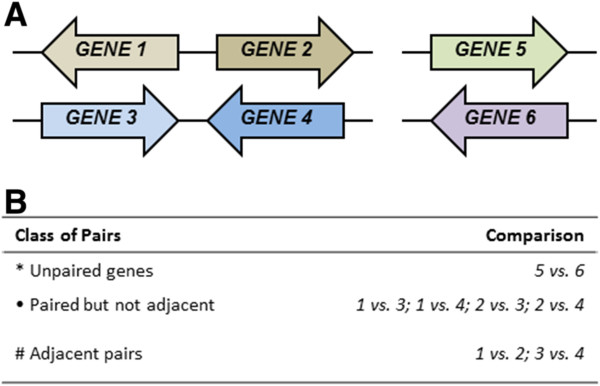
Figure 1
Figure 1
Classification of pairing relationships compared in this study. The members of a hypothetical regulon comprised of six genes (A) and the classification of the pairings used for the determination of the average Pearson’s correlation coefficient (B).
Figure 2
Figure 2
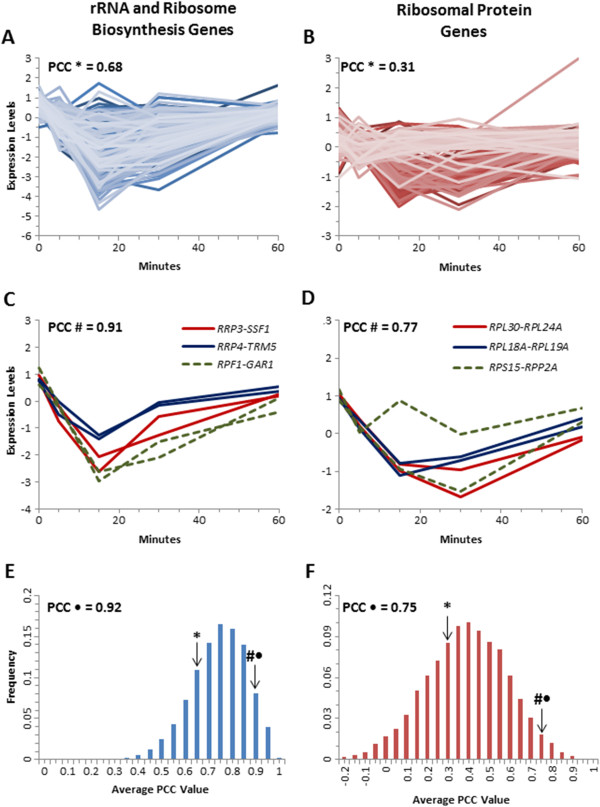
Paired genes have a tighter transcriptional response throughout a heat shock time-course. The transcriptional response of the unpaired RRB genes (n = 213) and RP genes (n = 151) throughout a heat-shock time-course (A and B). Representative expression profiles for three representative adjacent paired RRB genes and RP genes during this stressor (C and D). The average PCC was determined by bootstrapping random pairings and the frequency is plotted for the RRB genes (E) and the RP genes (F). The actual average PCC for the unpaired genes is indicated by *, for the paired but not adjacent genes by ·, and the adjacent paired genes by #.
Figure 3
Figure 3
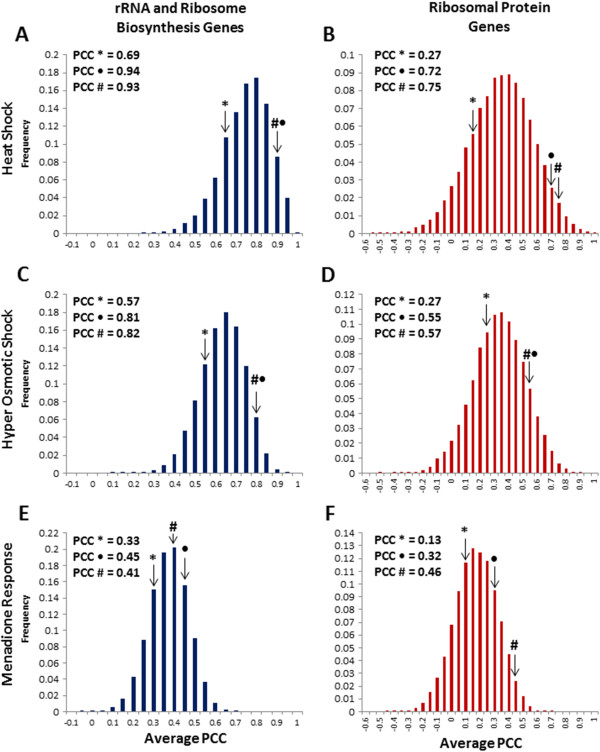
Paired genes exhibit a tighter transcriptional coordination during the budding yeast stress response. The average PCC was determined by bootstrapping random pairings of genes from the RRB and RP gene sets during a heat-shock (A and B), during the hyper-osmotic shock (C and D), and following treatment with menadione (E and F). The actual average PCC for the unpaired genes is indicated by *, for the paired but not adjacent genes by ·, and the adjacent paired genes by #.
Figure 4
Figure 4
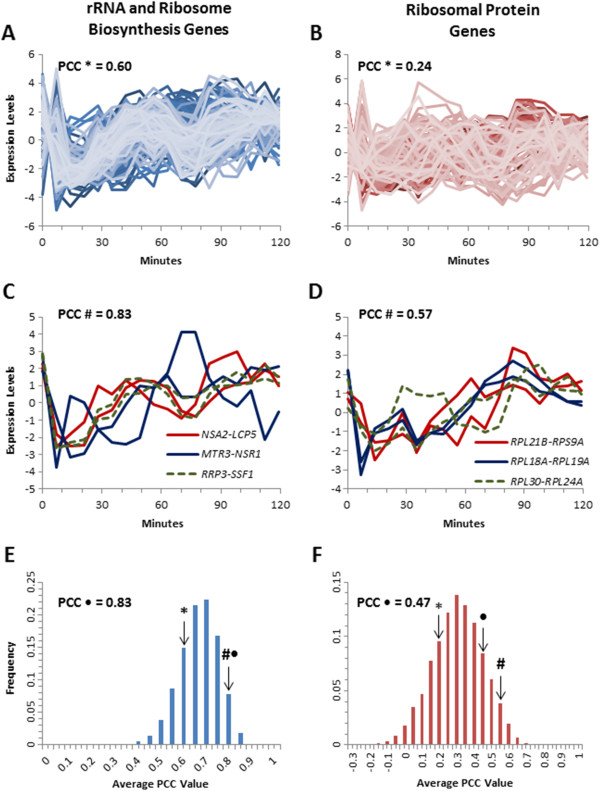
Paired genes have a tighter transcriptional response following the release from alpha-factor arrest and progression through the cell-cycle. The transcriptional response of the unpaired RRB genes (n = 210) and RP genes (n = 154) following release from alpha-factor (A and B). Representative expression profiles for three adjacent paired RRB and RP genes during this stressor (C and D). The average PCC was determined by bootstrapping random pairings of genes from the RRB (E) and the RP genes (F). The actual average PCC for the unpaired genes is indicated by *, for the paired but not adjacent genes by ·, and the adjacent paired genes by #.
Figure 5
Figure 5
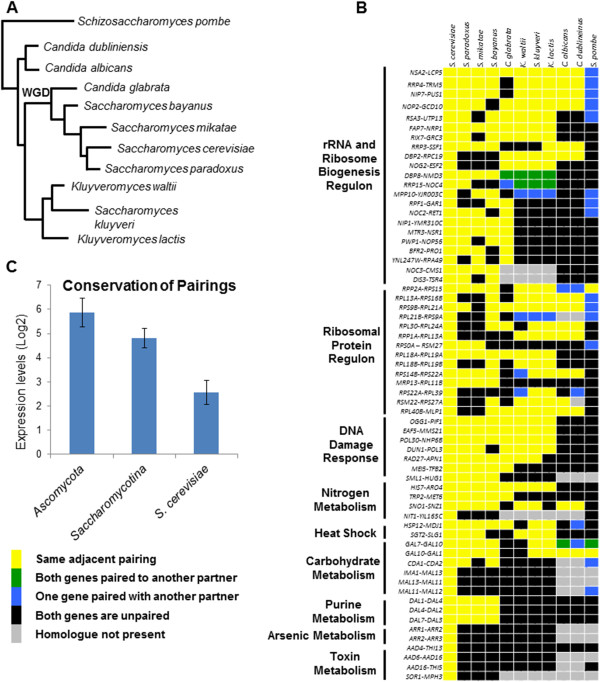
The S. cerevisiae gene pairing relationships are conserved across divergent fungal lineages. The phylogenetic relationship of fungal lineages analyzed in this study (A) and the heat map depicting the degree of conservation (B). Absolute mRNA levels of conserved gene pairing relationships (C).

References

    1. Ewen ME. Where the cell cycle and histones meet. Genes Dev. 2000;14(18):2265–2270. doi: 10.1101/gad.842100. - DOI - PubMed
    1. Noordermeer D, de Laat W. Joining the loops: beta-globin gene regulation. IUBMB Life. 2008;60(12):824–833. doi: 10.1002/iub.129. - DOI - PubMed
    1. Gasch AP, Spellman PT, Kao CM, Carmel-Harel O, Eisen MB, Storz G, Botstein D, Brown PO. Genomic expression programs in the response of yeast cells to environmental changes. Mol Biol Cell. 2000;11(12):4241–4257. - PMC - PubMed
    1. Perry RP. The nucleolus and the synthesis of ribosomes. Prog Nucleic Acid Res Mol Biol. 1967;6:219–257. - PubMed
    1. Duan Z, Andronescu M, Schutz K, McIlwain S, Kim YJ, Lee C, Shendure J, Fields S, Blau CA, Noble WS. A three-dimensional model of the yeast genome. Nature. 2010;465(7296):363–367. doi: 10.1038/nature08973. - DOI - PMC - PubMed

Publication types

MeSH terms

Substances

LinkOut - more resources