


Exercise of mechanisms of dynamic stability improves the stability state after an unexpected gait perturbation in elderly
- PMID: 23054828
- PMCID: PMC3776125
- DOI: 10.1007/s11357-012-9481-z
Exercise of mechanisms of dynamic stability improves the stability state after an unexpected gait perturbation in elderly
Abstract
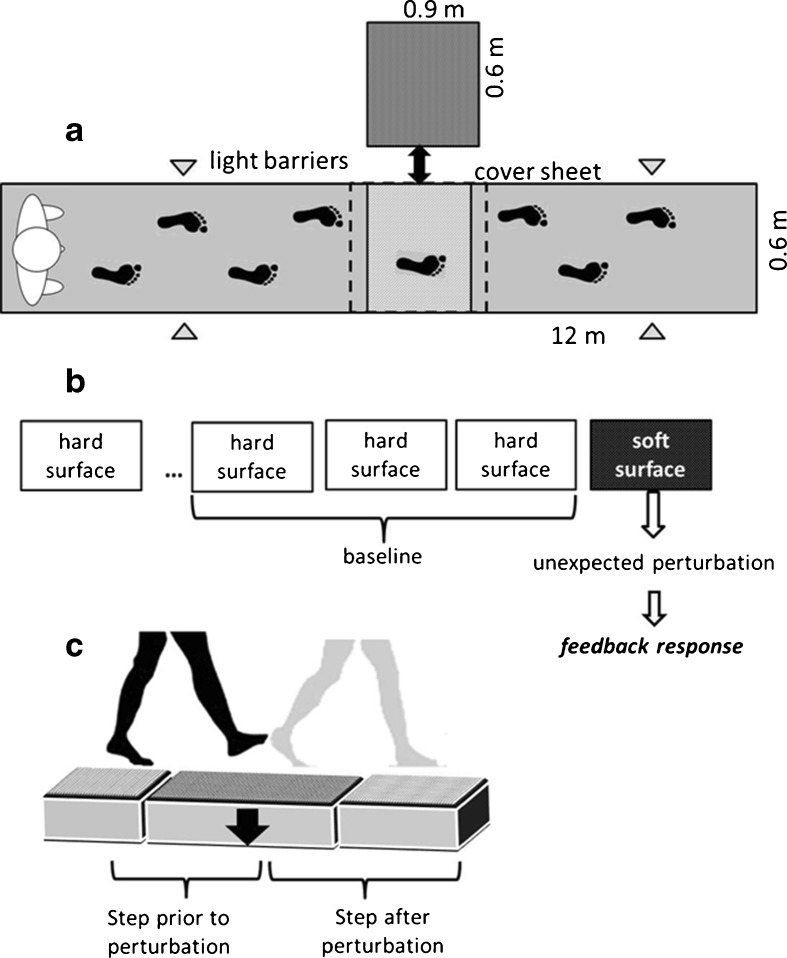
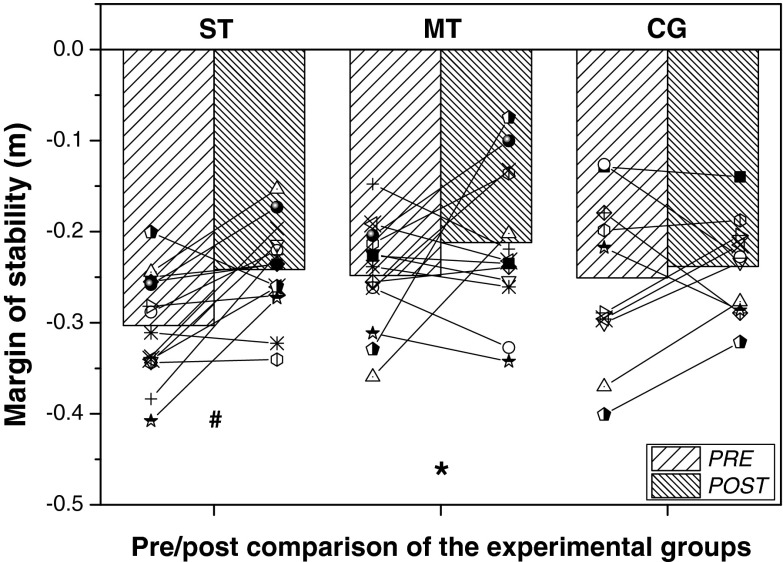
Unexpected changes during gait challenge elderly individuals to a greater degree than young adults. However, the adaptive potential of elderly seems to be retained, and therefore, the training of the mechanisms of dynamic stability as well as muscle strength training may improve the dynamic stability after unexpected perturbations. Thirty-eight subjects (65-75 years) participated in the study, divided into two experimental groups (stability training group, ST, n = 14 and mixed training group, MT, n = 14) and a control group (CG, n = 10). Both experimental groups performed exercises which focused on the mechanisms of dynamic stability. Additionally, the MT group executed a training to improve muscle strength. Session volume and duration were equal for both groups (14 weeks, twice a week, ~1.5 h per session). Pre- and post-intervention, subjects performed a gait protocol with an induced unexpected perturbation. Post-intervention, the margin of stability was significantly increased after the unexpected perturbation in the ST group, indicating an improvement in stability state (pre, -30.3 ± 5.9 cm; post, -24.1 ± 5.2 cm). Further, both intervention groups increased their base of support after the intervention to regain balance after gait perturbation, whereas only the ST group showed a statistically significant improvement (STpre, 90.9 ± 6.6 cm, STpost, 98.2 ± 8.5 cm; MTpre, 91.4 ± 6.2 cm; MTpost, 97.9 ± 12.7 cm). The CG showed no differences between pre- and post-measurements. The exercise of the mechanisms of dynamic stability led to a better application of these mechanisms after an unexpected perturbation during gait. We suggest that the repeated exercise of the mechanisms of dynamic stability contributes to significant improvements in postural stability. Additional strength training for healthy elderly individuals, however, shows no further effect on the ability to recover balance after unexpected perturbations during gait.
Figures

References
-
- Arampatzis A, Karamanidis K, De Monte D, Stafilidis S, Morey-Klapsing G, Brüggemann GP. Differences between measured and resultant joint moments during voluntary and artificially elicited isometric knee extension contractions. Clin Biomech. 2004;19(3):277–283. doi: 10.1016/j.clinbiomech.2003.11.011. - DOI - PubMed
MeSH terms
LinkOut - more resources
Full Text Sources
Medical